Watch the film
| Size in ft: | Width: 10' x Length: 17' |
| Size in Inch: | Width: 120" x Length: 204" |
| Size in meters: | Length: 5.18 x Width: 3.05 m |
| Colors: | Coral, Blue, Green, Ivory |
| Shape: | Rectangular |
| Woven: | 100% Hand-knotted | Handmade |
| Foundation: | Cotton |
| Pile: | 3/8" Dense Soft Wool |
| Age: | 1930's | Antique |
| Design: | Traditional | All Over Floral | No Medallion |
| Origin: | Persian Sarouk | Made in Persia |
| Condition: | Excellent | Normal signs of wear for age |
10' x 17' Persian Sarouk Rug | Antique 1930s Coral Field | All Over Floral Design
This is a genuine 1930s room size weaving, hand-knotted in wool on a cotton foundation and drawn in the detached floral manner that made Persian Sarouk rugs the most sought after decorative carpets of their generation. At 10' x 17' it is a true oversize Persian rug, long enough to carry a full dining table with chairs pulled clear or to anchor a double seating group in a great room. The pile stands at a dense 3/8", still soft underfoot after roughly 90 years, with the light low spots and gentle patina you expect and want in a piece of this age. It ships with a certificate of authenticity, and as an antique in this size it is free shipping in all 50 states with no freight surcharge.
Please Note About the Photographs:
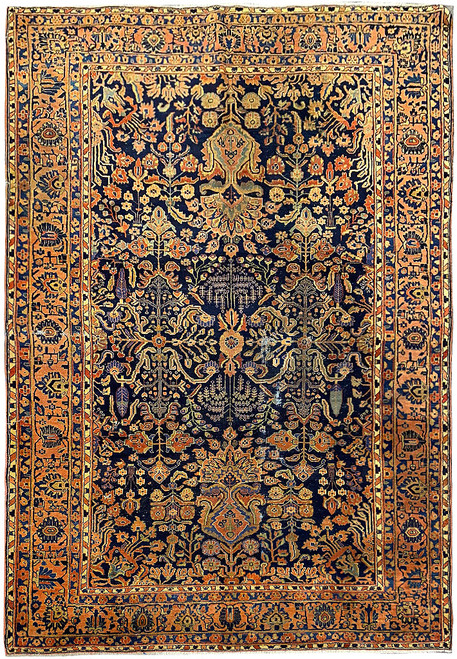
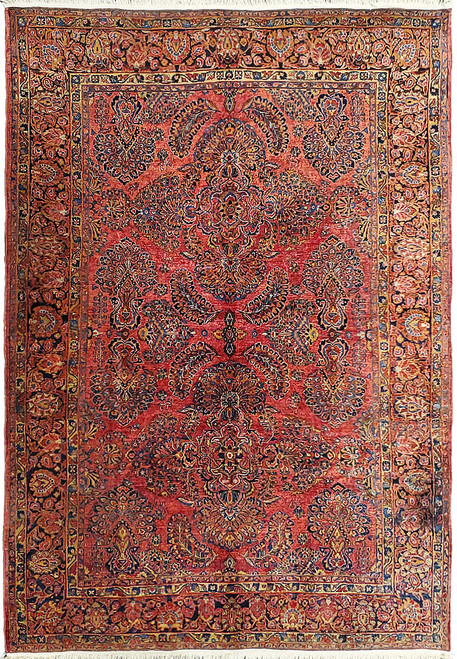
The field photographs differently depending on the light. In the wide overhead shots it reads as a soft coral, while the close-up corner shot and the back view show a deeper rose red where the camera sat closer to the pile. The true tone is a warm coral with red depth in the knot, and it will look richer in a lit room than it does on a concrete warehouse floor.
Design and Motifs
There is no medallion here. The whole field is given over to detached floral sprays, curved stems and curled serrated leaves that repeat and mirror across the length of the rug, each spray drawn as its own small bouquet with rosettes, tulip buds and eight petal blossoms hanging from it. Look along the center line and you can see the drawing reverse on itself, spray answering spray in an arrangement that reads as loose and natural from standing height but is in fact tightly controlled. The main border runs a navy ground with large fan shaped palmettes alternating with flowering vine, and it is bracketed by 2 pairs of narrow guard stripes carrying a running rosette and leaf meander. Corners are resolved cleanly, and the 4 corner blocks match, which is a mark of a weaver working to a properly drawn cartoon rather than improvising at the ends.
A Coral Field Against Deep Indigo Blue
The ground is coral, a warm salmon red with terracotta in it that has softened over 90 years into the kind of tone modern dyes cannot copy. Against it the floral work is carried almost entirely in blues: deep indigo for the stems and the heaviest leaves, a mid sky blue for the secondary foliage, and a bright turquoise teal that flickers through the smaller blossoms and gives the field its movement. Olive and antique gold fill the mid tones, soft green appears in the leaf tips, and small ivory rosettes sit like points of light across the whole surface. The main border reverses the scheme, putting the same coral, gold, rose and teal flowers onto a deep navy ground so that the field appears to glow inside its dark frame. There is natural abrash across the field, faint horizontal variation in the coral where the dye lot shifted on the loom, which is proof of hand dyed wool and part of why the color has aged so well.
Sarouk Weaving and 1930s Origin
Sarouk sits in the Arak region of west central Persia, and its weavers built their reputation on heavy, dense, honest carpets made for daily use rather than for display cases. The knotting here is firm and even, the wool is glossy and full of lanolin, and the back shown in the final photograph is tight and regular with straight rows and no slack. That combination of a thick pile and a compact knot is exactly why 1930s Sarouks survive in numbers when lighter carpets of the same decade have long since been worn out. If you want to understand what tells you the decade of a piece like this, the selvedge treatment, the dye palette and the wear pattern are the three things to read, and our guide on how to date an Oriental rug walks through each of them. A 10' x 17' example in this condition is scarce, because carpets this long were woven in small numbers and most were worked hard.
10' x 17' Persian Sarouk Rug | Antique 1930s Coral Field | All Over Floral Design
Ask about this rug
This piece is the only one of it, so the things worth knowing about it are particular to it. If you want to talk through the size, the colour in your own light, or the weave, speak to someone here first.