Watch the film
| Size in ft: | Width: 11'2" x Length: 16'5" |
| Size in Inch: | Width: 134" x Length: 197" |
| Size in meters: | Length: 5.00 x Width: 3.40 m |
| Colors: | Light Copper, Teal Blue, Brown |
| Shape: | Rectangular |
| Woven: | 100% Hand-knotted | Handmade |
| Foundation: | Cotton |
| Pile: | |
| Age: | 1950's | Vintage estate piece |
| Design: | Tabriz | All-Over Floral | Wide main border |
| Origin: | Persian Tabriz | Made in Persia |
| Condition: | Very Good | Soft even pile with age-appropriate patina |
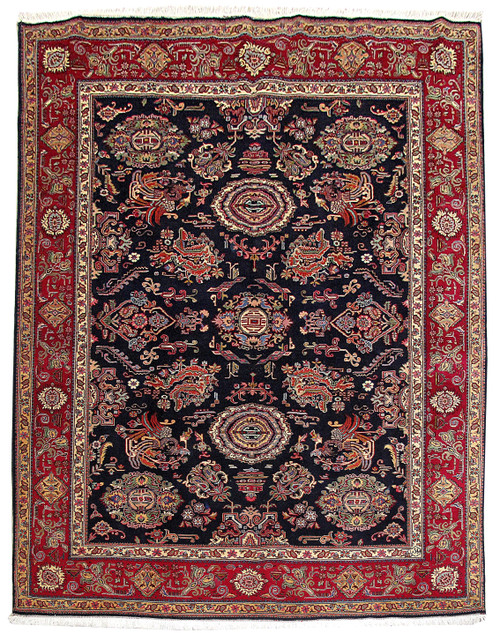
11'2" x 16'5" Persian Tabriz Rug | Light Copper All-Over Floral | 1950s Estate Piece
This is a 1950s Persian Tabriz that spent its life in one American home and came back to us with its wool still soft and its drawing still crisp. At 11'2" x 16'5" it belongs squarely in the world of oversize Persian rugs, the kind of piece woven for a long formal room rather than trimmed to fit one. The pile is hand-knotted wool on a cotton foundation, the handle is supple rather than stiff, and the field has mellowed into that light copper tone that decorators pay a premium for and cannot reproduce with new dye. Every rug we sell ships with a certificate of authenticity.
Please Note About the Photographs:
The full overview shot was taken under warehouse lighting and reads darker and greener in the border than the rug does in person. The daylight close-ups of the border and field are the truer record of the color. Nothing in those images indicates fade, wear or repair.
Design and Motifs
The field carries a balanced all-over floral composition rather than a single dominant medallion, with a soft central rosette anchoring the drawing and mirrored palmettes, lotus blossoms and split leaves radiating out along thin curving vines to all 4 corners. It is classic curvilinear Tabriz drawing: every stem bends, nothing is angular, and the pattern repeats in perfect symmetry across the long axis without ever turning mechanical. The main border is wide and generous, filled with linked palmettes and serrated leaves set in a continuous scroll, and it is framed on both sides by narrow guard stripes outlined in brown that step the eye down from border to field. Because the design reads as a repeat rather than a centerpiece, furniture can sit anywhere on this rug without cutting the composition in half, which is exactly why weavers used all-over layouts for rooms this long.
A Light Copper Field Against Teal Blue
The ground is light copper, a warm salmon-apricot that shifts toward pale peach where the pile catches light and deepens to a soft terracotta in the shadows between the knots. Drawn across it is teal blue, used here as a line color rather than a mass: the vines, the outlines of the blossoms and the smaller rosettes are all traced in it, so the field reads warm from a standing distance and cool the moment you look closely. The main border reverses the relationship, laying a teal blue ground under copper and ivory palmettes with brown detailing that gives the flowers their weight. Brown also does the quiet structural work, outlining the guard stripes and shading the leaves so the pastels never go flat. The few notes of ivory and pale sage in the larger blossoms keep the palette from being only two colors. It is a gentle, aged, low-contrast scheme that sits comfortably with oak floors, cream walls and both antique and modern furniture.
Tabriz Weaving in Northwest Persia
Tabriz sits in the northwest of Persia and has been the country's most organized weaving city for centuries, working from drawn cartoons in proper workshops rather than from memory. That workshop discipline is what allows a curved vine to run true across more than 16 feet of field and still meet its mirror image on the other side, and it is why Tabriz pieces of this scale stay square and lie flat. The weave here is tight and regular on a cotton foundation, the back shows clean knot rows with no slack, and the wool has the dense springy handle typical of the region's flocks. A piece of this age is old enough to have earned real patina but young enough to be used daily; if you want to understand how weavers, dealers and collectors date an Oriental rug, this 1950s Tabriz is a good teaching example.
11'2" x 16'5" Persian Tabriz Rug | Light Copper All-Over Floral | 1950s Estate Piece
Ask about this rug
This piece is the only one of it, so the things worth knowing about it are particular to it. If you want to talk through the size, the colour in your own light, or the weave, speak to someone here first.