Watch the film
| Size in ft: | Width: 9'10" x Length: 12'9" |
| Size in Inch: | Width: 118" x Length: 153" |
| Size in meters: | Length: 3.89 x Width: 3.00 m |
| Colors: | Navy Blue, Red, Rose, Ivory, Gold, Teal, Soft Green |
| Shape: | Rectangular |
| Woven: | 100% Hand-knotted | Handmade |
| Foundation: | Cotton warp and weft |
| Pile: | |
| Age: | 1950's | Mid-century weaving |
| Design: | Tabriz | Lobed floral medallion | All-over floral field |
| Origin: | Persian Tabriz | Made in Persia |
| Condition: | Very Good | Low pile |
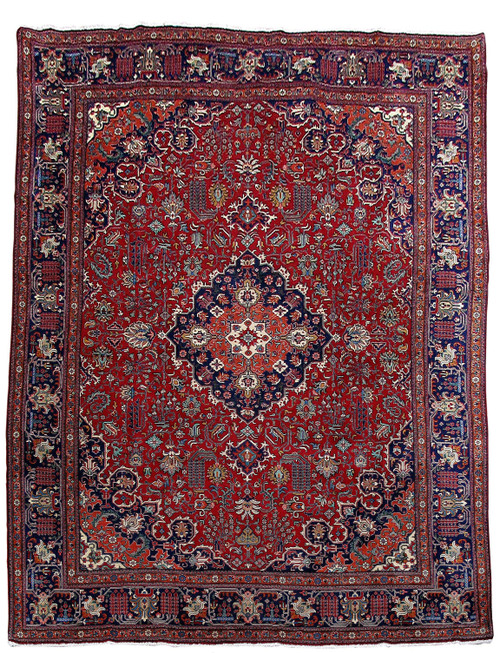
9'10" x 12'9" Persian Tabriz Rug | Navy Field, Red Floral Medallion | 1950s Estate Piece
This one came out of an American estate, woven in Persia in the 1950s in the Tabriz manner: a midnight navy ground filled corner to corner with curving vine, and one broad lobed medallion in soft madder red floating at the center with a pendant hanging from each end. The pile is low and evenly worn, which is why the drawing reads so crisply here, almost like a tapestry rather than a plush floor covering. It lies dead flat, the ends are straight, and the cream cotton fringe is intact at both ends. As a room-size piece it sits squarely in the 10x13 Persian rugs range, wide enough to hold a full seating group or a dining table with the chairs pulled out. It ships with a certificate of authenticity confirming the origin, the materials and the hand-knotted construction.
Please Note About the Photographs:
This is an honestly used piece from the 1950s and the wool pile has worn low across the field. The wear is even, the rug lies flat, and the low nap is exactly what gives the pattern its sharp, close-read appearance in the overhead photos. Tone shifts between the studio shot and the floor shots are lighting, not variation in the rug. Every rug is professionally steamed and pressed before it leaves us.
Design and Motifs
The layout is the classic town format: a single lobed medallion, a pendant at the head and foot, and heavy scalloped spandrels reaching in from all 4 corners. What makes it worth looking at closely is that the medallion is not left open. It carries its own miniature floral field, a rosette at the center ringed by leaves and split palmettes, all outlined in a thin ivory line that separates it cleanly from the navy around it. The field between medallion and spandrels is a dense all-over system of palmettes, serrated leaves, rosettes and small vase forms on a curving vine, drawn in the curvilinear rather than the angular manner. The main border repeats a series of flowering vases and cypress-like leaf clusters on red, flanked on both sides by a gold arabesque guard stripe and a narrow teal minor band. The close-up of the border shows how cleanly those small guard stripes are knotted, with the gold vine turning through each repeat without a break.
Color: Midnight Navy Against Madder Red
The field is a deep midnight navy that goes nearly black in low light and opens into a clear indigo where the light catches the low nap, visible in the angled floor shots. Against it the medallion and the wide border read as a warm madder red, brick at the border and a softer, slightly faded rose inside the medallion where the pile has worn thinnest. The secondary palette is where the age shows in the best way: dusty rose, salmon, a chalky ivory used for outlines and for the small blossoms, mustard gold in the guard stripes, teal and a muted sea blue in the leaves, and an olive to forest green scattered through the palmettes. The ivory outlining is the quiet workhorse here, since it keeps every motif legible against the dark ground instead of letting the field swallow the drawing. Overall the rug reads as a dark, formal navy and red piece with a great deal of small color happening at close range.
Origin and Weaving Quality
Tabriz sits in northwest Persia and has been the commercial and design center of Persian weaving for centuries, the place where the curved line and the flowing vine were worked out and then copied everywhere else. Rugs woven in that tradition are built on a cotton warp and weft with a wool pile, and they are known for holding a drawn cartoon faithfully across a large field, which is what you see in the symmetry of this piece: the spandrels match, the pendants match, and the border repeat comes around the corners without the drawing getting crowded. The folded-back photograph shows the reverse, where the knot nodes are small and regular and the pattern reads almost as clearly from behind as from the face, a good sign of an even, disciplined weave rather than a hurried one. Mid-century pieces like this one are the sweet spot for buyers who want real age and real hand work without antique pricing, and if you want to understand how weavers and dealers place a rug in time, our guide on how to date an Oriental rug walks through the same clues we used here.
9'10" x 12'9" Persian Tabriz Rug | Navy Field, Red Floral Medallion | 1950s Estate Piece
Ask about this rug
This piece is the only one of it, so the things worth knowing about it are particular to it. If you want to talk through the size, the colour in your own light, or the weave, speak to someone here first.