Watch the film
| Size in ft: | Width: 9'10" x Length: 12'9" |
| Size in Inch: | Width: 118" x Length: 153" |
| Size in meters: | Length: 3.89 x Width: 3.00 m |
| Colors: | Mocha Brown, Navy Blue, Seafoam Green, Ivory, Crimson, Turquoise |
| Shape: | Rectangular |
| Woven: | 100% Hand-knotted | Handmade |
| Foundation: | Cotton Warp & Weft |
| Pile: | |
| Age: | 1980's |
| Design: | Tabriz Floral Medallion | Corner Spandrels | All Over Vine Scroll |
| Origin: | Persian Tabriz | Made in Persia |
| Condition: | Excellent |
9'10" x 12'9" Persian Tabriz Rug | Navy Medallion on Mocha Brown Field | 1980s, Excellent Condition
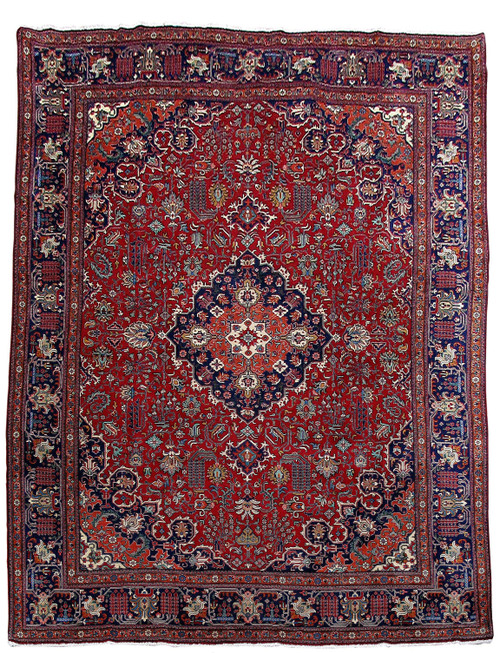
Brown grounds are uncommon in Tabriz weaving, and that is the first thing you notice about this 9'10" x 12'9" piece: a warm mocha field, closer to camel than to chocolate, carrying a full navy medallion and an unbroken lattice of flowering vine. It was knotted in the 1980s on a cotton foundation with a 3/8" wool pile, and the pile is still full and even from end to end, with clean selvedges and straight, undamaged fringes visible in the back photo. The scale is a true room size, one of the most useful proportions among 10x13 Persian rugs, large enough to seat a full sofa group or a 10 person table with all chairs on the wool. Every rug we sell ships with a certificate of authenticity documenting origin, materials and hand-knotted construction.
Design and Motifs
The drawing follows the classic Tabriz workshop formula, executed with more density than most village work. A lobed navy medallion sits dead center, filled with an 8 petal ivory and pistachio rosette and ringed by crimson palmettes, with slender pendants reaching toward each end. The 4 corners carry ivory cartouches drawn in mirror image, each holding a small burgundy shield and a spray of blossoms, and these sit on seafoam green spandrels that frame the field on all sides. Between medallion and corners the ground is filled edge to edge with curling arabesque vine, split leaves, rosettes and tiny bird-like blossom forms, all rendered in the fine curvilinear line that separates a Tabriz cartoon from a geometric tribal weave. The main border is a deep indigo band of reversing palmettes and vase forms with olive and crimson leafwork, flanked by ivory guard stripes of running floral meander, with a further outer ivory stripe finishing the edge.
A Mocha Brown Field With Navy, Green and Crimson
The field wool reads as a soft mocha brown with a warm pinkish cast where the light catches it, the sort of neutral that behaves like a taupe in a room rather than a dark brown. Against it, the medallion is a deep inky navy, and the same navy returns in the main border so the design reads as balanced from across the room. The third color is the surprise: a clear seafoam to mint green in the spandrels and scattered leaves, cool enough to lift the brown and unusual enough to make the rug memorable. Crimson and deep burgundy carry the palmettes and outline the scrollwork, ivory supplies the corner cartouches, the medallion rosette and the guard stripes, and turquoise blue is scattered through the smaller blossoms alongside olive green and touches of soft gold. Wool this age has begun to develop the low sheen that only time on good Persian fleece produces, and the color shifts subtly between the straight-on and angled photos because of it.
Tabriz Weaving in Northwest Persia
Tabriz, in the far northwest of Persia, has been the country's most organized weaving city since the Safavid era, and its workshops are the reason the curved line survives in Persian rug design at all. Weavers there work from a paper cartoon on the vertical loom and measure fineness in Raj, knots per gereh across the width, a system that lets a workshop specify quality before a single knot is tied. A piece like this one, with its dense vine fill, fully articulated medallion pendants and crisply drawn border cartouches, is squarely commercial workshop production of the 1980s rather than a village weave, and the tight, regular back visible under the tape measure confirms the discipline of the loom. Pile depth of 3/8" tells the same story, a deliberate clip that keeps the outlines sharp. If you want to understand how weave, wool and drawing together place a rug in a decade, our guide on how to date an Oriental rug walks through the same evidence we used here.
9'10" x 12'9" Persian Tabriz Rug | Navy Medallion on Mocha Brown Field | 1980s, Excellent Condition
Ask about this rug
This piece is the only one of it, so the things worth knowing about it are particular to it. If you want to talk through the size, the colour in your own light, or the weave, speak to someone here first.