Watch the film
| Size in ft: | Width: 11'3" x Length: 13'7" |
| Size in Inch: | Width: 135" x Length: 163" |
| Size in meters: | Length: 4.14 x Width: 3.43 m |
| Colors: | Multi, Rust, Terracotta, Salmon, Ivory, Indigo Blue, Teal, Sage Green, Dark Brown |
| Shape: | Rectangular |
| Woven: | 100% Hand-knotted | Handmade |
| Foundation: | Cotton |
| Pile: | |
| Age: | 1960's | Semi-antique |
| Design: | Bakhtiar Garden | Khesti Panel Grid | All-over Compartments |
| Origin: | Persian Bakhtiar | Made in Persia |
| Condition: | Excellent |
11'3" x 13'7" Persian Bakhtiar Rug | Khesti Garden Panel Design | 1960s Village Weave
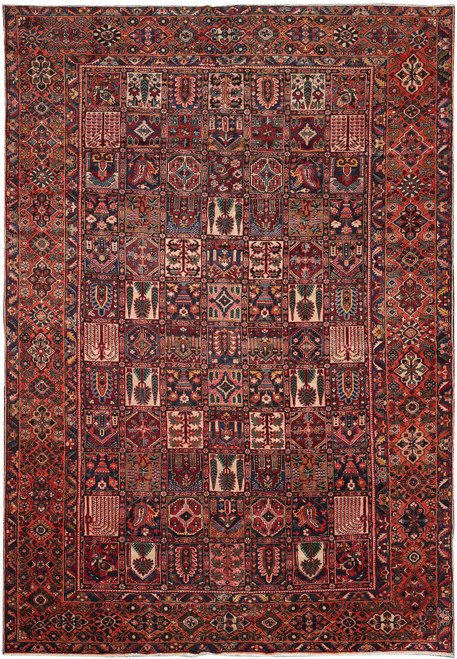
This Persian Bakhtiar was woven in the 1960s in the village belt of the Chahar Mahal, and it is the kind of room-filling piece that built the Bakhtiar reputation: a garden grid of small compartments, each one drawn a little differently, carried across more than 150 square feet of thick wool pile. At 11'3" x 13'7" it covers a great room or a formal dining table with every chair pulled out, and it sits in the genuinely usable end of our oversize Persian rugs, wide enough to read as a floor rather than an island. The pile is deep and even, the cotton fringe is secure at both ends, and the rug has been washed and is ready to lay flat. It ships from Freeport with a certificate of authenticity recording origin, age, materials and size.
Design and Motifs
The field uses the khesti or brick layout, a lattice of small squares outlined in dark brown and punctuated with tiny ivory crosses, which Bakhtiari weavers read as a walled garden seen from above. Neighboring panels almost never repeat: one holds a pair of green cypress trees flanking a flowering shrub, the next a weeping willow bent over a water channel, then a vase of carnations, a stepped lozenge medallion, a boteh with a curled tip, an arched niche, a latticed bed of small rosettes. That constant variation is the whole point of an all-over garden panel design, and it is why the eye keeps traveling across the rug instead of locking onto one center. The main border answers the grid with a broad ivory band of paired cypress trees, palmettes and rosettes on a scrolling vine, held between narrow guard stripes of rust and indigo and a final dark outer edge.
Color: Rust, Indigo and Ivory Across the Garden Grid
The panels run through the full Bakhtiar palette, which is why the spec sheet reads simply Multi. Rust and terracotta dominate, from a warm brick red in many of the compartment grounds to a softer salmon and dusty rose where the wool has mellowed with age. Set against that are blocks of clear indigo and a greener teal blue, ivory and camel cream, sage and pine green in the foliage, madder red in the rosettes, and a near-black aubergine brown in the outlines and panel frames. The ivory main border is the lightest passage in the rug and lifts the entire composition, its blue vine scroll and red flowerheads reading crisply against the cream ground. Up close the wool shows abrash, gentle horizontal shifts of tone within a single color, the signature of small dye lots and hand-spun yarn rather than any flaw.
Bakhtiar Origin and Village Weaving Quality
Bakhtiar rugs come from the villages of the Chahar Mahal, southwest of Isfahan, woven by settled Bakhtiari families in towns such as Shalamzar, Saman, Boldaji and Faradombeh. Highland grazing gives the district its famously tough, lustrous wool, and this weave is exactly what the tradition promises: a cotton foundation, a firm village knot, and a pile left heavy enough to absorb decades of traffic without thinning. The drawing is confident village drawing, geometric and slightly irregular from panel to panel, which is precisely how you separate a real Bakhtiar from a later copy. Pieces from the 1960s like this one now sit in the semi-antique band, and if you want to see how weavers, dealers and collectors date an oriental rug by wool, dye and structure, our guide walks through the evidence step by step.
11'3" x 13'7" Persian Bakhtiar Rug | Khesti Garden Panel Design | 1960s Village Weave
Ask about this rug
This piece is the only one of it, so the things worth knowing about it are particular to it. If you want to talk through the size, the colour in your own light, or the weave, speak to someone here first.