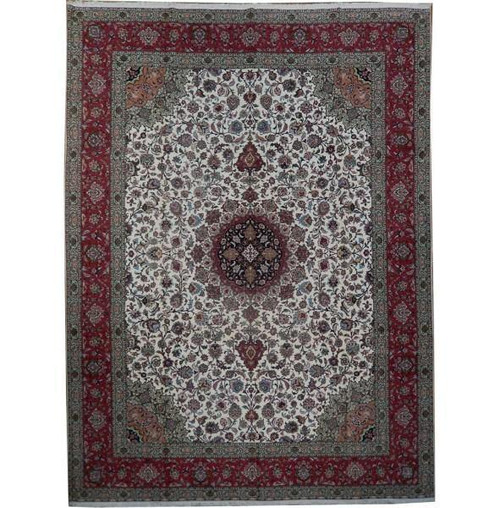
| Size in ft: | Width: 11'5" x Length: 16'7" |
| Size in Inch: | Width: 137" x Length: 199" |
| Size in meters: | Length: 5.05 x Width: 3.48 m |
| Colors: | Pom Red, Ivory, Green |
| Shape: | Rectangular |
| Woven: | Hand-Knotted |
| Pile: | Wool |
| Origin: | Persia |
| Design: | Tabriz |
| Age: | 1970's |
| Condition: | Perfect |
11'5" x 16'7" Persian Tabriz Rug | Mahi Fish Medallion | 1970s, Perfect Condition
A palace piece in the truest sense, this 11'5" x 16'7" Tabriz was woven in the 1970s and has survived in perfect condition, with full pile, straight sides and no repairs. The field is a deep pomegranate red packed corner to corner with the miniature Mahi fish repeat, and the drawing pulls inward to a scalloped ivory and sage medallion that floats over softly graduated shading. Wool pile on a cotton foundation gives the rug weight and a low, even clip that keeps the tiny motifs crisp rather than fuzzy. Rugs this long in a single unpieced weave are the hard part of the oversize Persian rugs market, and this one ships with a certificate of authenticity.
Please Note About the Photographs:
The soft diagonal shadows visible across the field in the first photograph are fold lines from pallet storage, not wear, fade or damage. A rug of this weight sits folded until it sells, and those lines relax once it is laid flat in the room. Every rug is professionally steamed and pressed before it leaves our warehouse.
Design and Motifs
The whole field is Mahi, the Herati fish pattern, drawn at a very small scale: a lattice of tiny rosettes, each ringed by four lancet leaves that the weavers read as fish circling a pond. That repeat runs unbroken from selvage to selvage and continues straight through the medallion and spandrels, which is the mark of a properly planned cartoon rather than a patched one. At the center sits a layered pointed medallion, 4 concentric rings of scalloped outline stepping inward to a small floral rosette, with a slender pendant at each end capped by a palmette finial. The 4 corners carry the same scalloped profile in reverse, so the shading reads as a series of ripples moving out from the middle. Framing it all is a wide ivory border of turning vine, serrated lancet leaves and alternating palmette cartouches, held between narrow guard stripes of running flowerheads and a fine outer meander.
A Pomegranate Red Field Cooled by Ivory and Green
The ground color is a pomegranate red with a plum and brick undertone, warm in daylight and considerably deeper under lamplight, and because the Mahi repeat is worked in ivory, gold and dark navy the red reads as a textured surface rather than a flat block. Where the medallion and the corner spandrels take over, the palette shifts to ivory, sage green and a soft apricot gold, with the same fish motif carried across in muted tones so the transition looks like a change of light rather than a hard edge. The medallion core brings in the strongest gold and a touch of terracotta, outlined in bottle green. The main border is ivory, which lifts the whole rug and gives the eye somewhere to rest, and its flowerheads pick up rust, olive, sage, pale blue and small hits of black for definition. Guard stripes in green and dark brown close the composition.
Tabriz Weaving and the Quality of This Piece
Tabriz sits in the northwest of Persia and has been the country's most commercially disciplined weaving city for well over a century, working to a measured fineness called Raj, the number of knots counted across a gereh of about 2.75 in of width. Fineness is what Mahi demands: the fish repeat only holds its shape at a tight knot count, and here the individual rosettes are small enough that the pattern stays legible from standing height instead of dissolving into speckle. The back shown against the ruler is tight and even, the selvages are original, and the pile is low and hard-wearing, which is exactly how a Tabriz of this generation was built to live under furniture. Buyers comparing Persian Tabriz rugs in palace sizes will find the Mahi field the most durable of the Tabriz drawings, because there is no large open ground to show traffic.
11'5" x 16'7" Persian Tabriz Rug | Mahi Fish Medallion | 1970s, Perfect Condition
Ask about this rug
This piece is the only one of it, so the things worth knowing about it are particular to it. If you want to talk through the size, the colour in your own light, or the weave, speak to someone here first.