Watch the film
| Size in ft: | Width: 11'8" x Length: 16'10" |
| Size in Inch: | Width: 140" x Length: 202" |
| Size in meters: | Length: 5.13 x Width: 3.56 m |
| Colors: | Ivory, Carrot Orange, Navy, Raspberry Rose, Sky Blue, Soft Green |
| Shape: | Rectangular |
| Woven: | 100% Hand-knotted | Handmade |
| Foundation: | Cotton |
| Pile: | |
| Design: | Kerman All-Over Floral | Navy Pictorial Border with Cartouche Rosettes |
| Origin: | Persian Kerman | Made in Persia |
| Condition: | Excellent |
11'8" x 16'10" Persian Kerman Rug | Antique Ivory All-Over Floral | Navy Pictorial Border
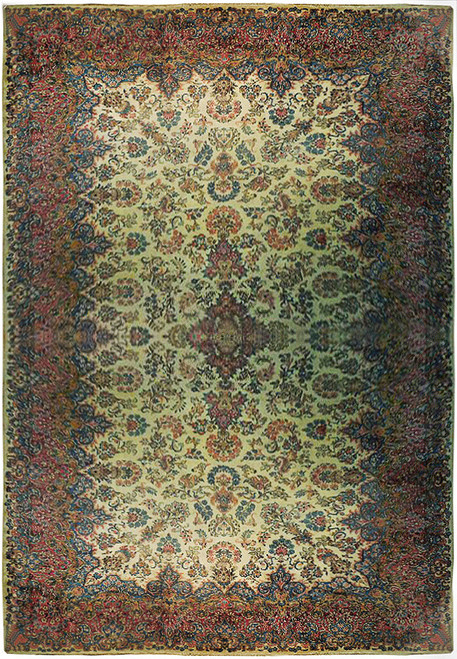
This is a room-filling antique Kerman drawn in the old formal manner: an ivory ground covered edge to edge in flowering vine, framed by a deep navy border set with oval rosette cartouches, and finished with a wide carrot orange outer band. At 11'8" x 16'10" it belongs with the true oversize Persian rugs, a piece made for a long formal room rather than a standard seating group, and the drawing holds together at that scale because the field was laid out as one continuous composition rather than repeated panels. The pile is 3/8" wool on a cotton foundation, still full and lustrous across the field, and the condition is excellent for a rug of this age. Every rug we sell ships with a certificate of authenticity stating origin, materials and hand-knotted construction, and it ships free anywhere in the 50 states despite the weight and freight class a piece this size would normally carry elsewhere.
Please Note About the Photographs:
The first overhead photograph was shot from height under strong studio light, so parts of the ivory ground read darker and slightly olive there. The floor-level close-ups show the true color: a clean ivory to light cream ground with crisp blue, rose and green drawing. The soft tonal shadows running across the field come from how the rug lay for photography, not from wear, fade or damage. They relax once the rug is laid flat, and every rug is professionally steamed and pressed before it leaves us.
Design and Motifs
The field is an all-over floral design built from thin curving vines that carry small rosettes, tulip sprays, carnations and feathery blue leaves, with a large lobed medallion outline traced in the same ivory ground so it reads as a halo rather than a solid shape. A small sky blue cusped medallion sits at the exact center, and matching blue pendants anchor the field at the head and foot. The 4 corners are filled with quartered spandrels of dense vine work that mirror the field drawing, so nothing in the layout repeats mechanically. The main navy border is the signature Kerman pictorial garden treatment: continuous flowering scroll interrupted by oval cartouches, each one a miniature raspberry or ivory ground filled with its own bouquet, placed at the center of every side and again at each corner. Inside, a narrow rose and ivory guard stripe separates border from field; outside, a broad carrot orange band carries reciprocal boteh and leaf scrolls out to the original ivory selvedge and fringe.
Ivory Ground, Carrot Orange and Deep Navy
The ground is ivory leaning to warm cream, with the faint golden tone that older Kerman wool takes on as it mellows, and it is the quietest part of the rug by design. Everything else is drawn on top of it in soft, slightly faded tones: mid sky blue for the leaves and the central medallion, a deeper indigo navy for the main border and the outlining of the vines, raspberry rose for the flower heads, and pale peach, camel and gold in the petals. Soft sage and eucalyptus green appears inside the cartouches and in the outer scroll, and there is a clear carrot orange to burnt gold in the wide outer band and in the spandrel grounds. The close-up photographs show how the shades were layered: a single rosette can run from deep raspberry at the rim through peach to a gold center, which is what keeps a field this busy from turning flat. Gentle abrash in the blues, visible where the light rakes across the pile, is normal in a hand-dyed antique and reads as depth rather than inconsistency. If you want to place the rug in a period context, our guide on how to date an oriental rug explains what the palette and the drawing tell you.
Kerman: The Weaving Town and the Weave
Kerman sits in the high desert of southeastern Persia, and its workshops built their reputation on exactly this kind of piece: a curvilinear floral field, a pictorial garden border, and a scale that no village loom could attempt. The finest work came out of the town and the nearby weaving village of Ravar, often sold under the name Lavar Kerman, where designers worked from full cartoons and weavers followed a drawn line rather than a memorized pattern. You can see that discipline here in the border cartouches, where the same bouquet is repeated at 4 corners and 4 midpoints without losing symmetry over nearly 17 feet of length. The weave is a fine, even asymmetric knot on a cotton foundation, tight enough for the thin vine stems and the small flower heads to stay legible, and the 3/8" wool pile still stands up under the hand with the soft sheen that good Kerman fleece keeps for decades. The folded corner photographs show the reverse: regular knot rows, clean color definition from the back, and the original ivory end finish intact.
11'8" x 16'10" Persian Kerman Rug | Antique Ivory All-Over Floral | Navy Pictorial Border
Ask about this rug
This piece is the only one of it, so the things worth knowing about it are particular to it. If you want to talk through the size, the colour in your own light, or the weave, speak to someone here first.