Watch the film
One of one
12 x 20 Antique Persian Bijar Rug | Triclinium Design | Signed Ostad Ali Workshop | Oversize Palace Size | About 120 Years Old
- SKU
- MBA30
- ORIGIN
- Bijar Rugs
- SIZES
- 12x20
- SHAPES
- Rectangular
12'3" x 20'3" Antique Persian Bijar Rug | Triclinium Design | Signed Ostad Ali Workshop | Oversize Palace Size | About 120 Years Old
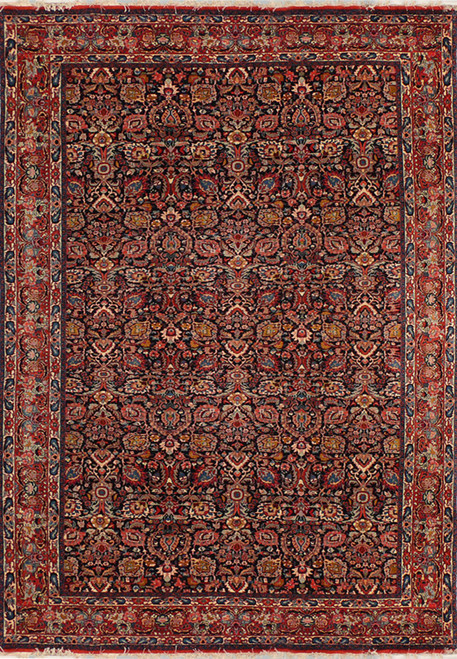
This is not a rug you find twice. It is a 12'3" x 20'3" antique Persian Bijar rug in the triclinium design, a layout named after the dining room of ancient Rome, where 3 couches stood in a U around a low table. Here that plan is woven into a single carpet: a wide panel across one end, and below it 3 long panels side by side, each with its own field, all held inside one great border. A woven cartouche in the center panel reads "Ordered by Mohammad Reza Khan, factory of Ostad Ali", a commission from a named patron to a named workshop. It was hand-knotted in wool on a cotton foundation about 120 years ago, at roughly 200 knots per square inch, and it has never been used. There is not a single flaw. It is a museum-level collector's piece, and comparable pieces, even in used condition, have sold for six figures. It comes with our certificate of authenticity.
Design and Motifs
Each of the 4 panels is filled with the herati pattern, the small repeating diamond of rosettes and curving leaves that Bijar weavers call mahi, or fish, and each one is treated differently. The cross panel at the head has a brick red field around a navy diamond medallion outlined in saffron yellow zigzags, with sky blue spandrels in all 4 corners marked by bold yellow hooked lines and small blossoms. The 2 side panels are long, narrow fields of red herati, a little like runners laid alongside the center. The center panel is the heart of the rug: a deep navy herati field framed at both ends by saffron yellow arched spandrels with stepped edges, scattered with blue lattice lines, red rosettes and small flowering plants. The signature cartouche sits in the yellow spandrel at one end, a lobed panel of dark Persian calligraphy flanked by small red scrolls. Every panel has its own frame of narrow guard stripes, and the whole composition is wrapped in a wide navy border of large curling acanthus leaves in coral, sky blue, forest green, lavender, gold and ivory, linked by vines of small red and green flowers. Ivory guard stripes of tiny red rosettes run on both sides.
The Colors: Brick Red, Navy and Saffron Yellow
Brick red, warm and deep, fills the head panel and both side panels, so it is the color that reads first across a room. Navy, close to indigo, anchors the center panel, the medallion and the great outer border, giving the design its weight. Saffron yellow is the showpiece: a strong, glowing yellow in the center spandrels and the medallion's zigzag frame that lights up the whole rug, and saturated yellows like this were among the most prized colors a workshop could produce. Sky blue fills the corners of the head panel and threads through the herati leaves. Coral and pink soften the rosettes, and ivory brightens the small flowers and guard stripes. Forest green, lavender, gold and chocolate brown complete the palette, used most freely in the acanthus leaves of the border. After roughly 120 years every color is still full and even, with no fading, a sign of both fine dyes and a rug that was never put on a floor. The fringe is natural cotton.
Bijar: The Iron Rug of Persia, Woven to Commission
Bijar is a Kurdish weaving town in western Persia, famous as the home of "the iron rug of Persia". Its weavers pack every row down with a heavy metal comb, which makes the rug so dense and stiff that a good Bijar is nearly indestructible. That is part of why this piece has survived some 120 years in such perfect condition. Even so, the triclinium layout is extraordinarily rare. Building 4 separate fields, each with its own frame, into one carpet more than 20 feet long demands careful planning on the loom, and pieces like this were made to order for particular rooms and patrons, not for the open market. The inscription naming both the man who ordered it and the master whose workshop wove it makes this piece a documented commission. Among oversize Persian rugs, an antique signed Bijar in never-used condition is about as rare as a carpet gets. It belongs in a grand living room, a formal dining hall or a collection.
12 x 20 Antique Persian Bijar Rug | Triclinium Design | Signed Ostad Ali Workshop | Oversize Palace Size | About 120 Years Old
Ask about this rug
This piece is the only one of it, so the things worth knowing about it are particular to it. If you want to talk through the size, the colour in your own light, or the weave, speak to someone here first.