Watch the film
| Size in ft: | Width: 3'2" x Length: 12'8" |
| Size in Inch: | Width: 38" x Length: 152" |
| Size in meters: | Length: 3.86 x Width: 0.97 m |
| Colors: | Red, Ivory, Navy, Camel, Apricot, Multi |
| Shape: | Runner |
| Woven: | 100% Hand-knotted | Handmade |
| Foundation: | Cotton |
| Pile: | 100% Wool | 3/8" pile |
| Age: | Semi-Antique | Mid 20th century village weave |
| Design: | Karaja | Repeating geometric medallions | Tribal filler motifs |
| Origin: | Persian Karaja | Made in Persia |
| Condition: | Excellent | Even pile | Original ends and sides |
3'2" x 12'8" Persian Karaja Runner Rug | Repeating Geometric Medallions | Semi-Antique Village Weave
A runner this long is harder to find than any room-size rug, and this one is the real village article: 12 feet 8 inches of hand-knotted wool on a cotton foundation, drawn freehand in the Karaja manner with a column of geometric medallions marching from one end to the other. The wool has the dry, slightly glassy handle that older northwest Persian weaving develops, the pile is still a full 3/8 inch deep across the whole length, and the ends and sides are original. Image 6 shows the back with a ruler laid across it, so you can see the honest village knot and the single wefted structure that gives a Karaja its flat, hard-wearing feel underfoot. It is a semi-antique piece rather than a new production rug, and it ships with our certificate of authenticity confirming origin, materials and hand-knotted construction.
Design and Motifs
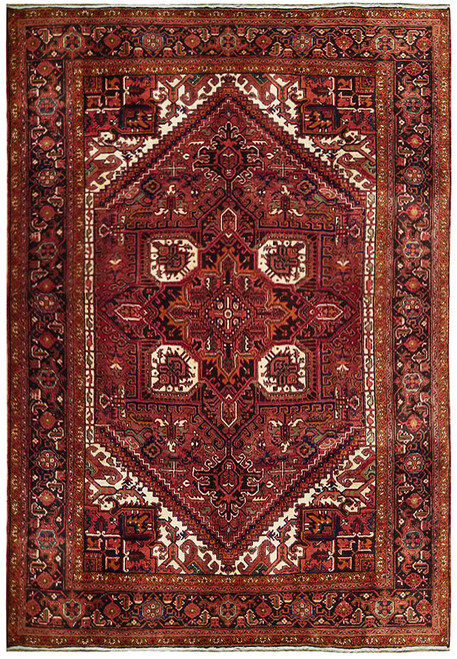
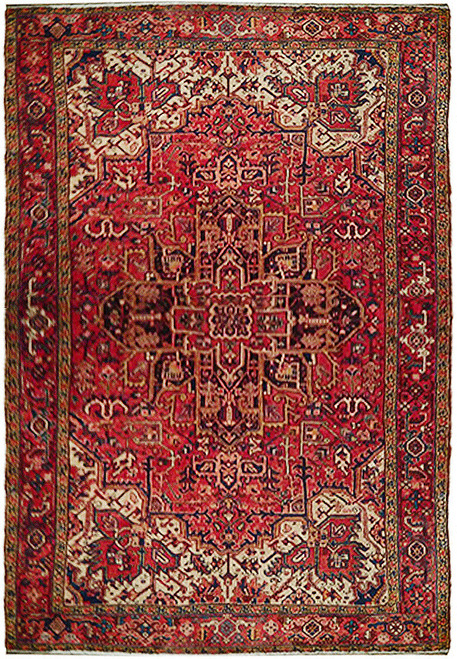
The field runs as an alternating sequence of medallions rather than a single centerpiece, which is exactly how Karaja weavers solve a long narrow format. Wide ivory star medallions with hooked arms and a small 8 petal rosette at the center trade places with elongated navy and charcoal hexagons filled with stepped bands, combs and tiny diamonds. Around them the ground is packed with the tribal shorthand that makes this drawing so readable: arrowheads, cypress forms, latch hooks, little blossom sprays, comb figures and the occasional stick-figure animal, all set out in straight lines and right angles with no curved work anywhere. The borders follow the same logic, a dark main band carrying angular tree and triangle devices, flanked by an ivory guard stripe of meandering vine and rosettes, with a narrow red and ivory bead stripe at the outer edge. If you like geometric Persian rugs, this is the type at its most characteristic, and the small irregularities from medallion to medallion are proof the pattern came from memory and not from a printed map.
Color: Brick Red Ground with Ivory, Navy and Camel
The ground is a warm tomato-to-brick red that shifts gently along the length, the soft natural abrash you get from hand-dyed yarn woven in small batches, which is most visible in the angled photographs. Against it, the ivory medallions read as a creamy oatmeal white rather than a bleached white, and the navy medallions are a deep indigo that goes almost black where it meets the charcoal-brown outlines. The secondary palette is where the rug earns its multi description: apricot and salmon pink in the small blossoms and hooks, camel gold and soft wheat in the filler figures, a mid sky blue in the border devices, and touches of aubergine and dark olive in the rosettes. The main border is the darkest value in the rug, an inky navy-black that frames the red firmly, while the ivory guard stripe keeps a bright line running down both sides for the full 12 feet 8 inches. Overall it reads as a rich red rug with ivory punctuation, warm enough for oak or walnut floors and dark enough at the edges to hide ordinary traffic.
Karaja: Village Weaving in Persian Azerbaijan
Karaja, also spelled Karadja, is a small village in Persian Azerbaijan in the northwest highlands, part of the group of weaving settlements in the Heriz district between Tabriz and Ahar. The looms there are village looms, not city workshops, so the knot count stays moderate and the value sits in the wool and the drawing instead. Highland sheep in that region grow a long, resilient fleece, and a single wefted cotton foundation beaten down tight produces a rug that stays flat, resists curling and takes decades of footfall without flattening out. Karaja became known in the trade specifically for runners and small medallion pieces, and a 12 feet 8 inches length in good order is the format collectors watch for, because long village runners were made in small numbers and most that survive are worn down to the knot. This one is not. In a corridor, an entry or a long upstairs hallway runner placement, the medallion sequence gives the eye something to follow the whole way down the floor.
3'2" x 12'8" Persian Karaja Runner Rug | Repeating Geometric Medallions | Semi-Antique Village Weave
Ask about this rug
This piece is the only one of it, so the things worth knowing about it are particular to it. If you want to talk through the size, the colour in your own light, or the weave, speak to someone here first.