| Size in ft: | Width: 3'7" x Length: 5'7" |
| Size in Inch: | Width: 43" x Length: 67" |
| Size in meters: | Length: 1.70 x Width: 1.09 m |
| Colors: | Ivory, Blue, Sky Blue, Burgundy, Rose Pink, Olive Green, Brown |
| Shape: | Rectangular |
| Woven: | 100% Hand-knotted | Handmade |
| Foundation: | Silk |
| Pile: | Wool and Silk |
| KPSI: | Approx. 500 |
| Age: | 2000's |
| Signature: | Signed | Woven cartouche in Persian script at one end |
| Design: | Isfahan Medallion | Floral Vine Field | Vase and Bird Corners |
| Origin: | Persian Isfahan | Made in Persia |
| Condition: | Perfect | Never used |
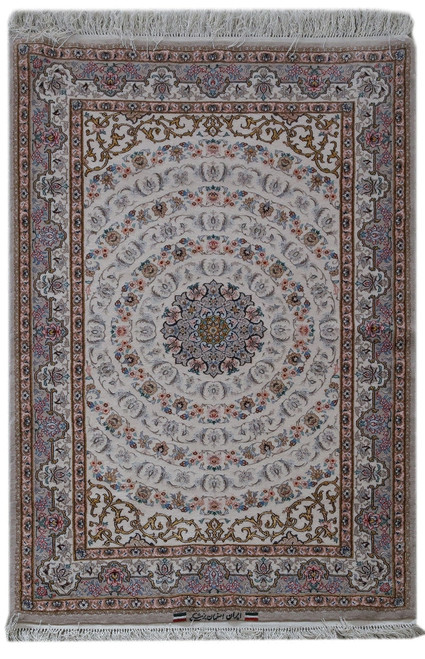
3'7" x 5'7" Persian Isfahan Rug | Signed Ivory Medallion | Wool & Silk on Silk, Approx. 500 KPSI
This 3'7" x 5'7" Persian Isfahan is a workshop piece in the truest sense, with a wool and silk pile knotted on a silk foundation at roughly 500 knots per square inch and a woven cartouche signature at one end. It was woven in the 2000's and has never been used, so the pile still holds its original sheen: the silk catches the light along the vine work while the wool keeps the ground a soft matte ivory. At this size the drawing never loosens, and every leaf, blossom and curl of arabesque holds its shape down to a single knot. It ships with a certificate of authenticity. Among 4x6 Persian rugs this is the type collectors buy to hang on a wall or to place where it will be seen up close rather than crossed daily.
Design and Motifs
The center holds a small 8 petal rosette set inside a stepped quatrefoil medallion of burgundy and mid blue, filled with yellow and cream arabesques that turn back on themselves like handwriting. Out of the medallion run heavy brown vines, drawn like real branches rather than stylized scrolls, that arch across the ivory field and carry rose, crimson and pale blue blossoms on every fork. A deep blue pendant cartouche anchors the field at the top and the bottom, and paired half medallions press in from both sides. The 4 corners of the field are filled with grey green spandrels that hold sky blue vase forms with small bird figures perched on them, a courtly touch typical of the best Isfahan drawing. The wide burgundy main border runs a rhythm of navy palmettes flanked by rosettes and curled leaves, and it is framed on both sides by sky blue guard bands of fine scrolling vine, with narrow pink and ivory reciprocal stripes separating each band.
A Palette Built on Ivory and Blue
Ivory carries the field, a warm undyed cream rather than a bleached white, and it is exactly the tone that lets everything else read clearly. The blues do most of the work: a bright sky blue in the guard bands, the vase motifs and the flower heads, a deeper cornflower blue through the medallion arabesques, and a near black indigo used as an outline colour that sharpens each petal and stem. Against those, the border reads a rich burgundy, close to wine, and the same burgundy returns in small doses inside the field so the eye keeps travelling. Rose pink, soft blush and a dusty olive green fill the blossoms and leaves, brown defines the branching vines, and a smoky grey green shades the spandrels so the corners recede and the medallion advances. Where silk is used in the highlights the colour shifts as you walk around the rug, brightening from one side and cooling from the other.
Isfahan: Central Persia and the Safavid Workshop Tradition
Isfahan sits in central Persia and has been a court weaving city since the Safavid workshops of the 16th century, and its reputation has always rested on drawing rather than on scale. A curved line, a vine that flows without a break, a palmette that stays symmetrical across the fold: none of that survives at a low knot count, which is why the good ateliers work on a silk foundation and push the count as high as the loom allows. That is what you are looking at here, roughly 500 knots per square inch on silk warps, with the weaver confident enough to put his name in the end cartouche. If you want the wider history and the marks of quality to look for, our guide to Isfahan rugs covers it in full, and a signed, unused example in this condition is about as clean an entry point into the group as you will find.
3'7" x 5'7" Persian Isfahan Rug | Signed Ivory Medallion | Wool & Silk on Silk, Approx. 500 KPSI
Ask about this rug
This piece is the only one of it, so the things worth knowing about it are particular to it. If you want to talk through the size, the colour in your own light, or the weave, speak to someone here first.