Watch the film
| Size in ft: | Width: 5' x Length: 13' |
| Size in Inch: | Width: 60" x Length: 156" |
| Size in meters: | Length: 3.96 x Width: 1.52 m |
| Colors: | Blue, Red |
| Shape: | Runner |
| Woven: | Hand-Knotted |
| Pile: | Wool |
| Origin: | Persia |
| Design: | Bijar |
| Age: | 1940's |
| Condition: | Excellent |
5' x 13' Antique Persian Bijar Gallery Runner | Navy Boteh Field | Circa 1940s
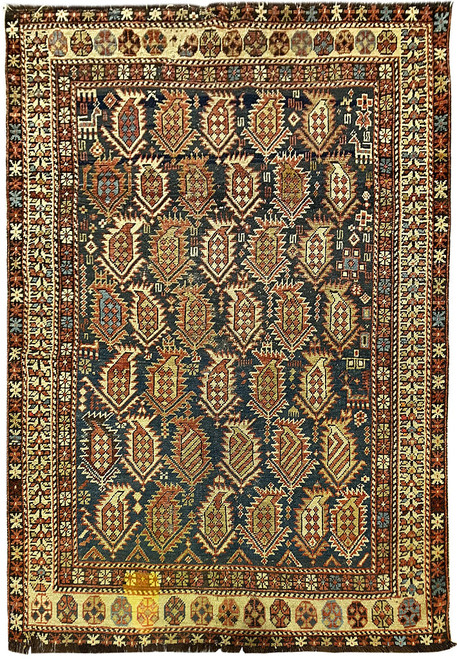
This is a true gallery format piece, 5 feet wide and 13 feet long, woven in the Kurdish town of Bijar around the 1940's and still heavy, flat and sound after eight decades. Three stepped medallions run end to end down the center, filled edge to edge with small boteh paisleys on deep indigo, with a rose red surround carrying the open tribal drawing that village looms in the Bijar district do better than anyone. The pile is hand-knotted wool on a cotton foundation, the handle is thick and board-like in the way collectors expect from this weaving group, and the colors have aged into the soft, settled tones that no new rug can imitate. It ships with a certificate of authenticity confirming origin, age, materials and hand-knotted construction.
Please Note About the Photographs:
The first studio photograph is lit brighter than the rug reads in person and pushes the red toward pink. The floor photographs taken on tile are the honest reference for color: a deeper rose red field and a dark indigo center. The gentle banding visible in the navy is abrash, the natural shift that happens when a village weaver moves from one batch of hand-dyed yarn to the next, and it is a hallmark of an antique rather than wear or fading.
Design and Motifs
The center is a chain of 3 stepped, hexagonal medallions joined point to point, each outlined in a fine ivory sawtooth that snaps the navy away from the red ground. Inside them runs a dense boteh repeat, the small hooked paisley known as mir-i-boteh, drawn in rows so tight and regular that the field reads as texture before it reads as pattern. The rose red surround is a different conversation entirely: scattered rosettes, angular leaf sprays, diamond lozenges, hooked brackets and a pair of facing blue vase forms at each end, all drawn freehand with the confident shorthand of a weaver working from memory rather than a cartoon. Framing it all are 7 narrow bands, the widest being an ivory palmette and vine stripe, with reciprocal brown and red guard stripes stepping inward. The repeating 4 corners never match perfectly, which is exactly the charm of a village piece of this age.
Color
Two colors carry the rug. The medallion field is a deep indigo navy that reads almost black in low light and opens up to a dusty blue-black where the abrash bands cross it, and the surround is a rose red with a terracotta undertone, the kind of madder-based red that mellows rather than dulls. Against those two, the accent palette is small but lively: a bright light teal in the rosettes and vase forms, warm ivory in the sawtooth outlines and the main border, a dark chestnut brown in the leaf sprays and guard stripes, and small touches of soft peach and pale gold in the floral heads. The boteh themselves are drawn in the red against the navy, so the two main tones trade places between center and surround, which is why the rug never looks heavy despite the strong indigo core. In a room with warm wood, brass or cream plaster it will look settled from the first day.
Origin and Weave
Bijar sits in Kurdistan in northwest Persia, and the weavers there earned the nickname the iron rug of Persia honestly. Wefts are driven down with a heavy metal comb while the warps are held under tension, which compacts the knots into a stiff, immensely durable structure that resists folding and outlives generations of use. You can read it in the photographs of the back, where the knot rows sit tight and even, and you can feel it in the weight of a 5 by 13 gallery runner like this one. The drawing here is village work rather than workshop work, geometric and slightly irregular, with the long narrow format woven for the corridor of a traditional house. If you want to understand what separates this weaving group from its neighbors, our guide to Persian Bijar rugs covers the construction in detail, and the comparison of Bijar, Zanjan, Tekab and Bukan weaving explains the district by district differences. For placement, pieces in this proportion belong with long Persian gallery runner rugs rather than standard room sizes, and the 1940's dating is consistent with the wool, the dyes and the weave structure described in our notes on how to date an Oriental rug.
5' x 13' Antique Persian Bijar Gallery Runner | Navy Boteh Field | Circa 1940s
Ask about this rug
This piece is the only one of it, so the things worth knowing about it are particular to it. If you want to talk through the size, the colour in your own light, or the weave, speak to someone here first.