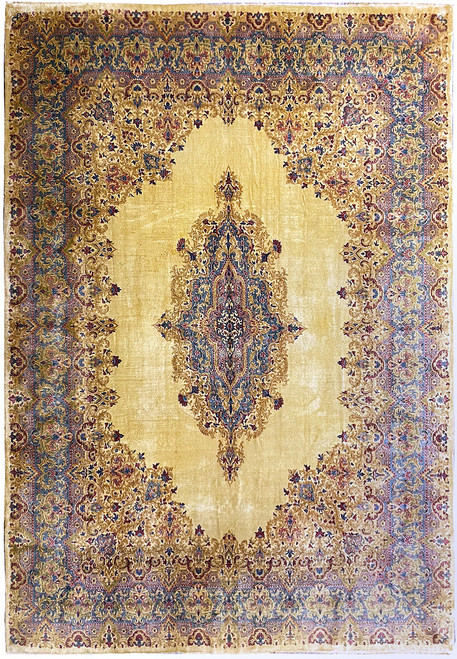
| Size in ft: | Width: 8'9" x Length: 18'8" |
| Size in Inch: | Width: 105" x Length: 224" |
| Size in meters: | Length: 5.69 x Width: 2.67 m |
| Colors: | Green, Pink, Blue |
| Shape: | Rectangular |
| Woven: | Hand-Knotted |
| Pile: | 3/8" Wool |
| Origin: | Persia |
| Design: | Kerman Lavar |
| Age: | 1940's |
| Condition: | Very Good |
8'9" x 18'8" Persian Kerman Lavar Rug | Green Field Gallery Length | Circa 1940s
Hand-knotted in southeast Persia in the 1940s, this 8'9" x 18'8" Persian Kerman runs more than 18 feet down its length, which puts it with the oversize Persian rugs rather than any standard room size. The pile is 3/8" wool on a cotton foundation, still full underfoot and carrying the soft, faintly lustrous handle that Kerman wool is known for. Condition is very good for a rug approaching 80 years old: the surface shows light, even wear and the sides and ends are intact, with fringe present at both ends. It ships with a certificate of authenticity.
Please Note About the Photographs:
The first photograph was taken against a white studio background and reads considerably lighter and pinker than the rug actually is. The floor photographs show the true color: a sage to olive green field with a deep raspberry pink border. Please judge the color from those images.
Design and Motifs
There is no central medallion. The green ground carries an all-over floral design built from repeating bouquets, single roses, tulips and small bell flowers on thin brown vines, each group mirrored across the long center line so the field reads the same from either side. Because the drawing is open rather than crowded, large stretches of bare green are left to breathe between the sprays, which is exactly what the Lavar Kerman school aimed for. The main border reverses the scheme: a raspberry pink ground packed with big curling acanthus leaves, cream palmettes and indigo rosettes, interrupted at the 4 corners and at the center of each end by pale ivory cartouches. Inside that sits a soft teal band of small blossoms, and outside it a cream guard border of blue and rose leaf vine. Every flower is drawn with a curved outline and shaded petals, botanical rather than geometric, which is the whole point of a fine Kerman.
Sage Green, Raspberry Pink and Indigo
The field is an unusual color for a Persian rug of this period and the reason this one stands out among green Persian rugs: a soft sage that leans olive in daylight and cools toward moss under lamplight. It carries visible abrash, with one end reading lighter and slightly golden where the dye lot changed on the loom, a natural feature of hand-dyed wool rather than a stain or a fade. Against that green the flowers are worked in raspberry, rose pink, coral, salmon and cream, with leaves and rosettes in deep indigo and a grayer teal blue. The border pink is the strongest note in the rug, a saturated raspberry that darkens where it meets the navy outlines, and the ivory of the outer guard and the corner cartouches keeps the whole thing from going heavy. Brown and pale olive stems tie the pinks back into the field.
Kerman and the Lavar Drawing Tradition
Kerman sits in the far southeast of Persia, a city with a court weaving history reaching back to the Safavid era and a reputation built on drawing rather than raw knot count. The Lavar name comes from Ravar, the town north of the city whose workshops produced the most finely drawn floral and pictorial pieces, and the term has long been used in the trade for Kerman work of this quality. This piece is a workshop weave of the 1940s: an asymmetric knot on a cotton foundation, fine enough to hold a curved rose petal and a shaded leaf without breaking the line, with a low pile that keeps the drawing crisp. The wool comes off local sheep and takes dye with the softness you see in the pinks here. If you want to understand what the wear, the abrash and the weave structure tell you about a piece like this, our guide on how to date an Oriental rug walks through the same clues we used on this one.
8'9" x 18'8" Persian Kerman Lavar Rug | Green Field Gallery Length | Circa 1940s
Ask about this rug
This piece is the only one of it, so the things worth knowing about it are particular to it. If you want to talk through the size, the colour in your own light, or the weave, speak to someone here first.