Watch the film
| Size in ft: | Width: 9'7" x Length: 14'4" |
| Size in Inch: | Width: 115" x Length: 172" |
| Size in meters: | Length: 4.37 x Width: 2.92 m |
| Colors: | Ivory, Green, Blue, Pink |
| Shape: | Rectangular |
| Woven: | Hand-Knotted |
| Pile: | Wool |
| Origin: | Persia |
| Design: | Lavar Kerman |
| Age: | 1940's |
| Condition: | Very Good |
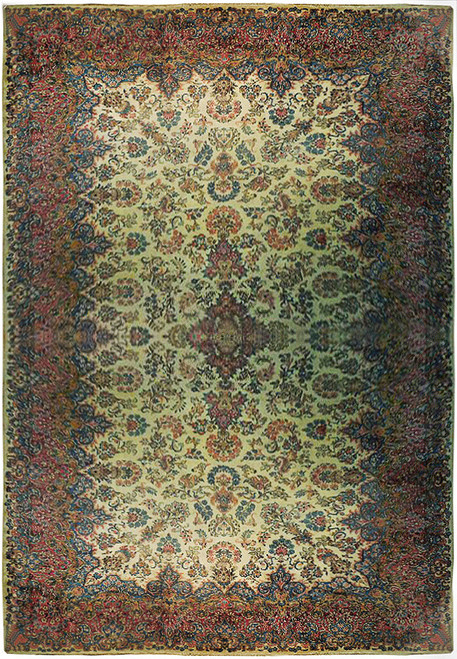
9'7" x 14'4" Persian Kerman Lavar Rug | Ivory All-Over Floral Field | Circa 1940s
This 9'7" x 14'4" Persian Kerman was woven in the 1940s in the Lavar manner, the finest and most delicately drawn of the Kerman styles. Instead of a single central medallion the weaver filled the ivory field with mirrored bouquets and loose sprays of roses, carnations and small blue blossoms, so the rug reads as one continuous garden from end to end. The pile is wool on a cotton foundation, still full underfoot after eight decades, and the ivory ground has warmed into the soft honey tone that only real age produces. It ships with a certificate of authenticity. At this scale it belongs with the 10x14 Persian rugs that sit comfortably under a fully extended dining table or hold a large living room with floor showing on all 4 sides.
Please Note About the Photographs:
The close-up photographs show faint vertical crease lines where the rug has been folded on the pallet. These are not wear, not fade and not damage, and they relax once the rug is laid flat. Every rug is professionally steamed and pressed before it leaves us. The gentle tonal variation you see across the ivory ground is the natural patina of a 1940s wool pile rather than a flaw.
Design and Motifs
The centre of the field is marked by a tall upright bouquet with mirrored sprays fanning out to either side, and from that point the drawing opens into a true all-over floral composition: full-blown roses, carnations, drooping clusters of small blue flowers and serrated leaves, all carried on fine brown vines that curl rather than repeat mechanically. Nothing is stiff, and no two bouquets are drawn quite alike. The border system is where the Lavar hand shows most clearly. A wide main band in soft turquoise is planted edge to edge with rosettes and leafy scrolls, interrupted at intervals by rose-pink reserves holding cream palmettes and curling acanthus in camel and dark brown. Inside it a narrow rose guard runs the length of the rug, and along the field edge a row of pendant flower baskets drops into the ivory ground, a device the Kerman workshops used to soften the transition between border and field.
A Palette of Ivory, Rose and Turquoise
The field is ivory that has mellowed toward cream and, in places, a light honey gold, with the sort of uneven warmth that separates a genuine 1940s piece from anything new. Against it the flowers run through a full range of pinks: raspberry and deep magenta in the larger roses, a lighter salmon rose in the smaller buds, and pale blush in the border reserves. The blues are the heart of the rug, a soft turquoise in the main border that carries a distinct green cast, with brighter sky blue flowers and deep indigo outlines giving the drawing its definition. Sage and olive green leaves, camel and cinnamon brown scrollwork, and small touches of apricot and gold fill out the rest. The overall effect is pastel and luminous rather than saturated, which is exactly why this palette works so well with pale walls, dark wood and antique furniture alike.
Kerman Weaving and the Lavar Tradition
Kerman sits in southeastern Persia, an oasis city with a weaving history running back to the Safavid era and a reputation built on curvilinear drawing and pictorial garden borders rather than geometry. Lavar, the town of Ravar north of the city, gave its name to the most finely drawn Kerman production, and the name has long been used in the trade for pieces with this quality of line and this density of floral detail. The weave here is the asymmetric knot on a cotton warp and weft, with regional wool that takes dye beautifully and holds a silky sheen as it ages. Rugs of exactly this type were made in quantity for the American market in the 1930s and 1940s, which is why so many of the finest surviving examples turn up in estates today; if you want to understand the tells, our guide on how to date an Oriental rug walks through the same clues we used on this piece.
9'7" x 14'4" Persian Kerman Lavar Rug | Ivory All-Over Floral Field | Circa 1940s
Ask about this rug
This piece is the only one of it, so the things worth knowing about it are particular to it. If you want to talk through the size, the colour in your own light, or the weave, speak to someone here first.