| Size in ft: | Width: 10' x Length: 14'8" |
| Size in Inch: | Width: 120" x Length: 176" |
| Size in meters: | Length: 4.47 x Width: 3.05 m |
| Colors: | Ivory, Blue, Green, Rust |
| Shape: | Rectangular |
| Woven: | 100% Hand-knotted | Handmade |
| Foundation: | Cotton |
| Pile: | |
| Age: | Circa 1950s | Mid-20th Century |
| Design: | Lavar | All-Over Floral | Multiple Borders |
| Origin: | Persian Lavar | Made in Persia |
| Condition: | Excellent | Perfect |
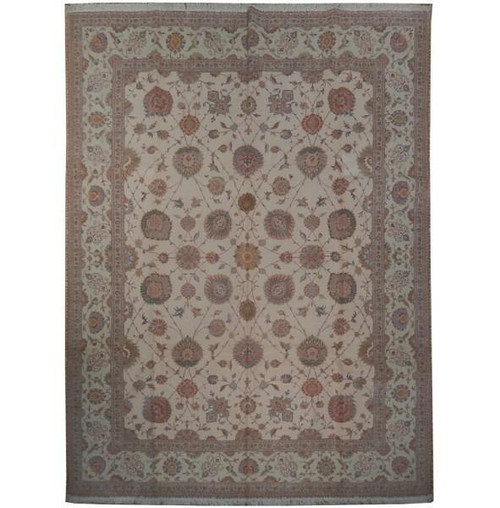
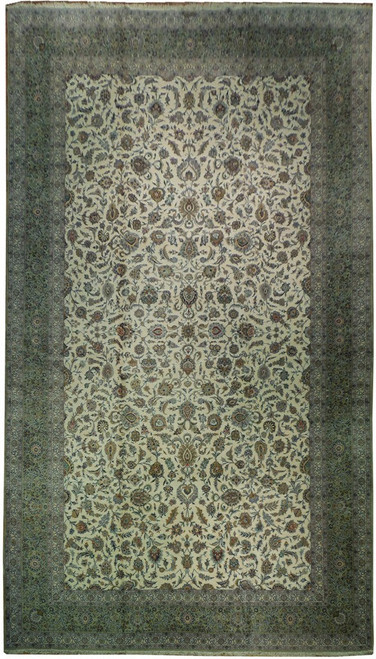
10' x 14'8" Persian Lavar Rug | All-Over Floral Ivory Field | 1950s Fine Wool
This is a mid-century Lavar, woven in the 1950s in fine wool on a cotton foundation and kept in the kind of order that is rare for a rug of this size and age. The ivory field runs unbroken from selvage to selvage with no central medallion, a continuous floral lattice that reads as one uninterrupted piece of drawing across all 176 inches of length. The pile is still full, the fringes are clean and original, and the back tag pinned to the end finish records the piece as a genuine hand woven Persian rug at 10 x 14.8. At 10 feet wide it belongs in a formal dining room or a large living room the way the best 10x14 Persian rugs do, covering the floor rather than floating in the middle of it. It ships with a certificate of authenticity.
Design and Motifs
The field is a true all-over floral design, built from slender arching vines that cross and recross into a wide diamond lattice. Each intersection is pinned by a small rosette, and inside every compartment sits a flowering shrub, a spray of serrated leaves, a curled palmette or a cluster of tiny blossoms, with no two panels repeating in an obvious way. Larger dark palmettes and feathery cypress-like sprays punctuate the field at intervals and give the eye somewhere to rest. The frame is a full multiple border system: a wide main band of palmettes and rosettes, flanked by narrower guard stripes of meandering vine and boteh forms, a second broad band in a softer tone carrying its own rosette rhythm, and a plain outer band at the very edge before the fringe. The corners resolve cleanly, which is the mark of a properly drawn cartoon rather than an improvised one.
Color Palette
The ground is a warm ivory that leans toward cream and light gold under lamplight, and it is that light field that lets the drawing read from across a room. Working over it are two distinct blues, a deep midnight navy in the palmette hearts and a clear medium sky blue in the small rosettes, together with soft sage and pine green in the leaves. Rust and burnt orange appear in short flashes, tulip heads and leaf tips, just enough to warm the whole surface. The main border turns to deep burgundy with ivory outlining, while the outer band shifts to a dusty salmon rose that lifts the corners, and the very edge finishes in a plain camel gold before the ivory fringe. Touches of pale mauve, dove grey and white dot the flower centers. The overall effect is a multi-colored palette held together by the ivory, which is why this rug sits comfortably with both antique wood and contemporary upholstery.
Origin and Weaving Quality
Lavar is the name the trade has always given to the finest drawing out of the Ravar district north of Kerman in southeastern Persia, and it describes a level of work rather than a village style: tighter knotting, more delicate vine work and a softer palette than standard Persian Kerman rugs. That is exactly what shows here. The wool is fine and lustrous, spun thin enough to carry outlines only 1 or 2 knots wide, which is what makes the tiny rosettes and leaf tips legible at all. The back is even and tightly packed on a cotton foundation, with straight sides and square corners that have not shifted in more than 70 years. Buyers who want to understand how a mid-century piece like this is placed in time can read our guide on how to date an oriental rug. Weaving a 10 by 15 piece at this density is the work of several people over a year or more, and it is the reason the rug still has decades of use ahead of it.
10' x 14'8" Persian Lavar Rug | All-Over Floral Ivory Field | 1950s Fine Wool
Ask about this rug
This piece is the only one of it, so the things worth knowing about it are particular to it. If you want to talk through the size, the colour in your own light, or the weave, speak to someone here first.