Watch the film
| Size in ft: | Width: 9'3" x Length: 13'4" |
| Size in Inch: | Width: 111" x Length: 160" |
| Size in meters: | Length: 4.06 x Width: 2.82 m |
| Colors: | Ivory, Sky Blue, Navy Blue, Gold, Camel, Rust |
| Shape: | Rectangular |
| Woven: | 100% Hand-knotted | Handmade |
| Foundation: | Cotton |
| Pile: | 3/8" Wool |
| Design: | Kashan | All Over Floral | Camel Main Border |
| Origin: | Persian Kashan | Made in Persia |
| Condition: | Excellent | Even pile throughout |
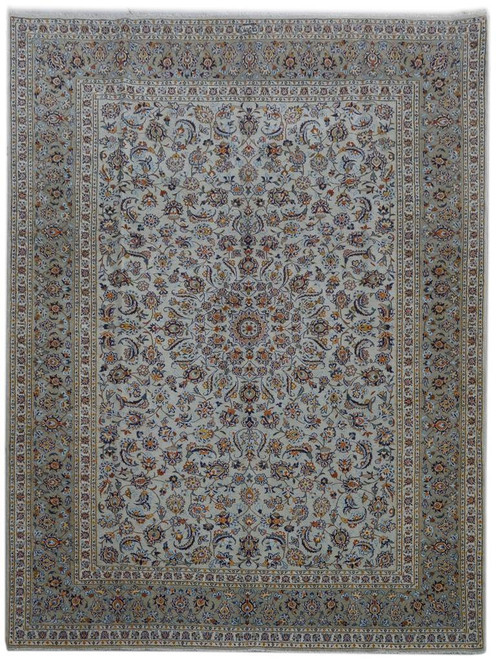
9'3" x 13'4" Persian Kashan Rug | Ivory All Over Floral Field | Fine Wool, Excellent Condition
Most Kashan rugs that reach the American market are red with a navy medallion, so an ivory ground piece of this scale is the less common half of the tradition. This one measures 9'3" x 13'4", hand-knotted in fine wool on a cotton foundation, and it covers a room rather than floating in the middle of it, which puts it squarely among large Persian rugs that anchor a full seating group. The pile stands at a full 3/8", even from end to end, with clean selvages and original fringe, and the wool still carries the soft sheen that good Kashan fleece keeps for decades. If you want the background on how these pieces are drawn and graded, our guide to Persian Kashan rugs covers it in detail. A certificate of authenticity is issued with the rug, confirming origin, materials and hand-knotted construction.
Design and Motifs
There is no central medallion here. Instead the weaver has run an all over floral system across the whole field, built from thin dark vines that loop and cross in mirrored pairs, carrying large lobed palmettes, serrated sickle leaves, small 8 petal rosettes and tight bouquets that read almost like blossom clusters up close. The repeat is symmetrical along both axes, which is why the pattern still looks organized from across a room even though no two adjacent flowers are quite identical. The main border sits on a camel ground and runs a classic turtle palmette and vine sequence, each unit centered on a starburst rosette with curling leaves reaching into the corners, and the corners themselves are resolved cleanly rather than cut off. Three guard stripes flank it on each side: a reciprocal rosette band, a fine vine stripe, and an outer navy line that frames the whole composition. It is a formal, drawn design rather than a village improvisation, and the curved line work in the vines is where the drawing quality shows.
The Ivory Ground and Its Blue Palette
The field is a warm ivory, closer to cream than to stark white, and it takes light well enough that the ground itself changes tone as you walk around the rug. Over it the weaver works a full ladder of blues: deep navy for the vine outlines and the darkest palmette hearts, a medium cornflower blue for the large flower heads, and a pale powder blue and soft blue grey for the leaf work and the inner petals. Gold and saffron supply the warmth, appearing as ring outlines around the palmettes, as small spade shaped blossoms and as accents that keep the blues from reading cold. Tiny red and rust dots mark flower centers, and a soft brown turns up in the leaf stems. The camel main border is the piece that ties it together, reading as tan against the ivory field rather than competing with it. Practically, this is a pale rug that sits well with wood floors, cream walls, blue upholstery and brass or antique gold hardware.
Kashan: The Town and the Weave
Kashan sits in central Persia, north of Isfahan on the edge of the desert, and its workshops trace back to the Safavid court weaving of the 16th century. The town built its reputation on two things: soft, lustrous local wool that holds dye beautifully, and a disciplined workshop system where a designer draws the cartoon and the weavers follow it knot for knot, which is how a rug this size keeps its symmetry over 13 feet of length. That formality is why Kashan became the default Persian rug in American interiors, and why, when you watch Shark Tank, there is a Persian Kashan on the floor. On the back of this piece the knotting is tight and regular, the rows are straight, and the design reads clearly from the reverse, all signs of a well supervised weave rather than a loose commercial one. Combined with the full pile and the cotton foundation, it is a rug built to be walked on for another generation.
9'3" x 13'4" Persian Kashan Rug | Ivory All Over Floral Field | Fine Wool, Excellent Condition
Ask about this rug
This piece is the only one of it, so the things worth knowing about it are particular to it. If you want to talk through the size, the colour in your own light, or the weave, speak to someone here first.