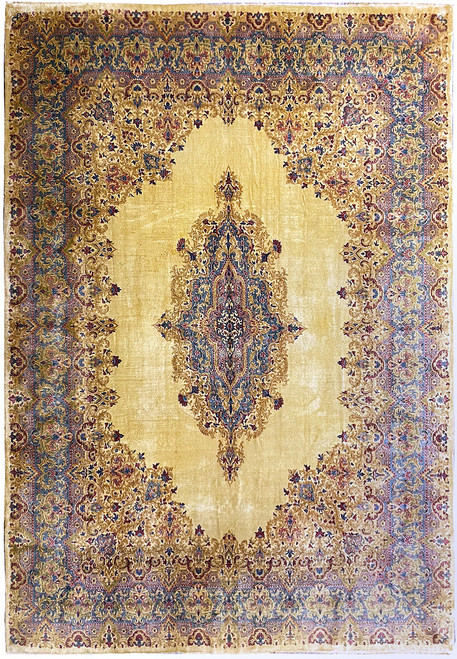
| Size in ft: | Width: 11' x Length: 17'4" |
| Size in Inch: | Width: 132" x Length: 208" |
| Size in meters: | Length: 5.28 x Width: 3.35 m |
| Colors: | Ivory, Blue, Green, Pink |
| Shape: | Rectangular |
| Woven: | Hand-Knotted |
| Pile: | Wool |
| Origin: | Persia |
| Design: | Lavar Kerman |
| Age: | 1940's |
| Condition: | Excellent |
11' x 17'4" Persian Kerman Rug | Lavar All-Over Floral Design | Circa 1940s
This is a true room-filling Persian Kerman from the 1940s, woven in the Lavar manner with a densely flowering ivory field and no central medallion, so the drawing runs uninterrupted from border to border across 11' x 17'4". Pieces this long and this old rarely survive with an even pile and original ends, and this one has both: the wool still has depth underfoot and the fringe and selvedges are the ones the weavers finished. It sits squarely in the group of oversize Persian rugs that were commissioned for long formal rooms, and it ships with a certificate of authenticity confirming age, origin and hand-knotted construction.
Please Note About the Photographs:
The first studio image reads cooler and more purple than the rug looks in person; the warehouse photographs taken on the floor show the true ivory ground and the warmth of the rose and blue. The faint straight lines crossing the field in the full-length shots are fold impressions from flat pallet storage, not wear, not fade and not damage. They relax once the rug is laid flat, and every rug is professionally steamed and pressed before it ships.
Design and Motifs
The field is a continuous garden: curling acanthus leaves, fan shaped palmettes, sprays of small rosettes and large boteh paisleys that unroll along serpentine vines, all mirrored across both the long and short axes so the composition balances from any seat in the room. Look closely at the detail shots and you can see how the drawing is built in layers, with a feathered blue leaf laid over a rose ground, then outlined in dark navy so it separates cleanly, then filled with tiny 5 petal flowers in gold, green and cream. The main border carries a procession of cartouche shaped ivory panels holding dark floral bouquets, separated by lobed rosettes, and is framed by narrow navy guard stripes with a running vine. There is no medallion and no open ground, which is the Lavar signature: the weaver committed to an all-over scheme and kept the density even for more than 17 feet.
The Ivory, Rose and Blue Palette
The ground is an ivory to soft cream that warms toward oatmeal where the pile catches the light, and against it the weaver ran an unusually wide rose family: deep raspberry and magenta in the larger leaves, a clear mid pink in the rosettes, and a dusty salmon pink in the border panels. The blues are just as varied, from a dark indigo used for outlining, through a mid denim blue in the palmettes, to a pale sky and soft teal that lift the border corners. Bottle green and moss green appear in the small leaves, with saffron gold and apricot used sparingly as accent notes at the heart of the big palmettes, and small touches of aubergine and chocolate brown in the flower centers. Aged eight decades, the dyes have settled into one another rather than competing, which is why the overall read from across a room is a warm ivory and rose glow rather than a busy multicolor.
Kerman Weaving and the Lavar Tradition
Kerman sits in southeast Persia and has been a workshop city for centuries, known for finely drawn curvilinear designs, pictorial and garden borders, and a soft lustrous wool that takes pink and rose dyes better than almost any other Persian wool. Lavar, the village north of the city, gave its name to the finest grade of the weave, and pieces in that tradition are drawn on paper cartoons by a designer and executed by a team on a single long loom, which is what allows an all-over pattern to stay in register across a rug this size. The back photograph shows a tight, regular knot with clear definition of every small flower, laid on a cotton foundation, and the pile depth in the rolled edge shot tells you how much wool is still there. If you want to understand what puts a piece like this in the 1940s, our guide on how to date an antique Oriental rug walks through the same clues we used here, and more antique work from the city sits in our Persian Kerman rugs collection.
11' x 17'4" Persian Kerman Rug | Lavar All-Over Floral Design | Circa 1940s
Ask about this rug
This piece is the only one of it, so the things worth knowing about it are particular to it. If you want to talk through the size, the colour in your own light, or the weave, speak to someone here first.