


Watch the film
| Size in ft: | Width: 10'10" x Length: 17'4" |
| Size in Inch: | Width: 130" x Length: 208" |
| Size in meters: | Length: 5.28 x Width: 3.30 m |
| Colors: | Ivory, Rose, Blue, Green |
| Shape: | Rectangular |
| Woven: | 100% Hand-knotted | Handmade |
| Foundation: | Cotton |
| Pile: | |
| Age: | Circa 1930s | Antique |
| Design: | Lavar Kerman | All-over boteh and floral | No medallion |
| Origin: | Persian Kerman | Made in Persia |
| Condition: | Excellent | Even pile throughout |
10'10" x 17'4" Persian Kerman Rug | Lavar All-Over Boteh Design | Antique Circa 1930s
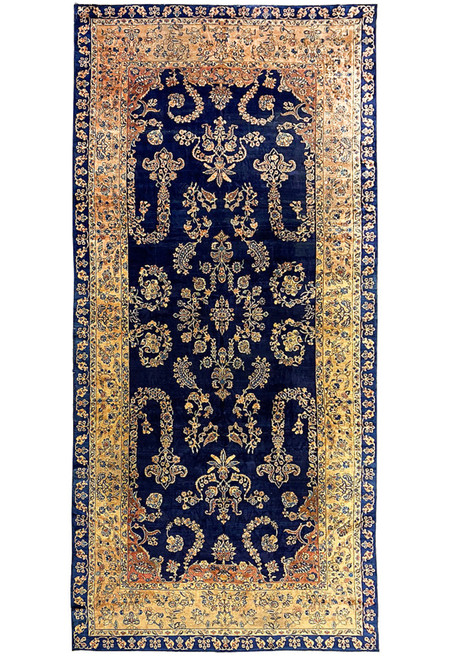
This is a genuine room-filling antique from the 1930s, woven in southeast Persia in the Lavar manner that Kerman weavers reserved for their most finely drawn work. The ivory ground runs the full 208 inches without a medallion or a repeat break, filled instead with curling boteh, palmettes and flowering vine that read as one continuous composition. Wool of this age has a particular quality: the 3/8" pile has settled and polished with use, so the rose and indigo catch light differently as you walk around it. Among oversize Persian rugs a piece this wide and this old in excellent condition is uncommon, and it ships with a certificate of authenticity.
Please Note About the Photographs:
The first photograph was shot flat under strong studio light, which lifts the ivory ground and flattens the rose and blue. The floor images that follow were taken in daylight and show the truer, deeper coloring of the pile. This is a difference in lighting, not fading, wear or damage.
Design and Motifs
The field is a true all-over design with no central medallion. Large boteh, the curved paisley form, are set in staggered rows across the ivory ground, each one outlined in a contrasting tone and packed with miniature rosettes, carnations and serrated leaves so that the motif reads as a garden folded into a teardrop. Between them run split palmettes, eight and ten petal rosettes and thin scrolling vines that tie every element to the next. The main border repeats the same vocabulary at larger scale, with oversized paisleys and fan-shaped palmettes on a darker ground, framed by narrow guard stripes of blossom and leaf. A pale outer stripe finishes the edge, which is what gives the rug its clean stop against a floor. There is no strapwork, no lattice and no geometry here: the drawing is entirely curvilinear, and holding those curves consistently over 208 inches of length is the part that takes a good workshop.
A Palette Built on Ivory, Rose and Indigo
The ground is a warm ivory that shades toward cream and, in places, toward pale honey where the wool has taken the dye unevenly, the gentle abrash you expect in a rug of this age. Over it the weavers laid an unusually broad range of rose: shell pink, coral, a clear raspberry and a deeper wine that anchors the larger paisleys. Blue does the structural work, moving from a deep indigo in the border ground to mid cornflower and a soft teal in the flower heads. Green appears as a quiet sage along the outer stripe and in the leaf forms, cooling the pinks rather than competing with them. Small quantities of old gold, camel and chocolate brown run through the vine work and the outlines, and it is those darker accents that keep such a pink-heavy palette from turning sweet. The overall effect in a room is light: ivory dominates from standing height, and the color reveals itself as you get closer.
Kerman Weaving in Southeast Persia
Kerman sits in the southeast of Persia, and its workshops have been drawing floral and pictorial designs for the export trade since the 19th century. The Lavar name comes from Ravar, the town north of Kerman city whose weavers were credited with the finest drawing and the highest knot counts in the region, and the term has long been used for Kerman pieces of this calibre. The 1930s were the high point for this work: asymmetric knots on a cotton foundation, local wool that is naturally soft and takes dye deeply, and enough knots per square inch to hold a curved line without the motif breaking into steps. The reverse photograph shows the result, an even, tight back where the pattern is fully legible from underneath. Palette, drawing and construction all point to the same period, and our guide on how to date an oriental rug sets out the same markers we used here.
10'10" x 17'4" Persian Kerman Rug | Lavar All-Over Boteh Design | Antique Circa 1930s
Ask about this rug
This piece is the only one of it, so the things worth knowing about it are particular to it. If you want to talk through the size, the colour in your own light, or the weave, speak to someone here first.
Related rugs
-

-

-

-

-
8'9 x 19'6 Persian Kerman Lavar Rug
$18,000.00