Watch the film
| Size in ft: | Width: 4'6" x Length: 7'1" |
| Size in Inch: | Width: 54" x Length: 85" |
| Size in meters: | Length: 2.16 x Width: 1.37 m |
| Colors: | Ivory, Green, Red, Blue, Brown |
| Shape: | Rectangular |
| Woven: | 100% Hand-knotted | Handmade |
| Foundation: | 100% Cotton |
| Pile: | |
| Age: | Circa 1940s | Antique |
| Design: | Paisley Lavar | Allover Boteh | Floral Border |
| Origin: | Persian Lavar Kerman | Made in Persia |
| Condition: | Excellent | Even pile throughout |
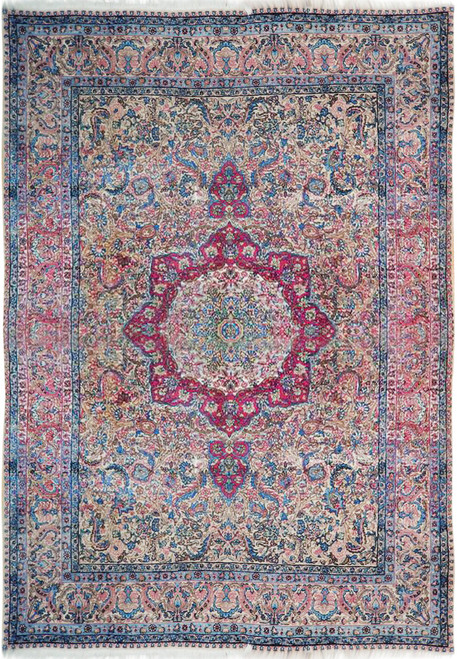
4'6" x 7'1" Persian Lavar Kerman Rug | Allover Paisley Boteh Design | 1940s Antique
This 4'6" x 7'1" Persian Lavar rug left the loom in the 1940s and has come through eight decades with its pile still even from end to end and its ivory ground still bright rather than yellowed. The whole field is given over to rows of paisley boteh, drawn small and packed tight, which is the kind of patience-heavy pattern that separates a workshop piece from a village one. At just over 4 and a half feet by just over 7 feet it fits the standard 5 x 7 Persian rug footprint, which makes it usable in front of a sofa, at the foot of a bed or as the one antique piece in an otherwise plain room. It ships with a certificate of authenticity documenting its origin, age, materials and hand-knotted construction.
Design and Motifs
The field carries an allover boteh, the teardrop paisley that Persian weavers have used for centuries, set in staggered rows of 6 across so that each curved tip leans into the next. Every paisley is outlined twice, first with a striped dark spine in brown and red, then with a feathered sage green edge that reads almost like a cypress frond, and the interior of each one holds its own miniature bouquet of red and blue blossoms. The spaces between are not left empty: small flowering sprigs, buds and leaf tips fill the ivory ground so the surface never goes flat. A narrow red vine stripe separates the field from the main border, which runs a repeating flowering plant, pink blossoms rising from a leafy base, alternating with a small sideways paisley. Outer and inner guard bands of red carry linked rosettes in blue, ivory and gold, and the 4 corners are resolved cleanly rather than cut off mid-motif, a sign the cartoon was drawn properly for this exact size.
Ivory, Sage Green and Crimson
The ground is a warm ivory, closer to unbleached cream than white, and it has picked up the faint honey tone that old undyed wool takes on. Over it the drawing works in a restrained palette: sage and olive green for the feathered paisley outlines and leaf work, crimson and a deeper oxblood red for the blossom centers and the striped spines, teal and soft cornflower blue for the rosettes and scattered flower heads, and dark chocolate brown reading almost black where the paisleys are outlined at their darkest. The borders reverse the balance, with strong true red ground bands framing an ivory main border, so the rug has a clear red frame from a distance and dissolves into fine multicolor detail up close. Touches of saffron gold appear in the rosette centers and give the ivory areas a little warmth. Nothing here is loud, which is why the rug sits comfortably with green, navy, wood tones and cream walls alike.
Lavar Weaving in Southeast Persia
Lavar, also written Laver or Ravar, is the weaving town north of Kerman in southeast Persia whose name has long been attached to the finest work of the Kerman region. The distinction is real: Lavar pieces are woven at a higher knot count than standard Kerman production, with a shorter clipped pile that lets a small motif like this boteh hold its shape instead of blurring. The wool of the region is soft and takes dye evenly, which is why the greens and reds here have aged together rather than one fading ahead of the others. The weave is fine and regular on a cotton foundation, the back is clearly legible motif for motif, and the selvages and ivory end fringes are original. The 1940s dating is consistent with the palette, the drawing style and the wear pattern, the same evidence used to date an Oriental rug when no signature cartouche is present.
4'6" x 7'1" Persian Lavar Kerman Rug | Allover Paisley Boteh Design | 1940s Antique
Ask about this rug
This piece is the only one of it, so the things worth knowing about it are particular to it. If you want to talk through the size, the colour in your own light, or the weave, speak to someone here first.