Watch the film
| Size in ft: | Width: 6'3" x Length: 14'3" |
| Size in Inch: | Width: 75" x Length: 171" |
| Size in meters: | Length: 4.34 x Width: 1.91 m |
| Colors: | Raspberry Red, Dark Brown, Sage Green, Ivory, Gold, Apricot, Blush Pink, Charcoal |
| Shape: | Rectangular |
| Woven: | 100% Hand-knotted | Handmade |
| Foundation: | 100% Cotton |
| Pile: | |
| Age: | Antique |
| Design: | Kerman | All Over Boteh Paisley | Floral Main Border |
| Origin: | Persian Kerman | Made in Persia |
| Condition: | Excellent |
6'3" x 14'3" Persian Kerman Gallery Rug | Antique All Over Boteh Paisley | Sage and Charcoal Borders
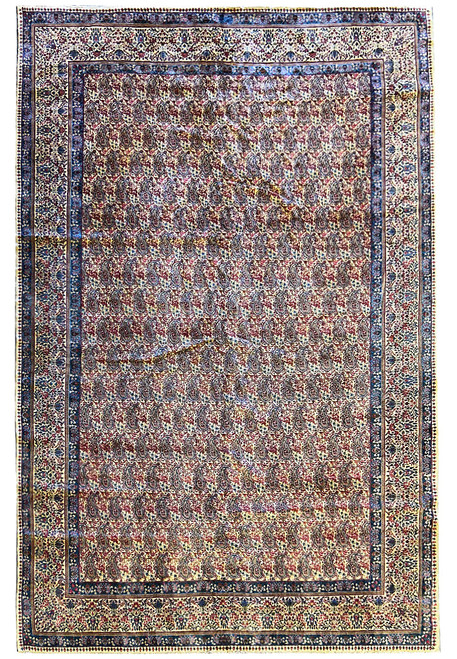
At 6'3" x 14'3" this antique Persian Kerman is a gallery carpet, long and narrow in the way that older Persian city pieces were woven for corridors, long reception rooms and the sides of a large hall. The pile is hand-knotted wool on a cotton foundation, and the field is given over entirely to rows of boteh, the paisley cone, drawn small and repeated up the full 14'3" length against a raspberry red ground. Nothing about it is a reproduction of a current pattern: the slight wander in the rows, the way no two boteh share the same pair of colors, and the softened tone of the wool all read as an older piece that was well kept. It arrives with a certificate of authenticity.
Design and Motifs
The field is an all over boteh design with no medallion and no open ground to interrupt it. Each cone is outlined in a contrasting shade, filled with a small 8 petal rosette or a cluster of blossoms, and tipped with a hooked curl that leans consistently to one side across each row, then answers back in the row above. Small pendant buds sit in the spaces between cones so the ground never reads as empty. The main border changes register completely: on a dark brown, almost black ground, large palmettes, rosettes and serrated leaves march between angular vine work, a broad and confident drawing that frames the busy field rather than competing with it. Two guard stripes on either side, one carrying a reciprocal zigzag and one a small running flower head, separate field from border and give the long sides a finished, deliberate edge.
A Raspberry Red Field Against Dark Brown and Sage
The ground is a cool raspberry red rather than a hot tomato red, the kind of tone that comes from natural dye settling over decades, and it shifts gently in bands of lighter and deeper red across the width. Inside it the boteh are worked in ivory, wheat gold, apricot, sage green, soft blush pink, mushroom brown, pale slate and deep charcoal, so the field reads as a quiet multicolor from a distance and as a catalogue of individual small paintings up close. The main border is the darkest element in the rug, a brown so deep it passes for black in shadow, lit from within by coral, yellow gold and celadon flower heads. The guard stripes bring in a pale blue green and a dusty rose that pick up the lighter boteh and carry them out to the selvage. Against a wood floor the overall impression is warm, aged and soft, with no harsh contrast anywhere.
Kerman Weaving in Southeast Persia
Kerman sits in the southeast of Persia and built its reputation on drawing and dyeing rather than on raw knot count, with city workshops producing floral, pictorial and repeat patterns for the export trade for well over a century. The boteh repeat seen here is one of the older Kerman formulas, and it demands discipline: every cone has to hold its place in the row while carrying a different color scheme from its neighbors. The wool is fine and long stapled, still with life in it, and the reverse shows an even, tightly packed weave with the pattern reading clearly through to the back, which is how a well made city piece from this region should look. Colour depth, wear pattern and the softened palette are exactly the traits used to date an oriental rug, and on this Kerman they all point the same way.
6'3" x 14'3" Persian Kerman Gallery Rug | Antique All Over Boteh Paisley | Sage and Charcoal Borders
Ask about this rug
This piece is the only one of it, so the things worth knowing about it are particular to it. If you want to talk through the size, the colour in your own light, or the weave, speak to someone here first.