Watch the film
| Size in ft: | Width: 9'9" x Length: 15'10" |
| Size in Inch: | Width: 117" x Length: 190" |
| Size in meters: | Length: 4.83 x Width: 2.97 m |
| Colors: | Ivory, Blue, Red |
| Shape: | Rectangular |
| Woven: | Hand-Knotted |
| Origin: | Persia |
| Design: | Kerman |
| Condition: | Excellent |
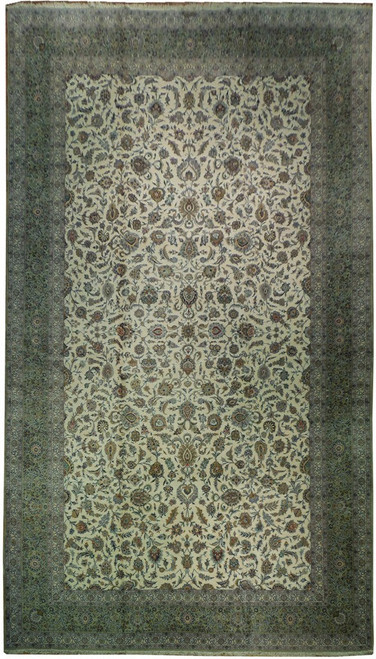
9'9" x 15'10" Persian Kerman Rug | All Over Paisley Boteh on Ivory | Signed Cartouche
A rug this long has to earn its scale, and this one does it with density rather than drama. The whole ivory field is covered in paisley, and each hooked form holds its own small garden of rose and blue blossoms, drawn with the patience that only a workshop cartoon and a slow loom produce. The wool is soft and lustrous in the hand, the pile is still full, and a woven cartouche sits in the light blue outer border, which tells you a named weaver signed off on the work instead of turning out an anonymous commercial piece. At 9'9" x 15'10" it belongs with genuine oversize Persian rugs, the group that finally reaches wall to wall in a formal living room or a long dining room. It ships with a certificate of authenticity recording origin, materials and measurements.
Please Note About the Photographs:
The two overhead photographs show faint diagonal lines running across the field. Those are fold shadows from storage on a pallet. They are not wear, not fading and not damage. They relax out once the rug is laid flat, and every rug is professionally steamed and pressed before it leaves us.
Design and Motifs
There is no medallion here. Rows of boteh paisley run the full 15'10" length, each one outlined in navy and slate blue and packed with tiny rose, raspberry and pale blue flower heads, while a mille fleur scatter of small blossoms and feathery leaves closes every gap between them. That makes it a true all over paisley design, readable from any side of the room, which matters on a piece long enough to be walked around rather than viewed from one end. Three borders frame the field: a narrow blue guard of paisleys and rosettes, a wide ivory main border of flowering vases, open roses and curling vine, and an outer slate blue band that picks the paisley theme back up. Thin gold and salmon vine stripes separate them, and an ivory row of upright buds finishes the very edge, so the frame steps down in scale instead of stopping abruptly.
Color: Warm Ivory, Rose Red and Sky Blue
The ground is a buttery ivory that reads closer to cream and old gold in raking light than to any cold white, and that warmth is what keeps the rest of the palette soft rather than loud. The paisleys carry raspberry rose alongside a deeper madder red, held in place by navy and mid blue outlines, with teal green leaves, small hits of apricot and saffron gold, and ice blue flower centers that lift the surface where the drawing gets busiest. The wide main border repeats the ivory ground, while the inner and outer bands move to a dusty sky blue that has settled toward slate in places, the natural abrash of hand-dyed wool rather than any flaw. For anyone comparing ivory Persian rugs against mixed upholstery, this one is unusually easy to live with: red and blue both appear in quantity, and neither takes over.
Kerman Weaving in Southeast Persia
Kerman sits in southeast Persia, an oasis city whose weavers built their reputation on drawing flowers rather than geometry, and on the pictorial garden borders that are still the surest Kerman tell. The local wool is fine and takes dye with a soft sheen, which is why a Kerman field keeps this much detail without looking hard. Large formats like this were woven on wide workshop looms from a full cartoon, with several weavers working shoulder to shoulder across the width, and the reverse shows exactly that discipline: a fine, even cotton foundation, small clean knots and pattern lines that stay true across nearly 16 feet. The signed cartouche in the outer border puts a workshop behind it. If you want to understand what the dyes, wool and back structure say about when a piece like this was made, our guide on how to date an Oriental rug walks through the same markers this weave shows.
9'9" x 15'10" Persian Kerman Rug | All Over Paisley Boteh on Ivory | Signed Cartouche
Ask about this rug
This piece is the only one of it, so the things worth knowing about it are particular to it. If you want to talk through the size, the colour in your own light, or the weave, speak to someone here first.