Watch the film
| Size in ft: | Width: 9'10" x Length: 12'8" |
| Size in Inch: | Width: 118" x Length: 152" |
| Size in meters: | Length: 3.86 x Width: 3.00 m |
| Colors: | Ivory, Cream, Light Blue, Slate Blue, Salmon, Soft Green, Navy, Brown, Gold |
| Shape: | Rectangular |
| Woven: | 100% Hand-knotted | Handmade |
| Foundation: | Cotton |
| Pile: | 3/8" Wool | 100% Wool |
| Age: | Circa 1970s | Approx. 50 years old |
| Signature: | Signed | Woven cartouche in the lower border |
| Design: | Kashan Paisley | All-Over Boteh | Multiple Borders |
| Origin: | Persian Kashan | Made in Persia |
| Condition: | Excellent |
9'10" x 12'8" Persian Kashan Rug | All-Over Paisley Boteh on Ivory | Signed, 1970s
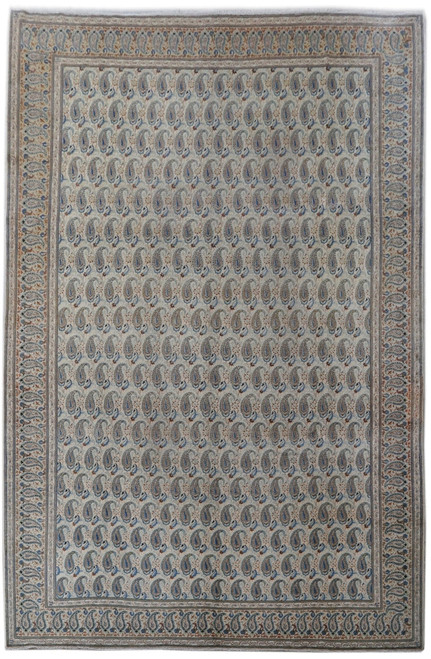
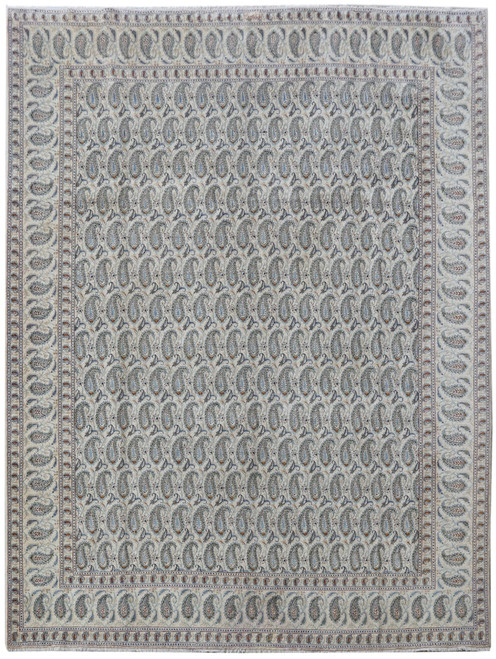
Most Kashan rugs that reach the market repeat the same formula: red field, navy medallion, ivory corners. This one does not. It is a signed Persian Kashan from the 1970s, hand-knotted in wool on a cotton foundation, and the weaver filled the entire 9'10" x 12'8" field with rank after rank of paisleys on a pale ivory ground instead. A woven cartouche sits in the lower border, which tells you this came off a named workshop loom rather than an anonymous production line. The 3/8" pile is even from end to end and the drawing stays crisp in every photograph, which is why the condition reads excellent at roughly 50 years old. It is a genuinely quiet room-size piece, one of the easier 10x13 Persian rugs to live with in a light-walled room, and it ships with a certificate of authenticity confirming origin, materials and hand-knotted construction.
Design and Motifs
The field is a true all-over design, built from the boteh, the teardrop paisley that Persian weavers have drawn for centuries. Each large boteh carries a triple outline, a cream halo and a dark inner cavity strung with small round beads, and each one leans the same direction within its row while alternate rows tip the other way, so the whole field reads as gentle movement rather than a rigid grid. Between the large paisleys the weaver tucked smaller sideways botehs, curling tendrils, 4 petal star flowers in deep brown and thin vine work that links one row to the next. The border scheme is layered: a wide main band of big open paisleys marching head to tail, flanked by narrow guard stripes of miniature botehs, a fine dotted line and a delicate serrated inner stripe. Look at the corner photograph and you can see the border paisleys resolve cleanly at all 4 corners, which is fussy work and a fair indicator of a drawn cartoon followed carefully.
A Palette of Ivory, Soft Blue and Salmon
The ground is ivory moving toward oatmeal cream, and because the wool has the lustre Kashan is known for it shifts between warm and cool depending on where the light falls. Everything drawn on top of it is restrained. The paisley outlines run light powder blue and slate blue, the halos around them are chalk cream, and a soft salmon or dusty rose line traces the outer edge of many of the larger botehs, which is what keeps the rug from feeling cold. Sage and soft green appear in the small leaves, deep navy fills the beaded centers, and there are pinpoints of chocolate brown and a little muted gold scattered through the field and border stripes. There is no red field, no strong contrast, no single dominant note: the overall impression at standing height is a hazy pale blue-ivory, with the detail only resolving as you walk up to it. That makes it unusually easy to place against white, greige or pale plaster walls, and it sits under light oak and walnut furniture without fighting either.
Kashan: The Weaving Town and the Weave Itself
Kashan sits in central Persia, north of Isfahan, and its weaving pedigree runs back to the Safavid court workshops. The town has always had two advantages: soft, lustrous local wool and a workshop culture disciplined enough to weave from a drawn cartoon rather than from memory, which is the only way a repeating paisley of this scale stays in register across nearly 13 feet. Kashan is also the Persian rug most Americans have already seen without knowing it. When you watch Shark Tank there is a Persian Kashan on the floor. On the back of this piece the knot rows are tight and regular, the cotton warps sit straight, and the modest 3/8" pile height is typical of a workshop weave where the knot count matters more than the plush. The woven cartouche is in Persian script and names the workshop or weaver, and a signature on a 1970s Kashan of this size is the difference between a decorative rug and a documented one.
9'10" x 12'8" Persian Kashan Rug | All-Over Paisley Boteh on Ivory | Signed, 1970s
Ask about this rug
This piece is the only one of it, so the things worth knowing about it are particular to it. If you want to talk through the size, the colour in your own light, or the weave, speak to someone here first.