Watch the film
| Size in ft: | Width: 9'8" x Length: 14' |
| Size in Inch: | Width: 116" x Length: 168" |
| Size in meters: | Length: 4.27 x Width: 2.95 m |
| Colors: | Ivory, Green, Blue, Red |
| Shape: | Rectangular |
| Woven: | 100% Hand-knotted | Handmade |
| Foundation: | Cotton |
| Pile: | |
| Age: | 1980's - 2000's |
| Design: | Kerman Floral | Allover Boteh | Star Medallion |
| Origin: | Persian Kerman | Made in Persia |
| Condition: | Excellent |
9'8" x 14' Persian Kerman Rug | Ivory Allover Boteh & Vase Field | 1980s to 2000s
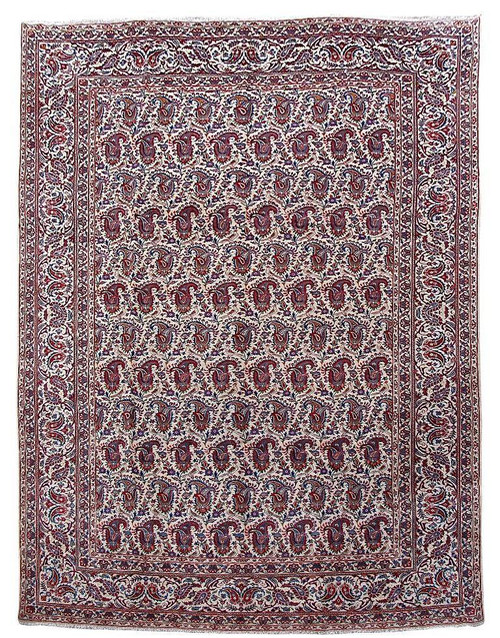
Kerman weavers built their reputation on drawing flowers rather than geometry, and this 9'8" x 14' example shows why. The field is a quiet ivory, clipped low so the wool reads almost like a painted surface, and across it sits a scattered garden of boteh, small flowering vases and delicate sprays that all radiate from one star rosette at the center. It is a room-size piece in the classic proportion most buyers searching 10 x 14 Persian rugs are after, wide enough to carry a full seating group or a long dining table with the chairs staying on the wool. Condition is excellent, the pile is even from end to end, and the rug ships with a certificate of authenticity confirming it as a hand-knotted piece woven in Persia.
Design and Motifs
The layout is an allover field anchored by a single 8 petal star rosette medallion, drawn without a hard outline so it emerges from the surrounding flowers rather than sitting on top of them. Around it the weaver worked concentric rings of boteh, some upright and slender, others full and curling, each one filled with its own miniature floral interior. Between the boteh are flowering vases on little plinths, bouquets of carnation and rosette heads, and thin feathered leaf sprigs that fill the ivory ground without crowding it. The drawing is mirrored along both axes, so the top and bottom halves answer each other exactly. Three borders frame the field: a broad main band of paired boteh, cypress forms and scrolling vine on a salmon ground, a saffron gold inner stripe with small blossoms, and an outer guard of rosette and leaf vine finished in deep madder red. The corners are resolved cleanly, with the border motifs turning rather than simply stopping at the miter.
Ivory Ground With Raspberry, Green and Blue Detail
The field is a warm ivory with a faint oatmeal cast, the kind of undyed cream that reads lighter under lamplight and softer in daylight. Against it the weaver placed raspberry and crimson as the leading accent, moving to a deeper madder red in the outer border and to pale rose and blush pink inside the larger boteh. Green does a great deal of work here: apple and sage tones in the leaf sprays, and a cooler olive in the border vine and the medallion petals. The blues split between a dark indigo used for outlining flower heads and a clear sky blue that lifts the smaller blossoms. Saffron gold appears in the inner stripe and in scattered flower centers, while the main border ground shifts to a salmon peach that separates the ivory field from the red outer frame. Fine chocolate brown outlining keeps every motif crisp, and the overall effect is a light, multi-colored rug that sits comfortably with cream walls, dark wood floors and burgundy or navy upholstery.
Kerman, Southeast Persia, and the Weave
Kerman sits in the southeast of Persia, a city whose workshops have supplied floral and pictorial garden designs to Western drawing rooms for well over a century, and whose weavers are trained to follow a cartoon line for line. That discipline is what makes a field like this possible: hundreds of separate small motifs, each with four or five colors inside it, all holding their shape at this scale. The rug is knotted in wool on a cotton foundation, with the pile sheared short in the Kerman manner so the curved line stays legible, and the back shows a regular, tightly packed knot across both directions. Fringe and selvedges are intact and the sides are firm. The colors, the clarity of the drawing and the low even shear place it in the later decades of the 20th century, and if you want to understand how weavers, dealers and collectors read those clues, our guide on how to date an Oriental rug walks through the same evidence.
9'8" x 14' Persian Kerman Rug | Ivory Allover Boteh & Vase Field | 1980s to 2000s
Ask about this rug
This piece is the only one of it, so the things worth knowing about it are particular to it. If you want to talk through the size, the colour in your own light, or the weave, speak to someone here first.