Watch the film
| Size in ft: | Width: 8'2" x Length: 11'4" |
| Size in Inch: | Width: 98" x Length: 136" |
| Size in meters: | Length: 3.45 x Width: 2.49 m |
| Colors: | Royal Blue, Ivory, Green, Red |
| Shape: | Rectangular |
| Woven: | Hand-Knotted |
| Pile: | Wool |
| Origin: | Persia |
| Design: | Kerman |
| Age: | 1980's |
| Condition: | Excellent |
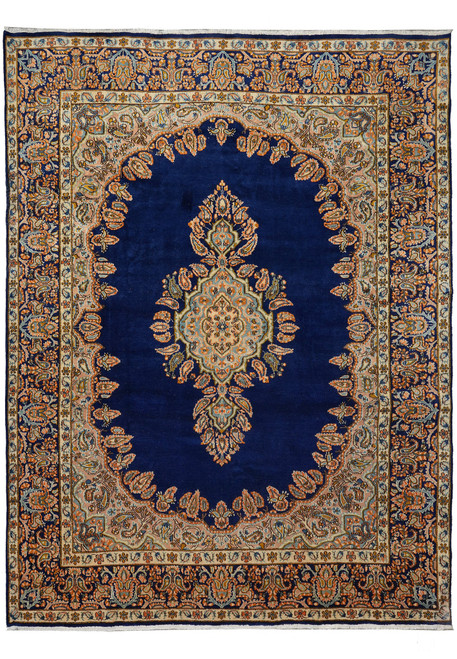
8'2" x 11'4" Persian Kerman Rug | Royal Blue Field with Ivory Medallion | 1980s Wool Pile
Kerman weavers almost always work on an ivory or rose ground, which is exactly why this one stops you. The whole open field is saturated royal blue, and the ivory and rose medallion sits on it the way a piece of jewelry sits on velvet. It is a 1980s workshop piece, hand-knotted in wool on a cotton foundation, with the full even pile, original fringe and intact selvages you want to see in a rug of this age. At 8'2" x 11'4" it covers a standard large room without crowding it, and it is one of the more usable proportions in our 8x11 Persian rugs. Every rug we sell ships with a certificate of authenticity.
Please Note About the Photographs:
The open blue field reads lighter in a few places in the floor photos. That is the pile lying in one direction and catching the showroom lights, together with the slight batch-to-batch variation in hand-dyed indigo wool that weavers call abrash. It is not wear, fade or damage. Walk around the rug and the light patch moves with you. Every rug is professionally steamed and pressed before it ships.
Design and Motifs
The drawing is pure classical Kerman: a single lobed medallion at the center of a cusped, arched field panel, with pendants dropping from the top and bottom points and small hooked finials at each side. The medallion core is a tiny oval cartouche of dark green and blue, ringed by rose and ivory scrollwork that unwinds into curling cloud-band arms. Because the field itself is left completely plain, all the ornament is pushed outward into the reserve panels, where dense rose and brick red vine work fills every inch around the arch and four quartered corner spandrels carry their own small rosette medallions on ivory grounds. The main border is the Kerman garden formula, a repeating march of flowering urns, arched niches and columnar cypress forms in red, ivory and pale blue, held between narrow reciprocal guard stripes of running vine. Look at photo 5 and you can follow one urn motif from its base to the crown of blossoms above it. That controlled, curved line, drawn without a single wobble across 11 feet, is what separates a real city Kerman from an imitation.
A Royal Blue Field Set Against Ivory, Rose and Green
The field is a deep royal blue, closer to true indigo than to navy, with a soft sheen where the wool catches light. Against it, the medallion works in three tones: a cream to ivory outer frame, a rose and raspberry interior, and small hits of olive and moss green in the scrollwork and at the pendant tips. The border zone shifts the balance, leading with rose red and brick red and cooling it with ivory ground, powder blue leaf accents and the same olive green. Tiny points of gold and soft pink appear in the urn blossoms, visible in the corner photograph. The overall effect is warm ornament on a cool, formal ground, which is why a rug like this works as well with dark wood and brass as it does with a modern neutral palette. The reverse in the final image shows the same colors coming through clean and clear knot by knot, a good sign of honest natural dyeing rather than surface treatment.
Kerman: The Weaving City of Southeast Persia
Kerman sits on the high desert plateau of southeast Persia and has been weaving for export since the 17th century, long enough to have built its own design vocabulary of pictorial garden borders, vase compositions and single lobed medallions. Kerman workshops use the asymmetric knot on a cotton warp and weft and favor a slightly longer, silkier wool clip than the northwest villages, which is why a Kerman feels plush underfoot rather than tight and boardy. The weave on the back of this piece is even and regular across the full 98 inch width, with straight, unbroken rows and no pulled corners, the mark of a rug woven on a properly tensioned loom by a workshop team rather than a single village loom. Plenty of Kermans were made in the 1980s; far fewer were ordered on a royal blue ground, and fewer still have survived 40 years with the pile, fringe and edges all still original.
8'2" x 11'4" Persian Kerman Rug | Royal Blue Field with Ivory Medallion | 1980s Wool Pile
Ask about this rug
This piece is the only one of it, so the things worth knowing about it are particular to it. If you want to talk through the size, the colour in your own light, or the weave, speak to someone here first.