Watch the film
| Size in ft: | Width: 8'2" x Length: 11'4" |
| Size in Inch: | Width: 98" x Length: 136" |
| Size in meters: | Length: 3.45 x Width: 2.49 m |
| Colors: | Ivory, Cream, Navy Blue, Light Blue, Gold, Rust, Taupe |
| Shape: | Rectangular |
| Woven: | 100% Hand-knotted | Handmade |
| Foundation: | Cotton |
| Pile: | 3/8" | Wool |
| Signature: | Woven cartouche in the top border | Script not fully legible |
| Design: | Ardakan | Lobed Central Medallion | All Over Floral Vine | 3 Guard Borders |
| Origin: | Persian Ardakan | Made in Persia |
| Condition: | Excellent | Full even pile |
8'2" x 11'4" Persian Ardakan Rug | Ivory Floral Medallion Field | Signed Cartouche
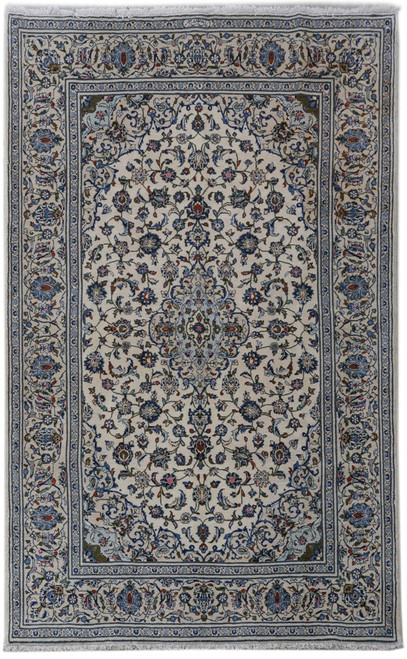
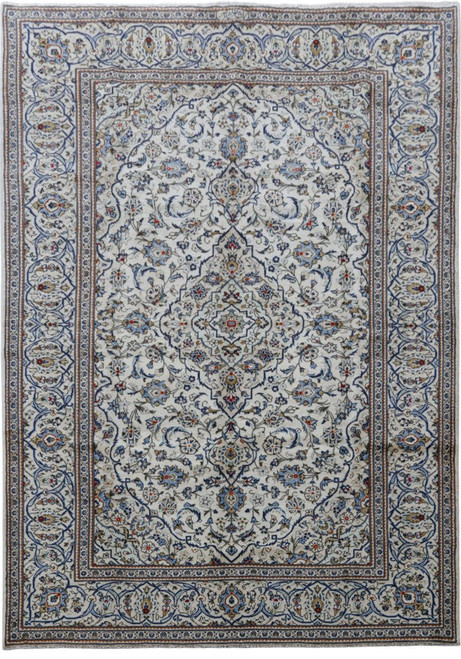
A signed piece at 8'2" x 11'4", this Ardakan is the quiet, light-ground version of the classic central Persian floral formula: an ivory field instead of the usual red, a soft taupe medallion instead of a hard navy one, and drawing fine enough that the vine scrolls hold their curve right to the edge of the border. The pile is 3/8" hand-spun wool on a cotton foundation, still full and even underfoot, and the weaver signed the work in a cartouche woven into the top border. It falls squarely in the most useful of the 8 x 11 Persian rugs footprints, large enough to carry a full seating group without swallowing a room. Every rug ships with a certificate of authenticity.
Please Note About the Photographs:
The full overhead photograph reads a little cooler and greyer than the rug is in person. The close-up and corner images are the truer reading: a warm cream ground with clear gold and rust in the flowers. This is a lighting difference in the studio shot, not fade and not wear.
Design and Motifs
The center holds a lobed, pointed medallion built up in taupe and navy outline, with 8 gold rosettes set into its inner ring and a small cruciform gold motif at the exact middle. Above and below it run matching pendants, and each of the 4 corners carries a spandrel drawn in the same vocabulary, so the layout reads as a medallion design without the field ever going empty. Around all of that the ground is filled with a continuous arabesque of split palmettes, curled saz leaves, open rosettes and small lotus heads, every stem connected to the next rather than floated in isolation. The border system is 3 deep: a wide taupe main band of alternating palmettes and blossoms, flanked by 2 pairs of narrow ivory guard stripes with a running vine and tiny paired leaves. A single cartouche breaks the top border with the weaver's woven signature, the mark of a piece made to be identified rather than sold anonymously.
A Study in Ivory, Navy and Gold
The field is a warm, slightly creamy ivory, the kind that sits comfortably against white oak, limestone and off-white walls without looking bleached. Against it the weaver worked in a restrained palette: deep navy for the outlines, stems and the darkest flower heads, a pale powder blue for the feathered leaf tips, saffron gold for the rosette centers and the thin outline rings, and a muted rust terracotta for the secondary blossoms. The medallion and the main border share a soft mushroom taupe that keeps the whole rug low in contrast, so the pattern is legible from across a room but never loud. Small touches of sage green appear in the leaf work, and a few pale ivory highlights are left almost undyed to lift the flowers off the ground. The overall effect is an ivory and beige Persian rug that behaves like a neutral while still being unmistakably hand-drawn.
Ardakan: Kashan Drawing on the Edge of the Desert
Ardakan is a small town north of Yazd in central Persia, and its weavers work the curvilinear floral cartoons associated with Kashan to the north. That lineage is written all over this rug: the lobed medallion with pendants, the spandrel corners, the palmette main border and the connected vine field all come out of the same classical school that produced Persian Kashan rugs, and the Kashan weaving tradition is the best reference point for judging what is on the loom here. A curved line only holds if the knot count supports it, and the back of this piece shows tight, regular rows with clean color changes where the vine turns. The hand-spun wool has the dry, durable character of desert flocks and takes a low sheen as it is walked on. Add the signed cartouche and this stops being a generic floral and becomes a traceable workshop weaving.
8'2" x 11'4" Persian Ardakan Rug | Ivory Floral Medallion Field | Signed Cartouche
Ask about this rug
This piece is the only one of it, so the things worth knowing about it are particular to it. If you want to talk through the size, the colour in your own light, or the weave, speak to someone here first.