Watch the film
| Size in ft: | Width: 11'5" x Length: 16' |
| Size in Inch: | Width: 137" x Length: 192" |
| Size in meters: | Length: 4.88 x Width: 3.48 m |
| Colors: | Burgundy, Salmon, Blue, Green, Black, Ivory |
| Shape: | Rectangular |
| Woven: | 100% Hand-knotted | Handmade |
| Foundation: | Cotton |
| Pile: | |
| Age: | Circa 1950s |
| Design: | Antique All Over Floral | Cartouche Border |
| Origin: | Persian Kerman | Made in Persia |
| Condition: | Excellent |
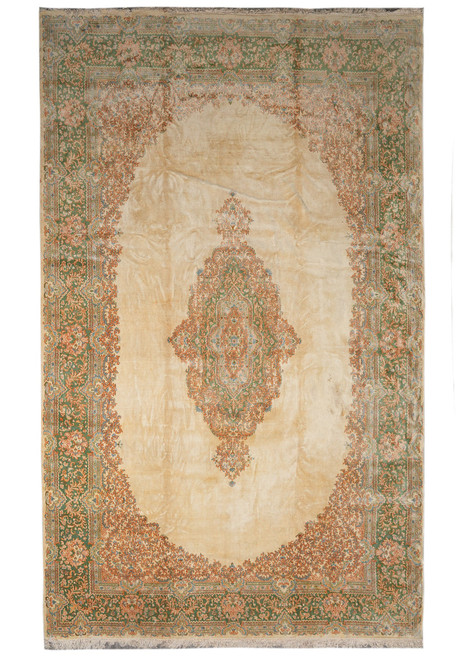
11'5" x 16' Persian Kerman Rug | All Over Floral Design | Circa 1950s Oversize
Pieces this size were woven to fill a room that a standard 9x12 cannot touch, and this one covers 11'5" x 16' of floor with a single continuous drawing. The field is deep burgundy, worked edge to edge with salmon palmettes, curling leaves and small blue blossoms, and the whole composition is framed by a black main border carrying full rose sprays. It was hand-knotted in wool on a cotton foundation around the 1950s, and the pile still has the soft, slightly lustrous handle that Kerman wool is known for. If you are shopping oversize Persian rugs for a great room, a long dining hall or a wide open plan space, this is the kind of piece that settles the room in one move. It ships with a certificate of authenticity from Rugs.net.
Please Note About the Photographs:
A soft diagonal line runs across the field in one of the floor photographs. That is a fold mark from pallet storage, not wear, not fade and not damage. It relaxes out once the rug is laid flat, and every rug we ship is professionally steamed and pressed before it leaves our warehouse.
Design and Motifs
The drawing is an all over floral rather than a single dominant medallion, though a small lobed center in salmon and olive green anchors the middle of the field and repeats in echo at the 4 corners. Around it the weaver ran large scrolling leaves and outsized palmettes, each one outlined in a lighter shade so the shapes read clearly against the dark ground, with clusters of 5 petal and 8 petal blossoms filling every open space between them. The corner spandrels are the boldest passage: broad salmon cartouches loaded with roses and turquoise flowers, edged in navy, that pull the eye out toward the border. The main border is black, the classic Kerman frame, and it alternates rose spray cartouches with palmette panels in pink, gold and pale blue. Two narrow guard stripes on either side, one salmon and one ivory, keep the heavy border from crowding the field, and ivory cotton fringe finishes both ends.
A Burgundy and Salmon Palette
The base note is a deep burgundy that reads almost black in low light and opens up to a warm wine red when daylight hits the pile, exactly as you see it in the close photographs. Against that ground the weaver placed a wide range of soft, aged tones: salmon and blush rose through the spandrels and border ground, a dusty rose in the flower heads, olive and moss green in the leaves, and two distinct blues, a light turquoise in the small blossoms and a darker navy in the outlines and in one of the guard bands. Ivory and pale gold appear in the finest detail work, the vine tips and the tiny petal centers, and they are what give the rug its lift. The black of the main border is a true dark that grounds everything inside it. This is a warm, layered, low contrast palette that works with mahogany and walnut furniture, cream plaster walls and antique brass, and it hides everyday traffic the way only a dark red Persian field can.
Kerman Weaving in Southeast Persia
Kerman sits in the southeast of Persia and has one of the longest continuous city weaving traditions in the country, built on fine local wool, a curvilinear drawing style and workshop looms wide enough to take room size and palace size commissions. Weavers there worked from full cartoons, which is why the vine scrolls stay fluid across 16 feet and why the border repeats line up cleanly at the corners. The back photograph shows an even, tight, well packed knot with no bald spots or crooked rows, the mark of an experienced workshop rather than a village loom, and the wool has taken on the gentle patina that only decades of settling can produce. If you want to understand the age markers yourself, our guide on how to date an Oriental rug walks through the same details we used here to place this piece around the 1950s.
11'5" x 16' Persian Kerman Rug | All Over Floral Design | Circa 1950s Oversize
Ask about this rug
This piece is the only one of it, so the things worth knowing about it are particular to it. If you want to talk through the size, the colour in your own light, or the weave, speak to someone here first.