| Size in ft: | Width: 10'10" x Length: 18'8" |
| Size in Inch: | Width: 130" x Length: 224" |
| Size in meters: | Length: 5.69 x Width: 3.30 m |
| Colors: | Ivory, Blue, Green |
| Shape: | Rectangular |
| Woven: | Hand-Knotted |
| Pile: | Wool |
| Origin: | Persia |
| Design: | Kerman |
| Age: | 1950's |
| Condition: | Excellent |
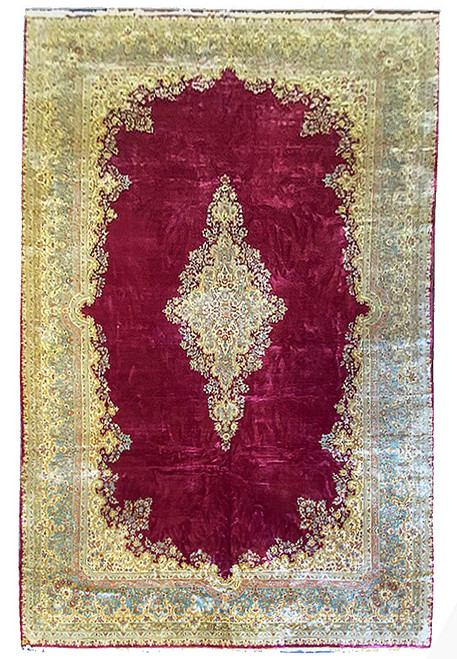
10'10" x 18'8" Persian Kerman Rug | Ivory Field, Teal Floral Medallion | Circa 1950s Palace Size
This is a true palace piece, 130 inches wide and 224 inches long, woven in Kerman in the 1950s and still carrying its original hand-written stock tag on the back. The field is an open ivory that has mellowed to warm cream with age, the medallion is teal blue, and the whole drawing is carried out in the pale, powdery palette that made mid-century Kerman the most collected floor covering in American houses of that era. It is one of the few genuinely oversize Persian rugs that stays light rather than heavy under a big room, because so much of the surface is left open. The pile is 100% wool on a cotton foundation, the ends and selvages are original, and a signed certificate of authenticity ships with the rug.
Please Note About the Photographs:
Several photos show faint horizontal shadow lines running across the ivory field. Those are fold marks from pallet storage, not wear, not fading and not damage. They relax out once the rug is laid flat, and every rug leaves our warehouse professionally steamed and pressed.
Design and Motifs
The composition is a classic Kerman open-field medallion. At the center sits a lobed oval medallion outlined in navy and filled with curling gold arabesques, with a rose-colored 8 petal rosette at its core. Above and below, two pendant cartouches drop into the field, each drawn as a small bouquet of tulips, carnations and rosebuds. The field itself is left largely bare, scattered only with delicate flowering sprays and single stems that let the wool show its sheen. Around that open ground runs a deep stepped and scalloped surround in celadon green, densely packed with roses and leafy scrollwork, with 4 corners squared off in the angular bracket shape typical of Kerman cartoon drawing. The main border is a wide navy and teal band of palmettes and rosettes, flanked by salmon pink guard stripes and a narrow reciprocal outer stripe. The drawing throughout is curvilinear and confident, the line never breaking as it turns.
Ivory, Teal and Celadon: The Color Story
Color is the reason this rug sells itself in person. The field runs from clean ivory at the ends to a warmer cream and light honey tone through the center, a natural abrash that reads as depth rather than inconsistency. Against it the medallion is a medium teal blue, cooler than navy and softer than turquoise, with a salmon pink and gold heart. The stepped surround is a pale celadon and sage green, one of the hardest tones for a dyer to hold over 18 feet, and it is even here. Scattered through the floral work are rose pink, coral, dusty lavender, straw gold, olive and small flashes of cherry red. The borders anchor everything with indigo and mid-blue, edged in blush pink. Nothing shouts. This is the pastel Kerman palette that works with white plaster, oak floors, antique walnut and modern upholstery alike.
Kerman Weaving in Southeast Persia
Kerman sits in the high desert of southeast Persia and has been a weaving city for centuries, known for fine local wool and for cartoon-drawn designs worked out on paper before a single knot is tied. That workshop discipline is exactly what an oversize rug demands: a medallion that lands dead center across 224 inches, borders that turn the corner cleanly, and a field that stays true for 4 corners. The weave here is a single wefted, fine hand-knotted wool pile on a cotton foundation, dense enough to hold crisp floral outlines yet supple enough to roll. Pieces like this were woven for export in the decades after the war and the best of them, this one included, have aged into exactly the muted tone collectors now chase. If you want to understand how the ends, the wear pattern and the dye behavior place a rug in a decade, our guide on how to date an oriental rug walks through the same clues we used here.
10'10" x 18'8" Persian Kerman Rug | Ivory Field, Teal Floral Medallion | Circa 1950s Palace Size
Ask about this rug
This piece is the only one of it, so the things worth knowing about it are particular to it. If you want to talk through the size, the colour in your own light, or the weave, speak to someone here first.