| Size in ft: | Width: 12' x Length: 19' |
| Size in Inch: | Width: 144" x Length: 228" |
| Size in meters: | Length: 5.79 x Width: 3.66 m |
| Colors: | Ivory, Green, Shrimp |
| Shape: | Rectangular |
| Woven: | 100% Hand-knotted | Handmade |
| Foundation: | Cotton |
| Pile: | |
| Age: | 1950's | Vintage |
| Design: | Kerman Medallion | Open Ivory Field | Floral Border |
| Origin: | Persian Kerman | Made in Persia |
| Condition: | Excellent |
12' x 19' Persian Kerman Rug | Ivory Open Field with Lace Medallion | 1950s Palace Size
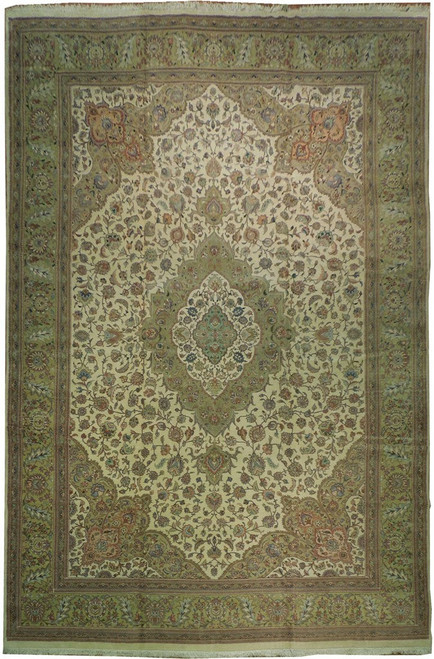
This 12' x 19' Kerman was knotted in southeastern Persia in the 1950s, when the city's workshops were still drawing the light, French-influenced palace layouts that made Kerman famous in American drawing rooms. It is a genuinely architectural piece: 228 inches long, with an ivory field left almost entirely open so that a single lace-cut medallion and its two pendants carry the whole composition. Pieces of this footprint rarely survive in this kind of shape, and among oversize Persian rugs a 12 by 19 in soft ivory is far harder to find than the usual red and navy formats. The wool has that dry, slightly waxy handle that older Kerman fleece develops, and the pile still stands well across the field. It ships with a certificate of authenticity, and despite a weight that would trigger a freight surcharge almost anywhere else, delivery is free to all 50 states.
Please Note About the Photographs:
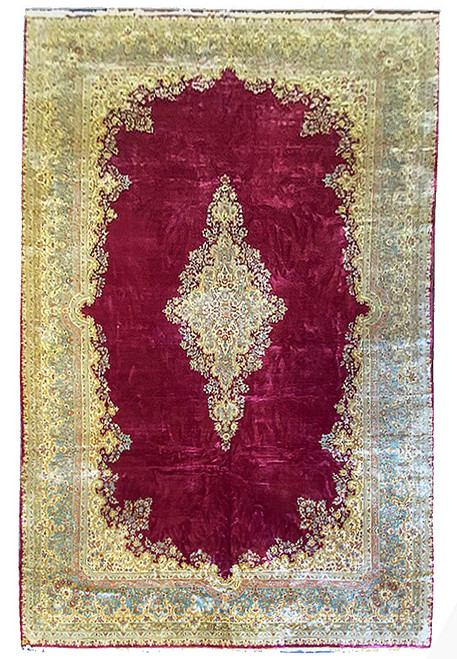
Several photographs show soft horizontal lines running across the ivory field. Those are fold and roll marks from flat pallet storage. They are not wear, not fade and not damage, and they relax once the rug is laid flat in the room. Every rug is professionally steamed and pressed before it ships. The first photograph was also taken under strong light and reads paler than the rug does in person; the floor photographs are the truer guide to color.
Design and Motifs
The drawing is pure curvilinear Kerman. A single elongated medallion sits dead center, built from a rosette core ringed by cusped cartouche lobes and then by a dense corona of acanthus and split leaf scrollwork that breaks into feathered points at the edges. Two slender pendants run off the top and bottom like finials, and the 4 corners answer them with large scrolling brackets that curl inward over the open ground. Between medallion and border the field is deliberately bare, which is the whole point of this layout: the empty ivory reads as light and makes a 19 foot room feel calmer rather than busier. The border system is generous, with a wide main band of leafy vine carrying crescent shaped cartouches and boteh forms, flanked by narrow floral guard stripes and a fine reciprocal outer stripe. Detail shots show how tightly the vine is drawn at that scale, with tiny buds and curled tendrils resolving cleanly rather than blurring into mass.
A Palette of Ivory, Sage Green and Shrimp
The field is a warm ivory that leans toward cream and old parchment rather than cold white, with a gentle abrash that lightens and deepens in bands across the width. The border ground is shrimp, a soft salmon coral that has mellowed toward dusty peach along the edges, and it frames the pale field without ever fighting it. Through the medallion and the border vine runs sage green, deepening in places to a clear turquoise that the close-up photographs pick up in the medallion core and in the small floral sprays of the guard stripes. Touches of camel, honey gold and a faded terracotta outline the leaves and give the scrollwork its depth. It is a quiet, sun-warmed palette of the kind Kerman built its export reputation on, and it sits easily with pale plaster walls, walnut and gilt furniture, or a modern room that needs warmth without a strong color statement.
Kerman Weaving in Southeastern Persia
Kerman sits on the high desert plateau of southeastern Persia and has been weaving for court and export since the Safavid period, with a house style built on curved line drawing, pictorial and garden inspired borders, and pastel grounds that other Persian centers never attempted. Work of this scale was loom work for a team: a 12 foot width needs several weavers side by side following a single cartoon, month after month, and the medallion here is symmetrical across the full 19 foot length, which tells you the cartoon was followed exactly. The reverse shows an even, regular cotton foundation with the knot rows lying straight and the wool pile clipped at a medium height, the combination that lets Kerman hold fine floral detail while still wearing like a floor rug. If you want to understand the cues that place a piece in the middle of the last century, our guide on how to date an Oriental rug walks through the same details visible in these photographs.
12' x 19' Persian Kerman Rug | Ivory Open Field with Lace Medallion | 1950s Palace Size
Ask about this rug
This piece is the only one of it, so the things worth knowing about it are particular to it. If you want to talk through the size, the colour in your own light, or the weave, speak to someone here first.