Watch the film
| Size in ft: | Width: 10' x Length: 16'4" |
| Size in Inch: | Width: 120" x Length: 196" |
| Size in meters: | Length: 4.98 x Width: 3.05 m |
| Colors: | Red, Light Blue, Ivory |
| Shape: | Rectangular |
| Woven: | 100% Hand-knotted | Handmade |
| Foundation: | Cotton |
| Pile: | |
| Design: | Kerman Floral Medallion | Open Field | Scalloped Cartouche Border |
| Origin: | Persian Kerman | Made in Persia |
| Condition: | Excellent |
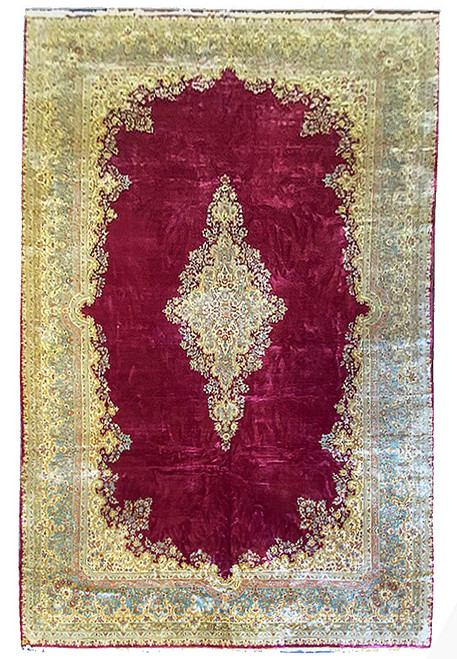
10' x 16'4" Persian Kerman Rug | Open Red Field with Ivory Medallion | Oversize Palace Size
This is a full palace piece: 10 feet wide and just over 16 feet long, hand-knotted in southeast Persia with a wool pile on a cotton foundation. The drawing is classic Kerman, an open tomato red field left mostly bare so the eye travels straight to the small ivory and navy medallion at the center, then out to the deeply scalloped spandrels and the wide navy border. Because it measures a true 10 by 16, it belongs with oversize Persian rugs rather than standard room sizes, and it is one of the few formats that can carry a long dining table or a double seating group without the furniture crowding the pattern. The pile stands even at 3/8 inch across the whole surface with no wear or repair, and every rug we sell ships with a certificate of authenticity confirming origin, materials and hand-knotted construction.
Please Note About the Photographs:
The first overhead photograph was shot under bright studio light and renders the field a lighter, more orange red than it actually is. The warehouse photographs taken on the floor show the truer tone: a deep, slightly cool tomato red. Every rug is professionally steamed and pressed before it leaves us.
Design and Motifs
The composition is built on restraint. A single lozenge medallion sits at the center, no more than 3 feet across on a field 16 feet long, drawn in ivory with a navy inner cartouche and filled with tiny rose and cornflower blossoms on curling vine. Two slender pendants extend from its tips, and beyond them a pair of small leaf shaped anchors float free in the red. The corner spandrels are the opposite idea: dense, deeply lobed clouds of palmettes, split leaves and flower sprays that eat into the field in a scalloped silhouette, so the empty red reads as a deliberate oval rather than a gap. The main border runs on a navy ground with a continuous procession of ivory vine scroll, pale blue acanthus and rose blossoms, framed inside and out by ivory guard stripes carrying a running flower head repeat. Every line in the drawing is curvilinear, not a single angular join anywhere, which is the mark of a cartoon drawn by a city designer and followed knot for knot at the loom.
A Red Field Carried by Light Blue and Ivory
Red does the heavy work here, and it is a good one: a clear tomato red with no brown in it, even from selvage to selvage with only the faint natural variation that wool takes from the dye vat. Against it the ivory reads almost white in the medallion core and warms to a soft cream through the spandrels and border ground. The light blue is the color that makes this rug, a chalky powder blue used for the acanthus leaves and the larger palmettes, cool enough to hold its own against all that red. Behind it the border ground is a near black navy that gives the whole design a frame and depth. Scattered through the floral work are salmon and rose pinks in the blossoms, small touches of olive and sage in the leaf tips, and a warm tobacco brown in the vine stems. The wool has a visible sheen in the raking light of the floor photographs, which is what you want from Kerman fleece.
Kerman: The Weaving City and the Quality of the Weave
Kerman sits in the high desert of southeast Persia and has been a weaving city for centuries, known for two things above all: the quality of its local wool and the discipline of its designers. Kerman workshops draw on paper first and weave second, which is why the floral scrollwork here stays symmetrical over a 16 foot length and why the medallion keeps its exact shape on both axes. Pictorial and garden borders are the signature of the city, and this piece shows the domestic version of that tradition, a formal open field framed by a garden of blossoms. Structurally it is an asymmetric knot on a cotton warp and weft, beaten firmly, finished with flat woven ends and cotton fringe as seen in the back photograph. The back shows clean, regular knot rows with the pattern legible from the reverse, always the honest test of a hand-knotted rug, and the pile depth is uniform with no low spots along the traffic lines.
10' x 16'4" Persian Kerman Rug | Open Red Field with Ivory Medallion | Oversize Palace Size
Ask about this rug
This piece is the only one of it, so the things worth knowing about it are particular to it. If you want to talk through the size, the colour in your own light, or the weave, speak to someone here first.