| Size in ft: | Width: 13' x Length: 21'1" |
| Size in Inch: | Width: 156" x Length: 253" |
| Size in meters: | Length: 6.43 x Width: 3.96 m |
| Colors: | Red, Ivory, Navy Blue |
| Shape: | Rectangular |
| Woven: | 100% Hand-knotted | Handmade |
| Foundation: | Cotton |
| Pile: | Wool | 3/8" pile height |
| Design: | Kerman | Floral Medallion | Navy Floral Border |
| Origin: | Persian Kerman | Made in Persia |
| Condition: | Excellent | Full even pile |
13' x 21'1" Persian Kerman Rug | Red Field with Ivory Medallion | Palace Size Wool
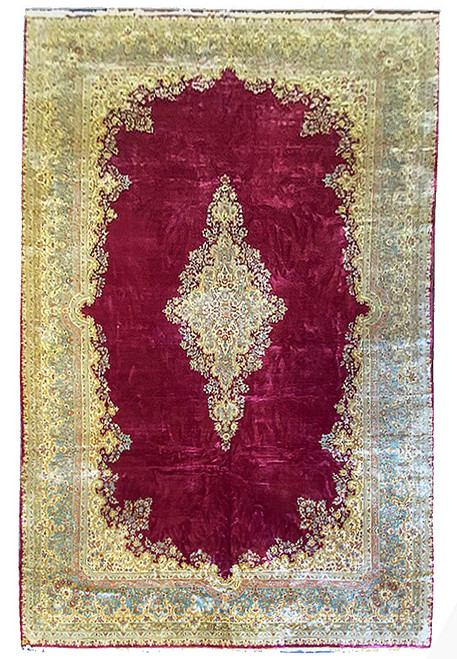
This is a palace format Kerman in the classic formal taste: a wide open red field, a single ivory medallion floating dead center, and a deep navy border crowded with flowers. At 13' x 21'1" it is a true room-filling piece, hand-knotted on a cotton foundation with a 3/8" wool pile that still stands full and even across all 273 square feet. Pieces at this width are rarely woven and even more rarely survive in this condition, which is what makes it a serious candidate among oversize Persian rugs for a great room, a long dining room or a hotel lobby. Every rug we ship leaves Freeport with a certificate of authenticity documenting origin, materials and construction.
Please Note About the Photographs:
The first photograph was taken under different lighting and reads lighter and pinker than the rug actually is. The remaining photographs, shot on our own floor, show the true color: a deep, saturated red with navy and ivory. This is a lighting difference in one image, not fade, sun damage or uneven dye.
Design and Motifs
The drawing is built on a single large oval medallion with a navy outline, filled with ivory ground and a dense lattice of rosettes, small palmettes and curling leaf tips, with one central rosette anchoring the axis. Above and below the medallion sit matching crested pendants, each one a tight bouquet of blossoms and feathered leaves reaching out into the empty field. The corners of the field are closed with navy spandrels drawn as full floral sprays, and small ivory cartouches punctuate the inner edge, so the eye reads one continuous garden frame around a calm open center. The main border is the Kerman signature: a navy ground packed with realistic flower heads, blue forget-me-not clusters, ivory serrated leaves and scrolling vine, with narrow red and ivory guard stripes on either side. Because the field is left largely plain, all of the detail work is concentrated where it shows best, and furniture set on the field will not fight the pattern.
The Red, Ivory and Navy Palette
The field is a warm brick red, slightly cochineal in tone rather than orange, and it carries subtle vertical variation across the open ground where the wool takes the dye differently from one section to the next. That movement is what separates a natural, hand-dyed field from a flat machine color. Against it, the medallion and pendants read in soft ivory and pale cream with touches of rose, sand and dull gold in the flower heads. The border is a true dark navy, almost black in low light, which frames the red hard and gives the rug its formal weight. Running through the navy are bright mid-blue blossoms, teal green leaf accents and small salmon and dusty pink flowers, and the same blues repeat inside the medallion so the palette ties together end to end. The back view shows those blue blossoms and ivory leaf scrolls reading clean and crisp from the reverse, a sign of well-defined knotting and stable, unfaded dyes.
Kerman Weaving in Southeast Persia
Kerman sits in the southeast of Persia, far from the northwest village belt, and its weavers built their reputation on floral realism rather than geometry: drawn flowers, garden borders and painterly pendants that look like they came off paper before they went on the loom. Kerman workshops were also among the few able to set up looms wide enough for palace formats like this one, which is why so many of the great oversize Persian floor pieces of the last century came out of this region. The construction here is orthodox Kerman: cotton warp and weft, asymmetric knotting, and a tightly packed wool pile clipped low at 3/8" so the fine floral drawing in the border stays legible instead of blurring. Look at the reverse and the knot rows are straight and even across a 13 foot width, which takes a well-built loom and a coordinated team of weavers working a full season or more. That discipline is why a Kerman of this size still lies flat, still holds its shape at the selvages, and still has years of floor life left in it.
13' x 21'1" Persian Kerman Rug | Red Field with Ivory Medallion | Palace Size Wool
Ask about this rug
This piece is the only one of it, so the things worth knowing about it are particular to it. If you want to talk through the size, the colour in your own light, or the weave, speak to someone here first.