| Size in ft: | Width: 9' x Length: 21' |
| Size in Inch: | Width: 108" x Length: 252" |
| Size in meters: | Length: 6.40 x Width: 2.74 m |
| Colors: | Rust Red, Blue, Ivory, Green |
| Shape: | Rectangular |
| Woven: | 100% Hand-knotted | Handmade |
| Foundation: | Wool | Hand-spun warp and weft |
| Pile: | |
| Age: | Circa 1930s | Antique |
| Design: | Bijar | Herati (Mahi) Field | Elongated Navy Medallion |
| Origin: | Persian Bijar | Made in Persia |
| Condition: | Excellent | Evenly low pile |
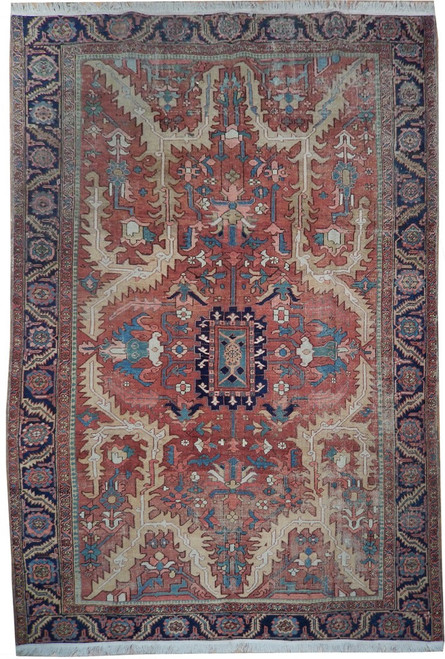
9' x 21' Antique Persian Bijar Rug | Rust Red Herati Field, Navy Medallion | Circa 1930s
This is a gallery length Kurdish weaving from the 1930s, 9' x 21' of hand-knotted wool on a wool foundation, the kind of piece that was made for a long formal room and has survived nearly a century of it. The proportions are unusual and valuable: a true 9 foot width carried out to 21 feet, which puts it firmly among oversize Persian rugs that almost never come to market in original, unrestored condition. It is an antique Persian Bijar rug in the classic Kord village manner, heavy in the hand, flat and true on the floor, with decades of gentle wear that have brought the pile down evenly and left the drawing perfectly legible. Every rug we sell ships with a certificate of authenticity.
Please Note About the Photographs:
The pile on this 1930s piece is low and even from age, which is exactly what a well kept antique Bijar should look like. The tonal shifts you see across the red field in the overhead photos are natural abrash from hand-dyed wool, not fading or damage, and the close-up shots are taken under strong light to show the knotting and the wool back. The rug is professionally cleaned, steamed and pressed before it ships.
Design and Motifs
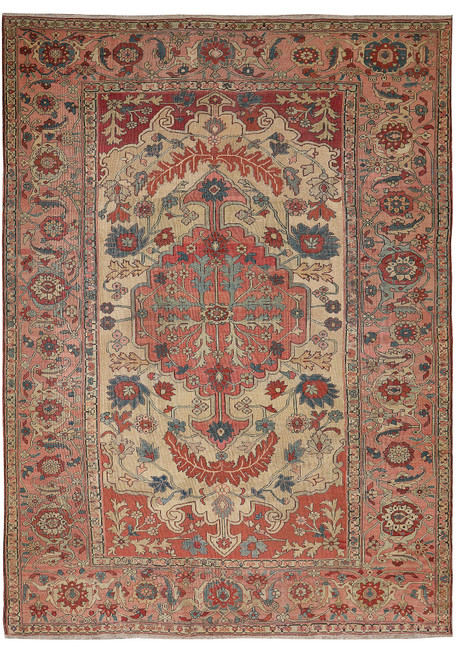
The field is a continuous Herati lattice, the pattern Bijar weavers call mahi or fish: a diamond framework of fine vines, each compartment holding a rosette flanked by 4 curved lanceolate leaves that read like fish circling a pond. Over that lattice sits an elongated navy medallion with a stepped, saw-tooth outline, filled with its own miniature Herati drawing in salmon, brick and pale green, and finished top and bottom with slender pendant finials that carry small hooked rosettes. Deep indigo spandrels anchor the 4 corners of the field with matching angular edges. The border system is generous, as Bijar borders usually are: a wide ivory main band of turtle palmettes linked by leafy vine, a broad terracotta secondary band carrying blue and salmon rosettes and hooked medallions, and several narrow guard stripes of rosettes and reciprocal barber-pole striping that keep the whole 21 foot length visually in step. Nothing here is mechanically repeated, and the small shifts in motif spacing along the field are the signature of a village loom working from memory.
The Rust Red, Indigo and Ivory Palette
The ground is a warm rust red that moves between brick and soft terracotta down the length of the rug, the kind of living tone only hand-dyed, hand-spun wool produces. Against it, the medallion and spandrels read as a dark indigo that goes almost black in low light and opens into true navy where the light hits the pile. The ivory main border is a genuine undyed cream rather than a bleached white, and it gives the whole piece its clarity from across a room. Through the borders and the field details run a chorus of secondary colors: sage and olive green in the palmette leaves, dusty salmon and blush pink in the rosettes, a clear sky blue in the hooked border medallions, and a chocolate brown that outlines many of the motifs. The overall effect is soft and mellow rather than loud, a palette that sits comfortably with antique wood, warm plaster, leather and brass.
Bijar, the Iron Rug of Persia
Bijar sits in Kurdistan in western Persia, and its Kurdish weavers earned the town the name the iron rug of Persia. The weft is beaten down with a heavy metal comb, row after row, which compresses the wool foundation and produces a rug that is stiff, extremely dense and close to indestructible. That technique is why a 1930s piece of this size can come through 90 years of use with an even, low pile and a foundation still completely sound, as the folded corner and rolled edge photographs show. This example is the Kord village type rather than a city workshop piece, with wool warp and weft throughout and a robust, confident hand. If you are comparing the different Kurdish weaving centers, our article on Bijar, Bijar Tekab and Bijar Bukan weaving explains what separates them, and our guide to how to date an oriental rug covers the structural clues that place this one in the 1930s.
9' x 21' Antique Persian Bijar Rug | Rust Red Herati Field, Navy Medallion | Circa 1930s
Ask about this rug
This piece is the only one of it, so the things worth knowing about it are particular to it. If you want to talk through the size, the colour in your own light, or the weave, speak to someone here first.