| Size in ft: | Width: 8' x Length: 11' |
| Size in Inch: | Width: 96" x Length: 132" |
| Size in meters: | Length: 3.35 x Width: 2.44 m |
| Colors: | Rust, Blue, Ivory |
| Shape: | Rectangular |
| Woven: | 100% Hand-knotted | Handmade |
| Foundation: | Cotton |
| Pile: | |
| Age: | 1950's | Approx. 70 years old |
| Design: | Heriz | Stepped Geometric Medallion | Corner Spandrels |
| Origin: | Persian Heriz | Made in Persia |
| Condition: | Excellent | Even pile throughout |
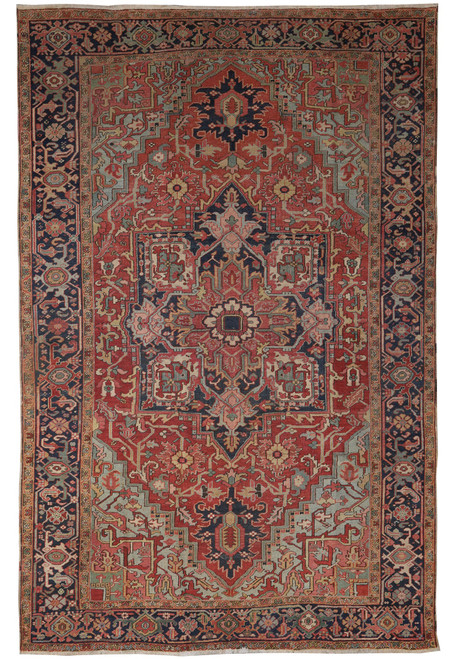
8' x 11' Persian Heriz Rug | Rust Field, Navy Stepped Medallion | Circa 1950s
This is a village-woven Persian Heriz from the 1950s, hand-knotted in wool on a cotton foundation and still carrying an even, honest pile across all 11 feet of its length. The drawing is pure Heriz: a large stepped medallion in deep navy floating on a rust field, ivory and green corner spandrels, and a navy main border of hooked vines and rosettes. It reads as one confident, angular composition rather than a busy one, which is exactly why rugs of this type keep working in real rooms decade after decade. At 8' x 11' it sits comfortably under a sofa group or a dining table, and it is a size we are asked for constantly among our 8x11 Persian rugs. Every rug we sell ships with a certificate of authenticity documenting origin, age, materials and construction.
Please Note About the Photographs:
The first photograph was taken under brighter studio lighting and reads lighter and pinker than the rug actually is. The floor shots and the close-up details show the true tone: a deeper, warmer rust field against a near-black navy. Please judge the color from those images.
Design and Motifs
The center holds a broad stepped medallion outlined in ivory, with serrated leaves and a small blue rosette cluster at its heart, and anchored top and bottom by tall navy pendants filled with ivory palmettes. Four square sub-medallions in rust and blue sit at the medallion's shoulders, each carrying its own 8 petal rosette. The open rust field between them is not empty at all: it is filled with hooked vines, cypress-like leaf forms, small ivory birds of the field and angular blossoms drawn in green, blue and cream. The ivory corner spandrels repeat the same vocabulary in mirror image at all 4 corners. The main border alternates rust cartouches and ivory-edged rosettes on navy, framed by narrow guard stripes of blue and cream blossoms. This is the angular, straight-line drawing that defines the best geometric Persian rugs, translated from curved court cartoons into the grid of a village loom.
The Rust, Navy and Ivory Palette
The field is a warm terracotta rust that shifts between brick and soft salmon depending on how the light crosses the pile, the natural abrash you want to see in a rug of this age. Against it, the medallion and main border read as a very dark indigo navy, almost black in the corner close-up, which is what gives the composition its graphic punch. Ivory does the outlining work throughout, and in the spandrels it opens up into full cream grounds that lighten the ends of the rug. Look closer and the secondary palette is richer than the three main colors suggest: bottle green in the spandrel leaves and border blossoms, a mid sky blue in the sub-medallion rosettes, camel and soft gold in the vine work, and small touches of pale pink in the flower heads. Nothing is harsh. Seventy years of gentle mellowing has pulled the whole palette together so that the rust and navy sit quietly rather than shouting.
Heriz Weaving East of Tabriz
Heriz is a group of weaving villages east of Tabriz, on the slopes below Mount Sabalan in northwest Persia. The water there runs through mineral-rich rock, and the local sheep produce a wool that is famously tough and slightly glossy, which is the reason Heriz rugs from this era are still in service in family houses three generations later. Weavers worked from memory on a village loom rather than from a fine workshop cartoon, so curves become steps and flowers become facets, and the knot count sits below the fine city standards, typically under 200 knots per square inch. The back of this piece shows exactly that: a firm, regular hand-knotted grid on a cotton warp with a clean ivory fringe, tight enough to hold crisp outlines while leaving plenty of wool on the surface. If you want to understand how weave, dye and wear together place a rug like this in the 1950s, our guide on how to date an Oriental rug walks through the same evidence we used here.
8' x 11' Persian Heriz Rug | Rust Field, Navy Stepped Medallion | Circa 1950s
Ask about this rug
This piece is the only one of it, so the things worth knowing about it are particular to it. If you want to talk through the size, the colour in your own light, or the weave, speak to someone here first.