Watch the film
| Size in ft: | Width: 8' x Length: 11'4" |
| Size in Inch: | Width: 96" x Length: 136" |
| Size in meters: | Length: 3.45 x Width: 2.44 m |
| Colors: | Red, Rust, Navy, Ivory, Salmon Rose, Light Blue |
| Shape: | Rectangular |
| Woven: | 100% Hand-knotted | Handmade |
| Foundation: | Cotton |
| Pile: | |
| Design: | Heriz | Star Medallion | Ivory Corner Spandrels |
| Origin: | Persian Heriz | Made in Persia |
| Condition: | Excellent | Even pile with soft patina |
8' x 11'4" Persian Heriz Rug | Rust Red Field with Navy Star Medallion | Excellent Condition
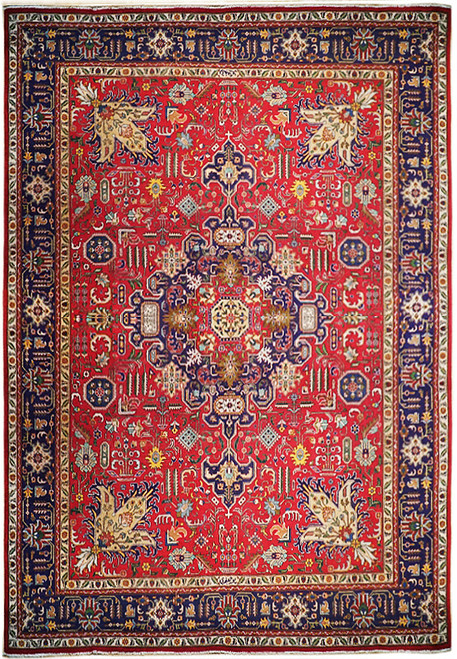
This 8' x 11'4" Persian Heriz is the classic northwest Persian room rug: a broad rust red field, a big navy star medallion held dead center, and ivory spandrels that push light into all 4 corners. It is hand-knotted on a cotton foundation with the heavy, springy highland wool that made these village weavings famous for outlasting the houses they were bought for. The pile is even from end to end with the soft sheen and gentle patina that only come from real wool and real use, and the drawing is confident rather than fussy, which is exactly what a collector looks for in this group. At 96" by 136" it sits comfortably as one of the more usable 8x11 Persian rugs, large enough to carry a full seating group. Every rug we ship leaves Freeport with a certificate of authenticity documenting origin, materials and construction.
Design and Motifs
The center holds a stepped 8 point star medallion outlined in deep navy, with a small ink dark cartouche at its heart carrying an 8 petal rosette in ivory and rose. Radiating out from the medallion are serrated leaves, hooked vines and angular palmettes, each one drawn in straight lines and clean steps rather than curves, the signature discipline of geometric Persian rugs from this district. Ivory corner spandrels repeat the same vocabulary in reverse, filled with blossoms and jagged leaf forms that anchor the composition. The main border runs dark indigo with alternating rosettes and turtle palmettes in rose, brick and light blue, flanked by narrow reciprocal guard stripes that keep the whole frame crisp. Small blue birds and scattered blossoms appear in the field where the weaver filled open ground by eye, a detail you only get from a hand-drawn village cartoon.
A Study in Rust Red, Navy and Ivory
The dominant note is a warm brick to rust red, a madder toned ground that shifts from terracotta in raking light to a deeper oxblood where the pile lies the other way. Against it the navy reads almost black at the medallion outline and in the main border, giving the design its weight and its edges. Ivory does the lifting work in the spandrels, in the small reserve panels inside the medallion and in the guard stripes, while salmon rose fills the inner medallion ground and softens the contrast between red and navy. Light blue and steel blue accents run through the leaves, the border rosettes and the bird figures, and small touches of ochre and pale green turn up in the palmettes. It is a rug that sits naturally with other red and burgundy Persian rugs, warm wood floors and antique furniture, and the subtle abrash across the field is the fingerprint of small batch dyeing.
Heriz: The Villages East of Tabriz
Heriz is a cluster of weaving villages east of Tabriz, on the slopes below Mount Sabalan in northwest Persia. The water there is mineral rich and the sheep grazing those highlands grow a famously tough, high lanolin fleece, which is the real reason a Heriz can take a century of traffic and still show a full pile. Weavers work from memory and from simple village cartoons rather than a fully plotted workshop drawing, so the medallion is built in straight steps and angles instead of the flowing curves of a city loom. Knot counts in this group generally sit under 200 per square inch, and that is by design: a slightly coarser, heavier knot on a stout cotton foundation is what gives the rug its body and its legendary durability. The back of this piece, visible in the last photograph, shows a tight even weave with the knot nodes clearly defined and the original selvage intact along the side.
8' x 11'4" Persian Heriz Rug | Rust Red Field with Navy Star Medallion | Excellent Condition
Ask about this rug
This piece is the only one of it, so the things worth knowing about it are particular to it. If you want to talk through the size, the colour in your own light, or the weave, speak to someone here first.