Watch the film
| Size in ft: | Width: 9'9" x Length: 12'11" |
| Size in Inch: | Width: 117" x Length: 155" |
| Size in meters: | Length: 3.94 x Width: 2.97 m |
| Colors: | Ivory, Rusty Red, Red Brown |
| Shape: | Rectangular |
| Woven: | 100% Hand-knotted | Handmade |
| Foundation: | Cotton Foundation |
| Pile: | |
| Age: | Early 2000's |
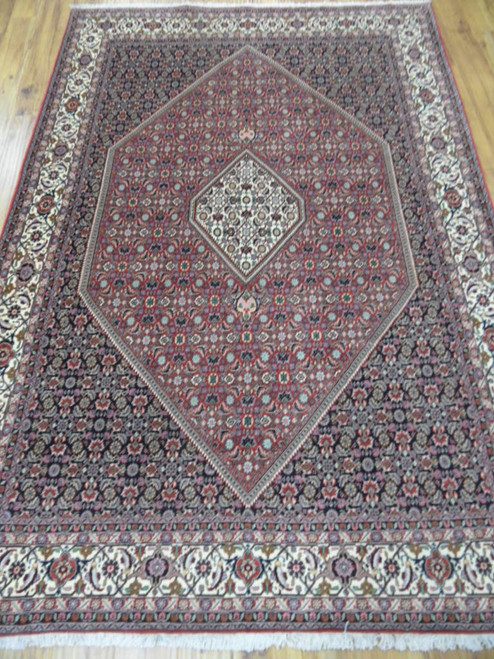
| Design: | Bijar | Herati (Mahi) Lattice | Concentric Diamond Medallion |
| Origin: | Persian Bijar | Made in Persia |
| Condition: | Excellent |
9'9" x 12'11" Persian Bijar Rug | Ivory Herati Field, Rust Red Borders | Early 2000s
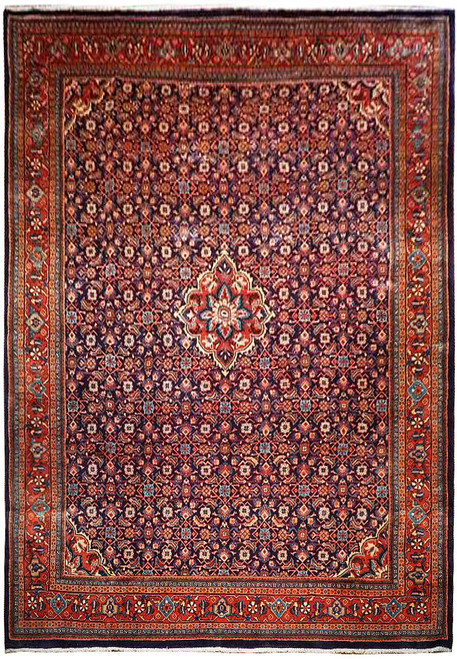
Pick this rug up by one corner and you understand what you are buying. At 9'9" x 12'11" it carries the weight of a much larger piece, because a Persian Bijar rug is packed so tightly that the pile stands up like a brush and the back feels like board. Woven in the early 2000s on a cotton foundation with a 3/8" wool pile, it lays out as a true room size piece and sits naturally with our other 10x13 Persian rugs, only heavier underfoot than almost anything in that group. Condition is excellent, the ends and sides are original and secure, and the piece ships with a certificate of authenticity documenting origin, materials and hand-knotted construction.
Please Note About the Photographs:
The diagonal shadows visible in the floor photographs are fold marks from flat storage on the pallet. They are not wear, not fading and not damage. They relax out once the rug is laid flat in the room, and every rug leaves our Freeport warehouse professionally steamed and pressed.
Design and Motifs
The whole field is drawn in herati, the small diamond enclosing a rosette with 4 curved fish leaves hooked around it, which is why weavers call it mahi, the fish pattern. Here it is not scattered loosely: the drawing is set into concentric diamond zones that step outward from the center, each band switching ground color so the lattice reads as a series of nested frames rather than one flat repeat. At the heart sits an elongated hexagonal medallion filled with the same herati units at a tighter scale, and the 4 corners repeat the zone structure so the whole composition stays perfectly balanced end to end. The main border runs a procession of palmettes and serrated leaves linked by a thin vine, held between multiple narrow guard stripes of reciprocal rosettes and running vinery. It is disciplined village drawing at a workshop level of accuracy, with every diamond closing cleanly where the bands change color.
Ivory, Rusty Red and Red Brown
The dominant note is ivory, a warm cream closer to unbleached wool than white, and it carries the widest diamond bands so the rug reads light and open from across a room. Against it the weaver alternated deep indigo and a soft red brown for the inner zones, which is what gives the field its depth and makes the lattice pulse as you walk around it. The main border is rusty red, a slightly brick tone with a touch of terracotta, and it frames the pale field firmly without going orange. Inside the drawing the detail colors do the fine work: rose and raspberry in the rosette centers, sky blue and pale aqua in the fish leaves, small hits of soft gold and charcoal outlining the diamonds, and ivory used again as the outline color so every motif stays legible. Close up, as in the medallion detail, the palette is genuinely polychrome; from standing height it resolves into ivory, rust and dark blue.
Bijar, the Iron Rug of Persia
Bijar sits in Kurdistan, in the mountains of northwest Persia, and the Kurdish weavers there build a rug unlike anywhere else in the country. The wefts are dampened and then beaten down with a heavy metal comb, row after row, until the structure is compressed to the point that the rug becomes nearly indestructible and earns its nickname as the iron rug of Persia. That is why a Bijar of this size feels so dense in the hand and why these pieces are still flat, tight and unbuckled decades after they leave the loom, which also makes them the right choice for a hallway-free open plan where furniture will sit on the pile for years. The Kurdish wool is strong and lustrous, takes madder red and indigo beautifully, and holds a firm 3/8" pile. If you are comparing weaving districts before you commit, our notes on Bijar versus Bijar Zanjan, Tekab and Bukan explain what separates them and where this style of herati field belongs.
9'9" x 12'11" Persian Bijar Rug | Ivory Herati Field, Rust Red Borders | Early 2000s
Ask about this rug
This piece is the only one of it, so the things worth knowing about it are particular to it. If you want to talk through the size, the colour in your own light, or the weave, speak to someone here first.