Watch the film
| Size in ft: | Width: 6'6" x Length: 8' |
| Size in Inch: | Width: 78" x Length: 96" |
| Size in meters: | Length: 2.44 x Width: 1.98 m |
| Colors: | Red, Black, Cream, Pink, Green, Brown |
| Shape: | Rectangular |
| Woven: | 100% Hand-knotted | Handmade |
| Foundation: | 100% Cotton |
| Pile: | |
| Age: | 2000's |
| Design: | Bijar | All Over Herati (Mahi) | Turtle Palmette Border |
| Origin: | Persian Bijar | Made in Persia |
| Condition: | Excellent |
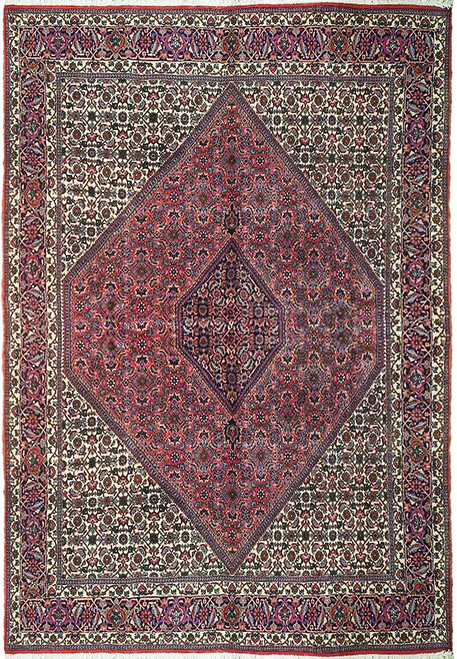
6'6" x 8' Persian Bijar Rug | All Over Herati Fish Design | Red Field, 2000s Weave
Pick this rug up by one corner and you feel immediately what it is. A 6'6" x 8' Bijar has the weight and board-like stiffness of a rug beaten down with a metal comb, and that density is exactly why weavers in the Bijar district earned the nickname the iron rug of Persia. The field is a warm salmon red carrying a small-scale all over Herati lattice, framed by a near-black border of turtle palmettes and ivory vine. The pile is 3/8" wool on a cotton foundation, the condition is excellent, and the piece dates to the 2000's, so there is a full lifetime of wear still ahead of it. Every rug we sell ships with a certificate of authenticity confirming it is hand-knotted and woven in Persia.
Please Note About the Photographs:
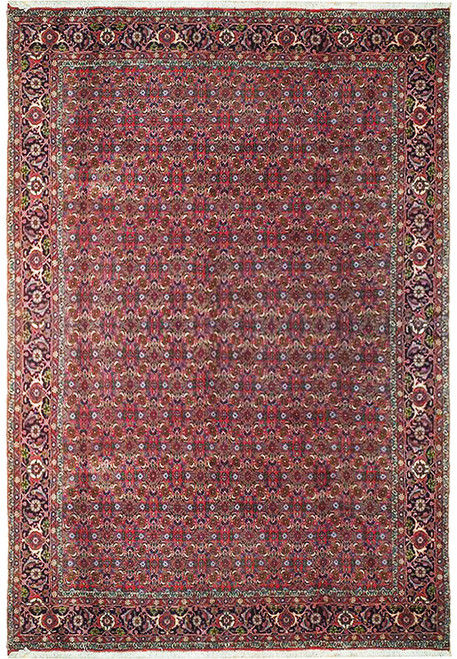
A faint vertical shadow line runs through the field in two of the photographs. That is a storage fold from the rug being rolled on the pallet, not wear, not fading and not damage. It relaxes out once the rug is laid flat, and every rug leaves us professionally steamed and pressed before shipping.
Design and Motifs
There is no medallion here. The whole field is given over to the Herati, also called mahi or the fish pattern, the motif most closely associated with Bijar weaving: a diamond lattice with a rosette at each intersection and 4 curved lanceolate leaves turned outward around it like fish circling a pool. Because the drawing repeats on a small scale across the entire field, the eye reads the surface as texture first and pattern second, which is why an all over Persian rug like this one sits so easily under furniture. The main border is broad and dark, filled with alternating turtle palmettes and cusped cartouches in ivory, olive and rose, and it is fenced on both sides by narrow floral guard stripes and a fine reciprocal minor band. Look at the corners in the detail photograph: the border turns cleanly, with the palmette sequence resolving rather than being cut off mid-motif, which is the mark of a weaver following a properly drawn cartoon.
A Salmon Red Field Against Near-Black Borders
The ground is red, but a specific red: a soft salmon-terracotta with a rose cast, lighter and warmer than the tomato reds of many central Persian rugs, and it photographs slightly differently depending on the light. Set against it, the main border is so deep a navy-aubergine that it reads as black, and that contrast is what gives the rug its graphic punch from across a room. Inside the lattice the palette is unusually varied for a Bijar: chalky cream and ivory outlines, pale ice blue rosettes, olive and moss green leaves, walnut brown, and small hits of deep pink and cherry red that keep the repeat from ever looking mechanical. The guard stripes run cream with red and green florals, and the plain ivory fringe at both ends finishes the piece cleanly. In practice this is a warm rug that pulls together brown leather, walnut, dark green and off-white walls without demanding that everything else in the room match it.
Bijar Weaving in Persian Kurdistan
Bijar sits in the Kurdish highlands of northwest Persia, and the weaving there is defined by technique as much as by design. The weft is packed down with a heavy metal comb between rows, forcing the knots into a foundation so compressed that the finished rug is stiff, thick and famously difficult to wear out, which is where the iron rug reputation comes from. Our complete guide to Bijar rugs goes deeper into how that beat-down is done and why it matters for longevity, and if you are comparing pieces from the surrounding towns, our breakdown of Bijar versus Bijar Zanjan, Tekab and Bukan is worth reading before you buy. This example shows the district at its best: tight, even knotting visible on the back, a low 3/8" pile that keeps the fine Herati drawing crisp, and hard-wearing highland wool that has held its lustre. It is a rug built to be walked on for decades, not protected from life.
6'6" x 8' Persian Bijar Rug | All Over Herati Fish Design | Red Field, 2000s Weave
Ask about this rug
This piece is the only one of it, so the things worth knowing about it are particular to it. If you want to talk through the size, the colour in your own light, or the weave, speak to someone here first.