| Size in ft: | Width: 10'5" x Length: 15'9" |
| Size in Inch: | Width: 125" x Length: 189" |
| Size in meters: | Length: 4.80 x Width: 3.18 m |
| Colors: | Blue, Ivory, Red, Green |
| Shape: | Rectangular |
| Woven: | 100% Hand-knotted | Handmade |
| Foundation: | Cotton |
| Pile: | |
| Age: | 1950's | Vintage |
| Design: | Bijar Mahi | Herati fish lattice | Central medallion |
| Origin: | Persian Bijar | Made in Persia |
| Condition: | Perfect | Full even pile throughout |
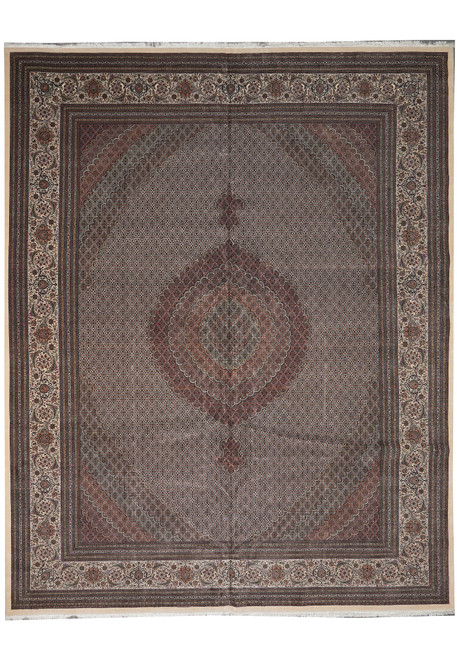
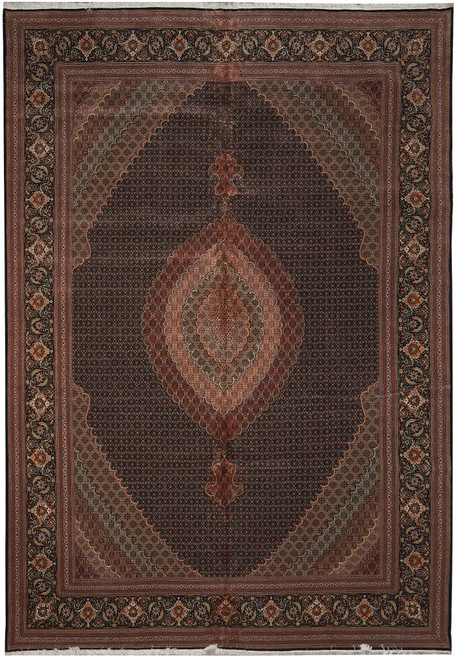
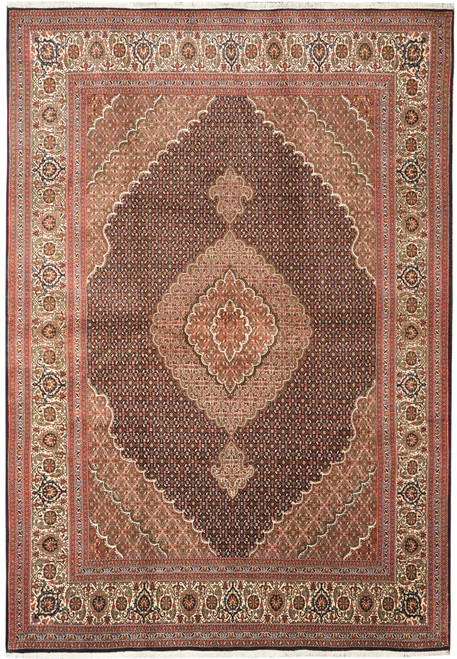
10'5" x 15'9" Persian Bijar Rug | Mahi Herati Fish Design | Navy Field | 1950's
This is a 1950's Persian Bijar in the Mahi drawing, 10'5" x 15'9" of hand-knotted wool on a cotton foundation, and it is the kind of piece that decides a room before the furniture arrives. The pile is heavy and dense in the hand, the drawing is small-scale and disciplined across the full length, and the condition is perfect, with even pile from selvedge to selvedge and original ivory fringe at both ends. Among oversize Persian rugs this width and length combination is genuinely useful, covering a large seating group or a long formal dining table without crowding the walls. It ships with a certificate of authenticity documenting origin, age, materials and measurements.
Please Note About the Photographs:
The overhead warehouse lighting in the wide shots pushes the field toward purple-mauve. The true field color is a deep midnight navy, as seen in the close-up photographs taken at floor level. Judge the color from the detail images rather than the full-length views.
Design and Motifs
The field carries the Mahi, the Herati fish pattern, drawn as a continuous diamond lattice with a rosette at each intersection and two curved lanceolate leaves flanking it, the leaves that read as fish circling the flower and give the pattern its name. The repeat is small and tightly spaced, so the whole 15'9" length reads as one even textile rather than a series of panels. At the center sits a compact lozenge medallion with a stepped, serrated outline: a light blue core filled with cream rosettes, ringed in deep red, with a thin ivory outline holding it apart from the field. Large ivory spandrels open out from the four corners and run down both long sides in a scalloped shoulder, filled with the same lattice in reverse colors, a device that visually widens the rug. Three borders finish it: a wide red main band of alternating palmettes, rosettes and boteh on a scrolling vine, an ivory guard band of turtle-style panels and eight petal rosettes, and a narrower ivory band of navy palmettes with gold vinework, all framed by a plain navy outer edge. It is a classic all-over Persian rug design with just enough medallion to give the room a center point.
Color Palette
The ground is a deep midnight navy, nearly black where the pile lies away from the light, and because the lattice is drawn so finely the field optically warms toward aubergine when seen from a distance. Inside that ground the rosettes alternate between coral pink, salmon and true red, with cream and ivory outlines that keep every flower legible. Small notes of soft turquoise and sage green sit inside the leaf forms, and a mustard gold appears in the vine scrolls and in the narrow outer guard stripe. The spandrels are a warm oatmeal ivory rather than a bright white, aged to a natural tone, and they hold the same red, navy and teal flowers at reduced scale. The main border is a saturated cherry red that reads as the rug's second main color, and the medallion center introduces the one cool accent in the piece, a powdery light blue that appears nowhere else. For decorating, the navy anchors the scheme, while the coral, ivory and red carry over easily to upholstery and drapery. Browse related navy blue Persian rugs if the field color is the deciding factor.
Bijar Origin and Weaving Quality
Bijar sits in Kurdistan in western Persia, and its weavings are known as the iron rugs of Persia for good reason. The weavers pack each row of knots down with a heavy metal comb while the warps are held under tension, which compresses the wool into a foundation so tight that the finished rug is stiff, extremely heavy for its size and nearly indestructible underfoot. The local Kurdish wool is high in lanolin and long in staple, so the pile keeps its spring and takes dye deeply, which is why a 1950's piece like this still shows full color and no thin areas. Bijar weavers borrowed the Mahi lattice from the northwest workshops and rendered it in their own idiom: slightly more angular drawing, heavier handle, stronger reds. Our full guide to Bijar rugs covers the construction in detail, and if you are comparing weaving districts, see Bijar vs Bijar Zanjan vs Tekab vs Bukan. A Bijar of this scale is a once-in-a-generation purchase, and it will outlast the house it goes into.
10'5" x 15'9" Persian Bijar Rug | Mahi Herati Fish Design | Navy Field | 1950's
Ask about this rug
This piece is the only one of it, so the things worth knowing about it are particular to it. If you want to talk through the size, the colour in your own light, or the weave, speak to someone here first.