Watch the film
| Size in ft: | Width: 9'6" x Length: 13' |
| Size in Inch: | Width: 114" x Length: 156" |
| Size in meters: | Length: 3.96 x Width: 2.90 m |
| Colors: | Navy Blue, Red, Ivory, Sky Blue, Gold |
| Shape: | Rectangular |
| Woven: | 100% Hand-knotted | Handmade |
| Foundation: | Cotton |
| Pile: | |
| Age: | 1980's | Vintage |
| Design: | Herati | Mahi (Fish) | All Over |
| Origin: | Persian Mahal | Made in Persia |
| Condition: | Excellent |
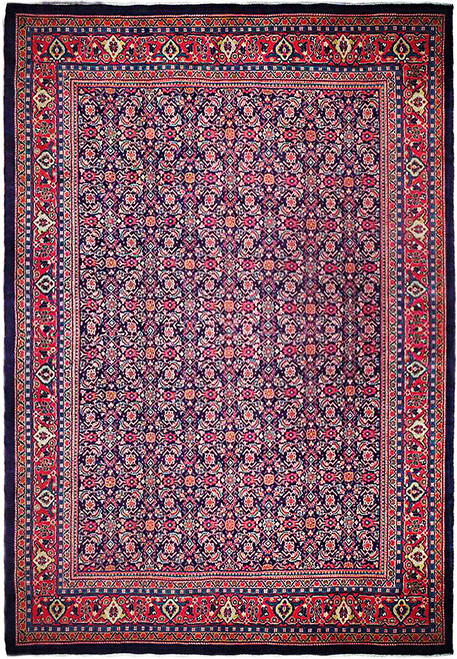
9'6" x 13' Persian Mahal Rug | All Over Herati Mahi Design | Navy Field, 1980s
This is a full room size piece, 9'6" x 13', hand-knotted in wool during the 1980s and still carrying a deep, even pile with no thin spots and no repairs. The whole field is given over to the herati, the classic fish pattern, drawn small and repeated hundreds of times across a dark blue ground, with a wide red border framing it on all 4 sides. Nothing about it is loud, which is exactly why it works under furniture: read from across the room it settles into a rich blue-red tone, and up close it rewards you with tiny ivory rosettes, serrated leaves and turquoise flickers. It ships with a certificate of authenticity, and buyers looking specifically at 10x13 Persian rugs will find this one of the more usable proportions for a large living or dining space.
Please Note About the Photographs:
The first full-length photograph was shot from a distance and reads slightly flat and purple-leaning. The close-up images show the true color: a clear royal navy field with bright red and ivory. Please judge the color from the detail shots.
Design and Motifs
The field is pure herati, also called mahi or fish pattern: a diamond lattice traced in pale blue, each diamond holding a rosette, with 4 curved lanceolate leaves turning around it like fish circling a pond. It is one of the oldest continuous patterns in Persian weaving and it demands discipline, because a single miscounted row shows up immediately in a repeat this tight. Here the drawing holds true from selvedge to selvedge across all 13 feet. Between the diamonds sit small ivory cartouches, stepped red medallions and eight petal rosettes in cream and coral, so the eye never lands on empty ground. This is a proper all over design rug with no central medallion, which is why it takes furniture so well: there is no focal point for a sofa or table to cover up. The main border runs a red ground with palmettes, scrolling vine and turtle style rosettes, flanked by sky blue guard stripes and a narrow ivory reciprocal line, and it is finished with navy selvedges and plain ivory fringe.
A Study in Navy, Red and Ivory
The ground is a saturated indigo navy that shifts toward a warmer royal blue where the light catches the pile, visible clearly in the rolled edge photograph. Against it the weaver set a true tomato red for the rosettes and stepped motifs, a softer brick red in the main border, and undyed ivory wool for the small blossoms and outlines that make the lattice legible. Two blues do the supporting work: a pale sky blue for the lattice lines and border guard stripes, and a deeper petrol blue inside the flower heads. Scattered through the field are small hits of saffron gold, olive green and a single warm orange, no more than a few knots each, which is what gives a dense pattern like this its life. The overall impression is a deep, cool, navy blue Persian rug warmed by red, a color pair that sits comfortably with dark wood, leather and cream walls alike.
Persian Mahal Weaving and Quality
Mahal rugs come from the villages of the Arak and Sultanabad region of central Persia, where weavers work on heavy cotton foundations with local wool and produce room size pieces built for daily life rather than for display cases. The herati mahi drawing seen here is the design most associated with the northwestern workshops around Tabriz and Bijar, and its appearance on a Mahal foundation tells you this was a workshop-directed commission rather than a free village piece: the repeat is measured, the borders are mitered cleanly at all 4 corners, and the pile was clipped at a medium height that has worn evenly over 40 years. The wool is the real asset. It has the slightly greasy, high-lanolin hand that central Persian fleece is known for, which is why the reds have not faded and why the pile still stands up rather than lying flat. Turn it over and the back reads clear and regular, with the pattern legible knot for knot, and the rug lies flat without a ripple.
9'6" x 13' Persian Mahal Rug | All Over Herati Mahi Design | Navy Field, 1980s
Ask about this rug
This piece is the only one of it, so the things worth knowing about it are particular to it. If you want to talk through the size, the colour in your own light, or the weave, speak to someone here first.