Watch the film
| Size in ft: | Width: 9'8" x Length: 13'5" |
| Size in Inch: | Width: 116" x Length: 161" |
| Size in meters: | Length: 4.09 x Width: 2.95 m |
| Colors: | Blue, Red, Ivory |
| Shape: | Rectangular |
| Woven: | Hand-Knotted |
| Pile: | Wool |
| Origin: | Persia |
| Design: | Mahal Herati |
| Age: | 1980's |
| Condition: | Excellent |
9'8" x 13'5" Persian Mahal Rug | Navy Herati All Over Field | 1980s Diamond Medallion
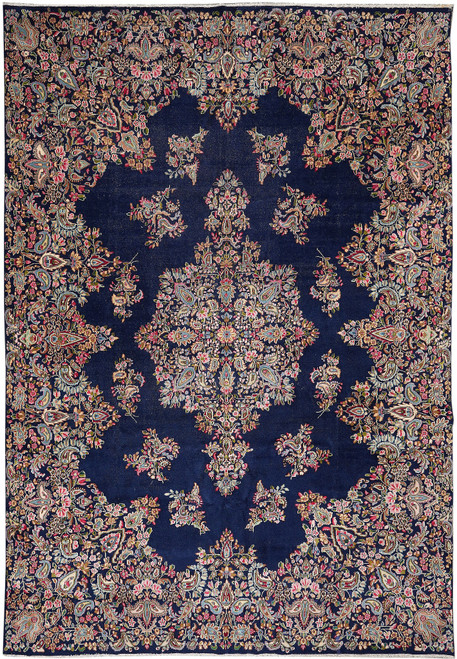
Woven in the 1980s in west-central Persia, this 9'8" x 13'5" Mahal is a full room piece built on the oldest and most durable idea in Persian village weaving: one small medallion, one deep indigo ground, and a Herati lattice repeated from selvage to selvage without a break. The wool is heavy and springy, hand-knotted on a cotton foundation, and after four decades the pile still stands full and even across the entire surface, with no low areas and no repairs. At 116 by 161 inches it falls into the 10x13 Persian rugs class, the size that fills a large living room wall to wall or carries a long dining table with room for the chairs to move. It ships with our certificate of authenticity recording origin, age, materials and measurements.
Please Note About the Photographs:
The two full-view studio photographs were shot under bright lamps, which pushes the indigo ground slightly toward violet. The close-up photographs, taken in daylight, show the true color: a deep navy blue. There is no fading and no color loss anywhere in the field.
Design and Motifs
The field carries a strict Herati lattice, known in the weaving towns as the mahi or fish pattern: a grid of small diamonds, each holding a rosette, each corner joined by a pair of curved lanceolate leaves that read like fish turning around the flower. Between the diamonds sit 8 petal rosettes in ivory, cobalt and turquoise, with tiny saffron buds filling the gaps, so the all over Herati design never leaves a plain inch of ground. At the center a compact red diamond medallion, outlined in ivory with a saw-tooth edge and finished with a small pendant at each tip, repeats the same lattice at a slightly larger scale on a madder red ground. The 4 corner spandrels are cut from ivory and filled with a matching diamond and rosette repeat, which pulls light into the corners of the room. The frame is layered: a red main border of rosettes, curling leaves and small palmettes, flanked by ivory guard stripes of connected flower heads, a bright turquoise minor stripe, and a plain navy outer edge that finishes the rug cleanly against a floor.
The Navy, Red and Ivory Palette
The ground is a deep indigo navy that darkens almost to midnight in low light and opens up to a clear blue where the sun hits the pile, a shift you can see between the overhead photographs and the corner details. Against it, the drawing is done in a true madder red, warm rather than orange, used for the medallion, the main border and thousands of small diamond outlines. Ivory does the structural work: it outlines the medallion, fills the spandrels, carries the guard borders and prints the small white rosettes that scatter across the field like stars. Around those three anchors the weavers worked in a full secondary range, bright turquoise, darker teal used as an outlining color, salmon pink, saffron yellow and a burnt orange that appears in the outer guard stripe. The result is a rug that reads dark and formal from a doorway and reveals a genuinely multi-colored surface up close, which is why it sits comfortably with both antique furniture and plain modern upholstery.
Mahal Weaving in the Arak Valley
Mahal rugs come from the cluster of villages around Arak in west-central Persia, the same district that produced the Sultanabad workshop pieces European dealers bought by the container load a century ago. Mahal weaving kept the scale and the honesty of village work: a cotton warp and weft, a heavy wool pile, a symmetrical knot pulled tight, and designs drawn from memory rather than from a full cartoon, which is why the lattice here breathes slightly and the medallion sits a touch off dead center. The wool from the Arak highlands is coarse in the best sense, long-stapled and high in lanolin, so it takes dye deeply and burnishes rather than wears under traffic. This 1980s example was woven at a noticeably tighter gauge than most village Mahals of its size, with small, well-articulated rosettes and clean outlines holding up even in the smallest diamonds, and it has the weight and body to lie flat in a big room for another 40 years.
9'8" x 13'5" Persian Mahal Rug | Navy Herati All Over Field | 1980s Diamond Medallion
Ask about this rug
This piece is the only one of it, so the things worth knowing about it are particular to it. If you want to talk through the size, the colour in your own light, or the weave, speak to someone here first.