Watch the film
| Size in ft: | Width: 9'8" x Length: 13'2" |
| Size in Inch: | Width: 116" x Length: 158" |
| Size in meters: | Length: 4.01 x Width: 2.95 m |
| Colors: | Burgundy, Blue, Ivory |
| Shape: | Rectangular |
| Woven: | 100% Hand-knotted | Handmade |
| Foundation: | Cotton |
| Pile: | 3/8" Wool |
| Design: | Herati | Mahi Fish Pattern | All Over Repeat |
| Origin: | Persian | Made in Persia |
| Condition: | Excellent | Semi antique |
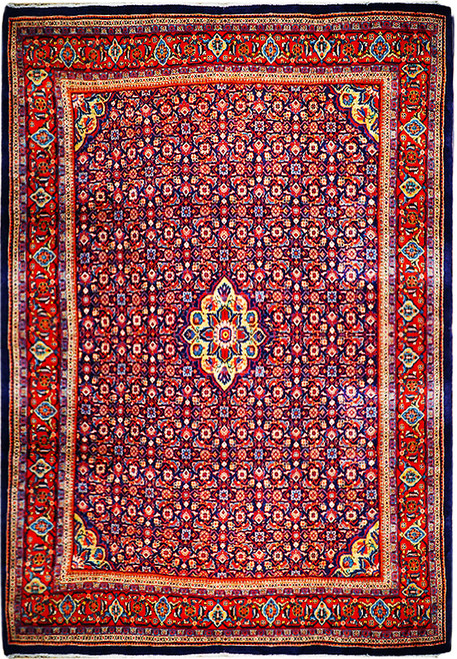
9'8" x 13'2" Persian Herati Rug | All Over Mahi Fish Design | Semi Antique Navy Field
This is a room size semi antique Persian rug measuring 9'8" x 13'2", hand-knotted in wool on a cotton foundation and drawn entirely in the classic Herati pattern. The field is a deep navy, so dark it reads nearly black between the motifs, and it is covered edge to edge with a repeating lattice in burgundy, rose and ivory. Nothing about it is loud: the interest comes from density and from the way the small ivory rosettes float forward off the dark ground. It falls squarely in the practical band of 10x13 Persian rugs, the size that anchors a full seating group or a table with all chairs pulled out. The pile stands at 3/8", handle is firm, the selvages and the ivory cotton fringe are intact, and every rug ships with a certificate of authenticity.
Please Note About the Photographs:
The first overhead photograph was shot under cool warehouse light and reads slightly more plum and purple than the rug actually is. The floor level photographs and the close-ups show the true colors: a true navy ground with warm burgundy and red in the border. Judge the color from those images.
Design and Motifs
The Herati, known in Persia as mahi or the fish pattern, is built from one repeating unit: a small rosette set inside a diamond, with 4 curved lanceolate leaves turning outward from the diamond's sides like fish circling a pond. Here that unit repeats across the whole field in a tight diagonal grid, alternating ivory rosettes with rose and slate blue ones so the eye keeps finding a new rhythm instead of a flat wallpaper effect. This is a true all over design with no central medallion, which is exactly why it works under furniture: no focal point gets buried by a sofa. The wide burgundy main border carries alternating palmettes and cartouche shaped rosettes with turtle style leaves, flanked by narrow reciprocal guard stripes in ivory, teal and navy, and the outer edge finishes in a dark navy band that frames the whole piece.
The Color Palette
Three colors do the structural work. The ground is a saturated indigo navy, the main border is a warm burgundy red that has softened with age into something closer to brick, and ivory supplies every highlight: the rosette centers, the reciprocal guard stripe, the fringe. Inside that framework the weaver worked in a second tier of tones you only see up close, including dusty rose, a chalky slate blue on the lattice bars, deep teal in the leaf tips, olive green and a light camel that warms the border palmettes. Because the field is dark and the motifs are light, the rug carries strong contrast without brightness, which is why it sits comfortably in a room with dark wood, leather or a deep painted wall. The burgundy and navy combination also hides traffic better than an ivory ground piece of the same size.
Persian Origin and Weaving Quality
The Herati is the most widely woven of all Persian field patterns, worked for generations in the villages and workshop towns of western and northeastern Persia, and a weaver's handling of it is a fair test of skill: the repeat has to stay square across more than 13 feet of length with no medallion to correct the drawing. On this piece the grid holds true corner to corner, the lattice bars stay even, and the corners of the border resolve cleanly rather than being cut off mid motif. The back shown in the final photograph gives you the rest of the story: cotton warps and wefts, a tight even knot, and clear definition of the pattern from the reverse. The gentle mellowing of the reds and the wool's settled sheen point to a rug with real age on it rather than a recent weave, and if you want to understand how that is judged, our guide on how to date an Oriental rug walks through the same clues we use.
9'8" x 13'2" Persian Herati Rug | All Over Mahi Fish Design | Semi Antique Navy Field
Ask about this rug
This piece is the only one of it, so the things worth knowing about it are particular to it. If you want to talk through the size, the colour in your own light, or the weave, speak to someone here first.