Watch the film
| Size in ft: | Width: 10' x Length: 12'10" |
| Size in Inch: | Width: 120" x Length: 154" |
| Size in meters: | Length: 3.91 x Width: 3.05 m |
| Colors: | Navy Blue, Red, Rust, Ivory, Teal |
| Shape: | Rectangular |
| Woven: | 100% Hand-knotted | Handmade |
| Foundation: | Cotton |
| Pile: | |
| Age: | 1980's | Semi-Antique |
| Design: | Herati Mahi All Over | Tabriz Design | Floral Vine Border |
| Origin: | Persian | Made in Persia |
| Condition: | Excellent | Ready to use |
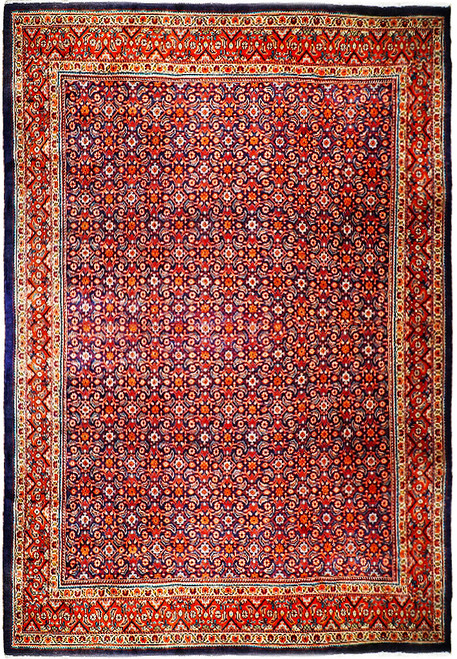
10' x 12'10" Persian Rug | Navy Herati Mahi All Over Design | Semi-Antique 1980s Wool
A deep navy field, a brick red floral border and an unbroken Herati lattice from fringe to fringe: this is the pattern Persian weavers have returned to for three centuries, and it was drawn here in the Tabriz manner with the field left completely open of any medallion. Woven in the 1980s on a cotton foundation with a hand-spun wool pile, the rug measures a true room size and sits comfortably in the practical 10x13 Persian rugs bracket. Condition is excellent with full pile, straight sides, original selvedges and intact ivory fringe, and the rug ships with a certificate of authenticity confirming it as hand-knotted in Persia.
Please Note About the Photographs:
The first photograph was taken under different lighting and pushes the field toward plum or purple. The true ground color is the deep navy blue you see in the showroom floor shots and in the pile close-up, which are the most accurate representation of this rug.
Design and Motifs
The field carries a full Herati repeat, known in Persia as the mahi or fish pattern: an ivory diamond trellis, a rosette at the center of each compartment, and 4 curved serrated leaves swimming around it, which is where the fish name comes from. Between the diamonds sit small blossom clusters and upright palmettes, so the eye never finds an empty spot of ground, which is exactly the appeal of all over Persian rug designs in a large room where furniture will cover part of the floor. The main border reverses the scheme, setting a continuous vine of 8 petal rosettes and lanceolate leaves across a red ground, and it is framed by narrow ivory guard stripes with a running flowerhead meander on each side. Note how the corners resolve: the vine turns cleanly at all 4 corners rather than being cut off, a sign the weaver worked from a properly scaled cartoon.
Navy Blue, Brick Red and Ivory Color Palette
The ground is a dark indigo navy that has softened a shade at the tips of the pile, giving the field a slightly aubergine shimmer when raked one way and a near black depth when raked the other. Against it the drawing reads in warm brick red and rust, a cooler coral pink in the leaf tips, and clean ivory for the lattice lines and the larger rosettes. The close-up shows the accent colors that make the piece: a true teal green in the rosette centers, soft camel and apricot in the palmettes, and dark brown outlining that keeps every motif crisp. The border red is brighter and more tomato toned than the rust in the field, which is what gives the rug its frame and its glow, while the navy selvedge wraps the whole thing in a dark edge. In practice it is a strongly blue rug with red warmth, so it anchors rooms with cream walls, walnut furniture and leather equally well.
Persian Origin and Weaving Quality
This is a Persian village and workshop weaving in the Tabriz design tradition of northwest Persia, where the Herati repeat is treated as a drawing exercise rather than a filler: the trellis has to stay square across 10 feet of width, and here it does. The structure is the honest workhorse combination, a cotton foundation for stability with a heavy wool pile, and the back photograph shows a tight, even row of knots with no slack or wavy wefts. That wool is the reason a rug of this age still has full height in the pile and no low spots in the traffic lanes, and it is why these semi-antique pieces are usually a better value than new production at the same knot count. If you want to understand how materials, wear and dye behavior place a rug in a decade, our guide on how to date an Oriental rug covers the signals we read on this one. Four decades on, it is still a rug you can put under a dining table without worrying.
10' x 12'10" Persian Rug | Navy Herati Mahi All Over Design | Semi-Antique 1980s Wool
Ask about this rug
This piece is the only one of it, so the things worth knowing about it are particular to it. If you want to talk through the size, the colour in your own light, or the weave, speak to someone here first.