Watch the film
| Size in ft: | Width: 9'2" x Length: 12'10" |
| Size in Inch: | Width: 110" x Length: 154" |
| Size in meters: | Length: 3.91 x Width: 2.79 m |
| Colors: | Navy Blue, Red, Ivory |
| Shape: | Rectangular |
| Woven: | Hand-Knotted |
| Pile: | 3/8" Wool |
| Origin: | Persia |
| Design: | Herati |
| Condition: | Excellent |
9'2" x 12'10" Persian Mahal Rug | Navy Herati All-Over Design | Semi-Antique Wool
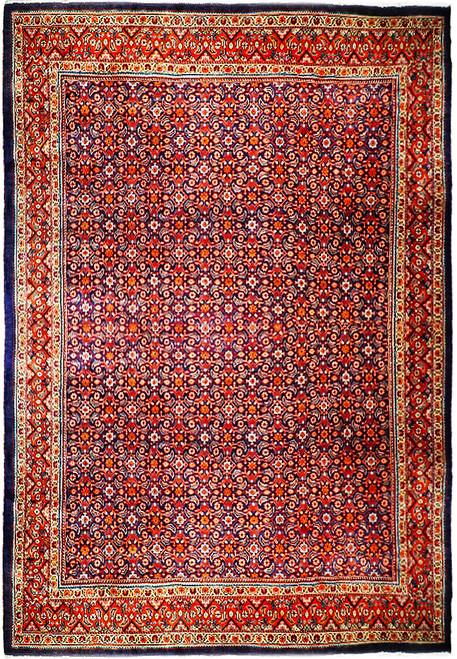
This is a room size semi-antique Persian Mahal, hand-knotted in wool on a cotton foundation, with a deep navy field carrying the Herati pattern from selvage to selvage and a wide rust red border holding it together. The drawing is village work in the best sense: repeated, disciplined, slightly irregular where the weaver's hand moved, and completely readable across nearly 13 feet of length. The pile stands at 3/8" and is even from end to end, the fringes and selvages are sound, and the wool has the soft sheen that only comes after decades of settling. Every rug we ship carries a certificate of authenticity stating origin, materials and hand-knotted construction.
Please Note About the Photographs:
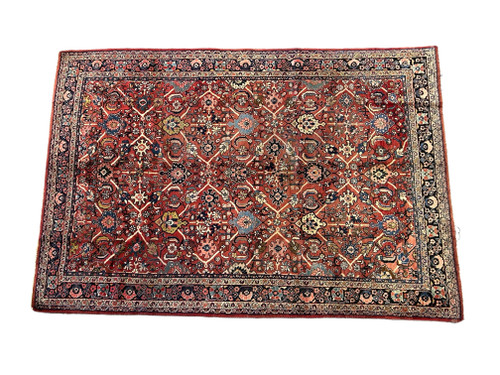
The first studio photograph reads slightly more violet than the rug does in person. The floor photographs, taken in our warehouse under natural light, are the truer reading: a dark navy blue field with a true rust red border.
Design and Motifs
The field is a classic Herati, also called mahi or fish pattern: a diamond lattice built from slender vines, each diamond centered on a small rosette and flanked by 4 curved lanceolate leaves that give the motif its fish nickname. Here the lattice repeats in tight ranks across the whole field with no medallion, a true all-over design that reads as texture from standing height and resolves into individual flowers when you look down at it. The main border runs a chain of shield shaped cartouches and turtle palmettes on rust red, separated by paired leaves and small 8 petal blossoms, with narrow floral guard stripes on either side and a plain navy outer band that frames the whole piece. Look at the 4 corners and you can see the weaver solving the border turn by eye rather than by cartoon, which is exactly what you want in a village piece of this age.
A Study in Navy, Rust and Ivory
The ground is a deep navy blue that goes nearly black in the shadows and opens to indigo where the light catches the pile. Against it the weaver worked a genuinely wide palette: brick and rust reds in the vinework, soft salmon and peach in the leaves, cool mid blue in the lattice diamonds, and small bright turquoise rosettes scattered through the field that act as the visual punctuation of the whole rug. Ivory appears sparingly, in outlining and in the cartouches of the border, so it lifts the pattern rather than competing with it. The main border is a warm terracotta rust, cooler and less orange in person than the studio image suggests, and the green touches in the guard stripes and border flowers tie the rust and navy together. In a room the overall impression is dark, rich and jewel toned, a rug that anchors furniture instead of disappearing beneath it.
Mahal Weaving and the Herati Tradition
Mahal rugs come from the villages of the Arak region in west central Persia, the same weaving district that produced the Sultanabad workshop pieces collected in the West since the late 19th century. What defines the group is sturdy construction: a heavy cotton warp and weft, a thick hand-spun wool pile and a knot count deliberately kept moderate so the rug can carry a large format and decades of traffic. The Herati pattern is the shared vocabulary of the region and of Tabriz and Bijar weavers further north, and a Mahal reading of it is bolder and more angular than a city version, which is precisely why these rugs sit so well in American rooms. At 9'2" x 12'10" this one is a true dining or living room size, and among large Persian rugs a semi-antique Mahal in excellent condition with full pile is the practical choice: heavy enough to lie flat without slipping, dark enough to forgive daily life, and old enough that the colors have already mellowed into their final state.
9'2" x 12'10" Persian Mahal Rug | Navy Herati All-Over Design | Semi-Antique Wool
Ask about this rug
This piece is the only one of it, so the things worth knowing about it are particular to it. If you want to talk through the size, the colour in your own light, or the weave, speak to someone here first.