Watch the film
| Size in ft: | Width: 6'7" x Length: 9'8" |
| Size in Inch: | Width: 79" x Length: 116" |
| Size in meters: | Length: 2.95 x Width: 2.01 m |
| Colors: | Red, Black, Cream, Pink, Blue, Green |
| Shape: | Rectangular |
| Woven: | 100% Hand-knotted | Handmade |
| Foundation: | Cotton |
| Pile: | |
| Age: | 1980's |
| Design: | Bijar Herati | All Over |
| Origin: | Persian Bijar | Made in Persia |
| Condition: | Excellent | Full even pile |
6'7" x 9'8" Persian Bijar Rug | Herati All Over Design | 1980s Excellent Condition
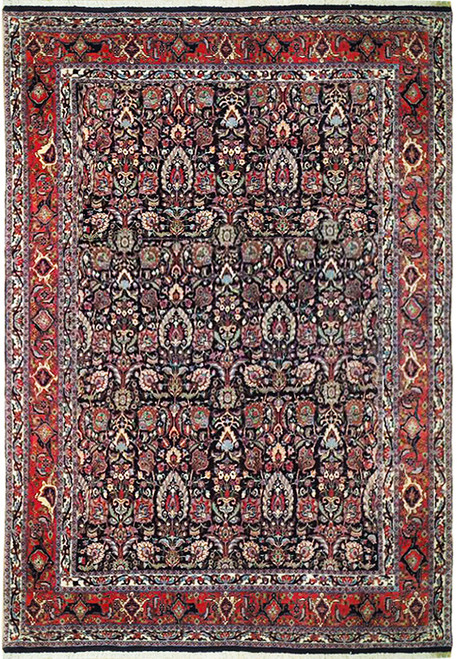
This is a proper 1980s Bijar: heavy in the hand, board flat on the floor, and packed with so much small drawing that the field only resolves when you stand over it. The whole surface carries a repeating Herati lattice worked at a scale that most weaving towns would not attempt on a 6'7" x 9'8" rug, and the pile is a full even 3/8" wool on a cotton foundation with no low spots, no repairs and no edge loss. Among Persian Bijar rugs this is the size and density people actually look for, and it slots neatly into the 7x10 Persian rug footprint under a seating group or a six seat table. A certificate of authenticity ships with the rug.
Please Note About the Photographs:
The darker and lighter patches you see across the field in the floor photographs are the nap of the wool catching the overhead lights from different angles, not wear, fading or damage. Bijar pile is dense and stands up straight, so it shifts tone as you walk around it. Every rug leaves us professionally steamed and pressed.
Design and Motifs
The field is a true all over Herati, the pattern Bijar weavers call mahi, the fish. A fine diamond lattice runs edge to edge, each diamond holding a small rosette at its center with 4 curved fish leaves turned outward at the corners, and a stepped diamond medallion filled with tiny stars sits between every group. Nothing repeats lazily: the lattice bars themselves are drawn with their own miniature flowerheads, and the palette rotates through the repeat so no two adjacent diamonds read the same. There is no central medallion, which is exactly what you want when furniture will cover part of the rug. The main border is broad and confident, alternating rounded palmettes with cream cartouche-like leaf forms on a black ground, and it is fenced on both sides by a reciprocal vine guard and then a narrow flowerhead stripe, 4 plain corners resolved cleanly without the pattern breaking.
Color
Red is the governing color, a brick to salmon red that lifts almost to terracotta where the light hits it straight on and drops to a deeper madder tone in the shadow. Against it the drawing is built from black outlines that give the lattice its structure, cream and ivory in the fish leaves and the border cartouches, and a soft rose pink that carries the palmettes and keeps the border from going heavy. Two blues do the detail work: a pale powder blue in the small rosettes scattered through the field, and a dark indigo that reads nearly black in the border ground. Small hits of olive and grass green appear in the flowerheads and along the guard stripes, just enough to cool the red. The overall effect from standing height is a warm, slightly dusty red, and only close up does the full multi-color range show itself.
Origin and Weaving Quality
Bijar sits in Kurdistan in northwest Persia, and its Kurdish weavers earned the rug its nickname, the iron rug of Persia. The loom is set with a thick warp, the wefts are driven home with a heavy metal comb after every row, and the result is a fabric so compressed that the rug barely bends and will outlast the room it is bought for. That beat-down is also why the Herati can be drawn this small and still stay crisp after 40 years of settling. The wool is local, springy and takes dye deeply, which is what gives the red its depth rather than a flat surface tone. If you are weighing this against the surrounding villages, the difference between Bijar, Bijar Zanjan, Tekab and Bukan comes down to density and drawing, and this piece sits firmly in the town-quality group.
6'7" x 9'8" Persian Bijar Rug | Herati All Over Design | 1980s Excellent Condition
Ask about this rug
This piece is the only one of it, so the things worth knowing about it are particular to it. If you want to talk through the size, the colour in your own light, or the weave, speak to someone here first.