Watch the film
| Size in ft: | Width: 7'3" x Length: 10'4" |
| Size in Inch: | Width: 87" x Length: 124" |
| Size in meters: | Length: 3.15 x Width: 2.21 m |
| Colors: | Red, Blue, Navy, Ivory, Salmon, Brown |
| Shape: | Rectangular |
| Woven: | 100% Hand-knotted | Handmade |
| Foundation: | Cotton |
| Pile: | |
| Design: | Heriz Medallion | All Over Herati (Mahi) Field |
| Origin: | Persian Bijar | Made in Persia |
| Condition: | Excellent | Full even pile throughout |
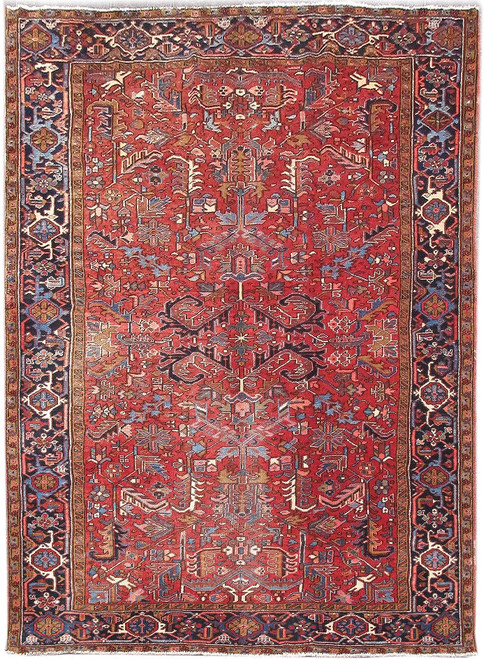
7'3" x 10'4" Persian Bijar Rug | Heriz Medallion, All Over Herati Mahi Field | Excellent Condition
Pick this one up by the corner and you understand it before you look at the pattern. It is heavy, stiff and tight, the handle that separates Persian Bijar rugs from every other village weave in the country. The drawing is Heriz in character, a bold angular medallion anchoring a field of small repeating Herati motifs, and the wool has the dry, dense feel that takes decades of traffic without flattening. At 7'3" x 10'4" it sits in the most useful of all the traditional formats, wide enough to carry a sofa and two chairs and long enough to hold a dining table, which is why buyers searching 7x10 Persian rugs keep coming back to pieces like this. Pile depth measures 3/8" and is even from end to end, with no thin areas, no repairs and tight selvedges. A certificate of authenticity is issued with the rug.
Please Note About the Photographs:
The two close-up photographs were shot under bright direct light and read as a lighter brick red. The full views of the rug show the truer tone, a deep saturated red with navy drawing. The pattern, pile and wool are identical in every shot, only the lighting changes.
Design and Motifs
The field is a true all over Herati repeat, known in the bazaar as mahi, the fish pattern: a small diamond lattice with a rosette at each center, four curved leaves framing it and tiny serrated palmettes filling the gaps. Counted across the width the lattice runs row after row with the hand drawn irregularity that tells you a weaver, not a machine, set the spacing. Sitting on top of it is the medallion, an 8 petal rosette in navy with a stepped outline, white reserved outlining, salmon boteh forms at the lobes and a small octagon at the dead center. Matching stepped spandrels close the 4 corners and leave the lattice reading as an open field. The main border carries alternating palmettes and hooked vine on navy, flanked by narrow guard stripes of reciprocal trefoils in ivory and red, and the whole frame is contained by a fine barber pole stripe that keeps the geometry crisp.
Color: Deep Madder Red with Navy and Ivory
The ground is a deep madder red that leans toward burgundy in the full length views and opens into warm brick where the light hits the pile directly, exactly the behavior you want from good wool and the reason red and burgundy Persian rugs hold their presence under both daylight and lamplight. Against it the lattice is drawn in near black navy, which reads as a dark skeleton across the whole field, while indigo blue picks out individual rosettes and gives the surface small flecks of cooler color. Ivory does the structural work, outlining the medallion and the spandrels and forming the trefoil guard stripes so the pattern stays legible at a distance. The softening comes from salmon and dusty rose in the medallion lobes and border palmettes, with scattered accents of apricot, camel brown and a true white. There is a gentle abrash through the field, a natural tonal shift between dye lots, and in the lower third the red shades a shade darker.
Bijar: The Iron Rug of Persia
Bijar sits in the Kurdish highlands of western Persia, and its weavers earned the rug its nickname, the iron rug of Persia, through technique rather than knot count. The weft is inserted wet and then beaten down with a heavy metal comb, so the foundation compacts into something close to a board and the pile is locked in under permanent tension. That is why a Bijar of this age still stands with a full 3/8" pile and square corners, and why these are the rugs dealers put in the hardest rooms in a house. The Kurdish wool from the surrounding pastures is long stapled and high in lanolin, which is what gives the red its glow instead of a flat matte surface. Design vocabulary travels in this region, so a Bijar loom drawing a Heriz style medallion over a mahi field is entirely normal workshop practice, and the sub groups are worth knowing if you are comparing pieces, which we cover in Bijar versus Bijar Zanjan, Tekab and Bukan.
7'3" x 10'4" Persian Bijar Rug | Heriz Medallion, All Over Herati Mahi Field | Excellent Condition
Ask about this rug
This piece is the only one of it, so the things worth knowing about it are particular to it. If you want to talk through the size, the colour in your own light, or the weave, speak to someone here first.