Watch the film
| Size in ft: | Width: 7'3" x Length: 10'4" |
| Size in Inch: | Width: 87" x Length: 124" |
| Size in meters: | Length: 3.15 x Width: 2.21 m |
| Colors: | Navy Blue, Red, Teal, Beige, Brown, Light Blue |
| Shape: | Rectangular |
| Woven: | 100% Hand-knotted | Handmade |
| Foundation: | Cotton |
| Pile: | |
| Age: | 1980's | Semi-antique |
| Design: | Bijar | All-over panel and floral repeat |
| Origin: | Persian Bijar | Made in Persia |
| Condition: | Excellent | Full even pile |
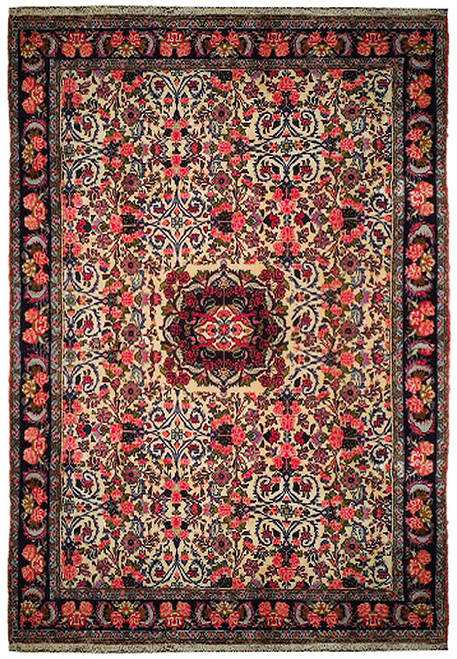
7'3" x 10'4" Persian Bijar Rug | All-Over Panel Design | Navy Blue Field | 1980s
This 7'3" x 10'4" piece was knotted in the 1980s in the Kurdish weaving district around Bijar, and it carries the weight in the hand that buyers look for in Persian Bijar rugs. The 3/8" wool pile sits on a cotton foundation that has been beaten down hard on the loom, so the rug lies flat from the first day and keeps its rectangle without a pad wrestling it into shape. What sets it apart from the usual village Bijar is the drawing: a deep navy blue ground carrying a formal all-over repeat of red outlined panels rather than a single medallion, closer in spirit to a workshop floral than to a tribal weave. In the 7 x 10 bracket this is the size most buyers want, and it slots straight into the useful middle of 7 x 10 Persian rugs. It ships with a certificate of authenticity.
Please Note About the Photographs:
A few of these frames were shot under warehouse lighting that pushes the border toward a bright magenta. In natural daylight the border reads as a deep rose red, closest to the overhead shot and the border close-ups. The navy blue field is consistent in every photograph.
Design and Motifs
The field is an all-over Persian rug design built from long rounded panels outlined in rose red, each one drawn with a fine sawtooth edge and each enclosing a single small boteh. The panels are grouped in threes and hung from slender red stems that branch out like the arms of a candelabra, and between them the weaver filled every inch of open ground with flowering vases, ivory blossoms with dark centers, tulip buds, brown and gold rosettes and small teal leaf sprays. The repeat runs the full length of the rug with no medallion and no open ground, which is what gives it that dense, tapestry-like read from across the room. The main border is a rose red band of ivory palmettes and long serrated leaves that curve back on themselves, flanked by light blue guard stripes of small four petal flowers and a narrow brown vine. A dark navy outer band and hand-tied ivory cotton fringe close the ends.
Navy Blue, Rose Red and Teal
The ground is a true navy blue, dark enough to read almost black at the edges of the room and opening up to a clear indigo where light falls across the pile. Against it the panel outlines and stems are a strong rose red that carries into the main border, where it becomes the dominant color of the rug's frame. Teal is the third voice and does most of the quiet work: teal leaves in the border, teal guard stripes, teal rosettes scattered through the field. Beige and ivory blossoms lift the field and keep the navy from going flat, brown and soft gold appear in the palmettes and the vine stripe, and pale light blue shows up in the small flowerheads and the outer guard. The palette is a classic dark and warm combination that handles a navy or blue upholstered room, walnut floors and cream walls without competing, as the styled photograph shows.
Bijar Weaving in Persian Kurdistan
Bijar sits in the Kurdish highlands of northwest Persia and its weavers earned the name the iron rug of Persia for one reason: the wefts are driven home with a heavy metal comb while the warps are held under extreme tension, so the pile packs in at a density that makes the finished rug thick, stiff and close to indestructible. That technique is why 1980s Bijars like this one still show full even pile decades later. The wool from the surrounding pastures is springy and takes dye deeply, which is why the navy and the rose red still look saturated rather than tired. If you are comparing pieces from the wider district, the differences between the town weave and the outlying groups are worth reading about in our guide to Bijar, Bijar Zanjan, Bijar Tekab and Bijar Bukan. This example belongs to the more formal end of the tradition, where a village loom takes on a workshop floral and beats it down like a Bijar.
7'3" x 10'4" Persian Bijar Rug | All-Over Panel Design | Navy Blue Field | 1980s
Ask about this rug
This piece is the only one of it, so the things worth knowing about it are particular to it. If you want to talk through the size, the colour in your own light, or the weave, speak to someone here first.