Watch the film
| Size in ft: | Width: 6'7" x Length: 9'4" |
| Size in Inch: | Width: 79" x Length: 112" |
| Size in meters: | Length: 2.84 x Width: 2.01 m |
| Colors: | Red, Navy Blue, Cream, Black, Green, Brown |
| Shape: | Rectangular |
| Woven: | 100% Hand-knotted | Handmade |
| Foundation: | Cotton |
| Pile: | |
| Age: | 1980's |
| Design: | Bijar Herati (Mahi) | All-over field | Cream vine border |
| Origin: | Persian Bijar | Made in Persia |
| Condition: | Excellent | Full even pile |
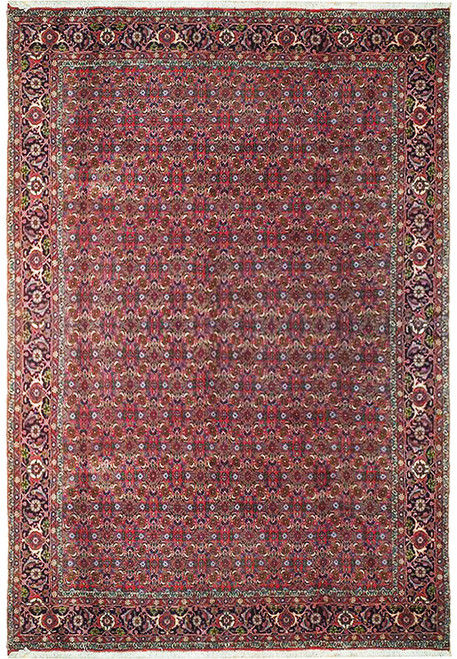
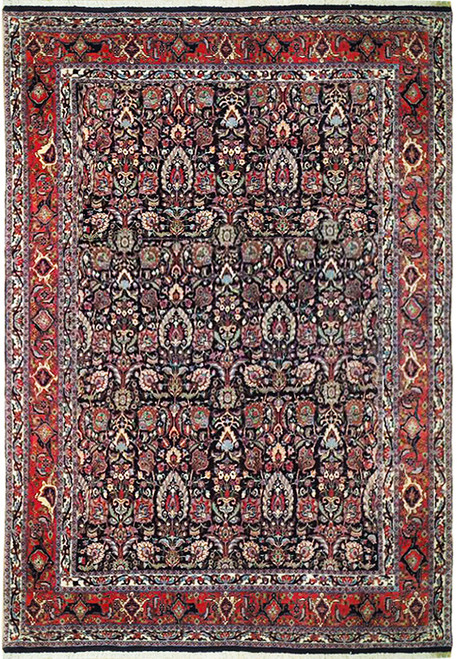
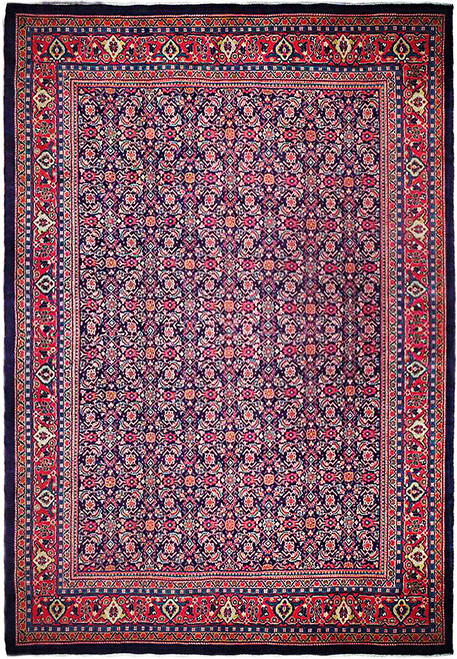
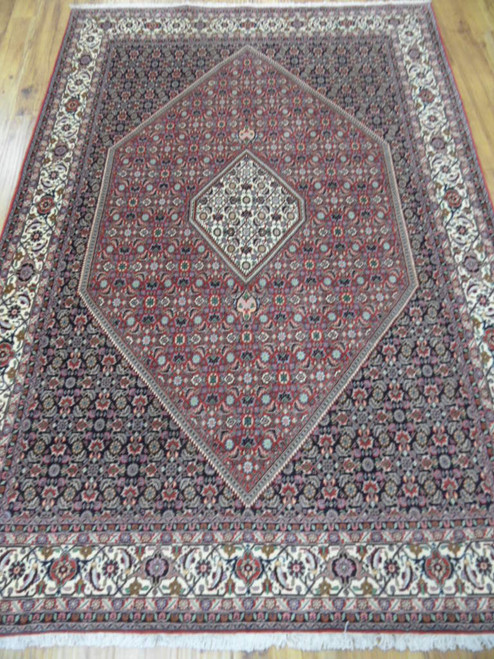
6'7" x 9'4" Persian Bijar Rug | All-Over Herati Mahi Design | 1980s, Excellent Condition
This 6'7" x 9'4" piece is a textbook example of what collectors look for in Persian Bijar rugs, the iron rugs of Persia: a heavy, tightly packed wool pile, an all-over Herati field drawn small and repeated without a break, and a 1980s date that puts it squarely in the last strong period of Kurdish village weaving. Pick up one corner and you feel the weight immediately, which is the honest test of a real Bijar. The 3/8" wool pile is full and even across the whole surface, the ivory fringes are intact at both ends, and the condition is excellent. It falls into the practical 6x9 Persian rug range that suits most seating areas and dining tables. Every rug we ship carries a certificate of authenticity confirming origin, materials and hand-knotted construction.
Please Note About the Photographs:
The field reads as a softer rose-toned red under studio lighting and deepens toward a true red in warm daylight, so expect slight variation from screen to room. The faint pale lines visible in the close-up are fold shadows from flat storage. They are not wear, not fade and not damage, and they relax once the rug is laid flat. Every rug is professionally steamed and pressed before it leaves our warehouse.
Design and Motifs
The field carries the Herati, also called mahi or fish pattern, worked at a very small scale in an all-over repeat with no central medallion. Each unit is built from a diamond lattice holding an 8 petal rosette, flanked by the curved lanceolate leaves that give the pattern its fish name, with tiny cruciform rosettes filling the intervals. Because the repeat is so dense, the eye reads texture first and structure second, which is exactly the effect Bijar weavers were after. Deep navy spandrels close the 4 corners with stepped diagonal edges and their own scrolling vinework, framing the field like an implied open medallion. The main border is a cream ground carrying a continuous cypress and palmette vine in red, navy and green, and it is bracketed by a full run of narrow guard stripes: a red band of stylized blossoms and arrowheads, a navy scroll band, and fine barber-pole stripes at the outer edge. The drawing stays angular and disciplined throughout, which places it firmly with the geometric Persian rugs rather than the curvilinear city workshops.
Color: Rose-Toned Red Field, Navy Corners, Cream Borders
The main color is red, but it is a soft rose-madder red rather than a hot or heavy tomato tone, and that lighter ground is what makes this rug unusually easy to live with. Against it, the Herati lattice is outlined in near-black and deep navy blue, with cream and ivory rosettes scattered evenly across the surface so the field reads as a fine rose and ivory mesh from standing height. Muted olive and forest green appear in the leaves and in the small arrowhead motifs of the guard stripes, warm brown and soft caramel fill the secondary vinework, and occasional pale blue and lilac highlights sit inside the rosette centers where the wool has taken the dye a shade lighter. The corner spandrels are the darkest passage in the rug, a dense midnight navy that anchors all 4 corners and makes the cream main border look brighter than it actually is. The cream border ground is the true neutral here, carrying red, navy and green vine figures, and it gives the whole piece a clean outer frame. It is a palette that sits comfortably with warm wood floors, brass, walnut furniture and off-white walls.
Bijar: The Iron Rug of Persia
Bijar is a Kurdish town in northwestern Persia, and its weavers built a reputation on construction rather than fineness. The wefts are driven home with a heavy metal comb while the weave is still damp, compressing the knots so tightly that the finished rug is dense, thick and nearly indestructible, which is how it earned the name iron rug of Persia. That beat-down is also why a Bijar of this size feels twice as heavy as a city rug with the same footprint, and why 1980s examples like this one still show full pile after decades. The local Kurdish wool is tough, springy and high in lanolin, so it resists crushing in traffic lanes and keeps its luster instead of going dull. Weaving from the surrounding villages is grouped under several names, and if you are comparing pieces it is worth reading how Bijar, Bijar Zanjan, Bijar Tekab and Bijar Bukan differ in weave and handle. This example shows the traits buyers want from the group: a small tight Herati repeat, clean border drawing, strong even selvedges and a body that will outlast the room it goes into.
6'7" x 9'4" Persian Bijar Rug | All-Over Herati Mahi Design | 1980s, Excellent Condition
Ask about this rug
This piece is the only one of it, so the things worth knowing about it are particular to it. If you want to talk through the size, the colour in your own light, or the weave, speak to someone here first.