| Size in ft: | Width: 12'10" x Length: 13'4" |
| Size in Inch: | Width: 154" x Length: 160" |
| Size in meters: | Length: 4.06 x Width: 3.91 m |
| Colors: | Coral Red, Green, Blue |
| Shape: | Square |
| Woven: | 100% Hand-knotted | Handmade |
| Foundation: | Cotton |
| Pile: | |
| Age: | 1970's | Approx. 50 years old |
| Design: | Herati Bijar | All over field | No medallion |
| Origin: | Persian Bijar | Made in Persia |
| Condition: | Very Good | Even patina consistent with age |
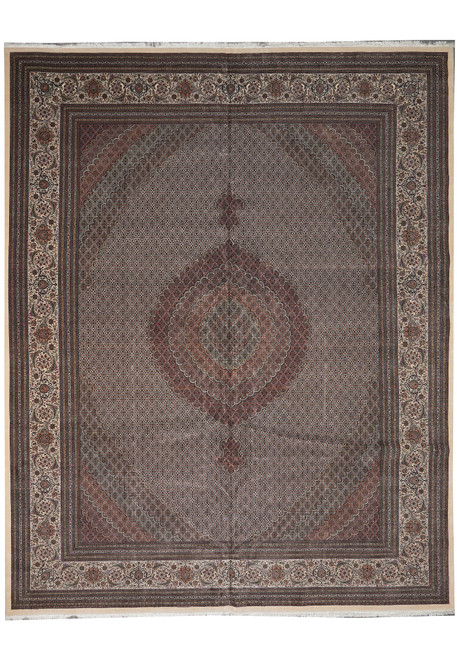
12'10" x 13'4" Persian Bijar Square Rug | All Over Herati Fish Design | 1970's Coral Red Wool
A true square is one of the hardest formats to find in a room-size handmade rug, and at 12'10" x 13'4" this one covers a 13 foot room almost corner to corner. It is a 1970's piece from the Kurdish weaving district of Bijar, woven on a cotton foundation with a heavy wool pile and an all over Herati field in coral red, framed by a deep green border. Pick up a corner and the weight tells you what it is: Persian Bijar rugs are beaten down so hard on the loom that they feel like a slab rather than a textile. Among oversize Persian rugs a square of this scale is genuinely uncommon, and it ships with a certificate of authenticity confirming origin, materials and hand-knotted construction.
Please Note About the Photographs:
The soft vertical lines and the lighter and darker bands across the field in the overhead photos are fold marks and shadows from pallet storage, plus the way studio light falls on a deep pile. They are not wear, not fading and not damage. They relax once the rug is laid flat, and every rug leaves us professionally steamed and pressed before shipping.
Design and Motifs
The field carries the classic Herati, also called mahi or fish pattern, repeated edge to edge with no medallion at all. Each repeat sets an 8 petal rosette inside a small diamond, with 4 curved lanceolate leaves turning around it like fish circling a pond, and the whole lattice is drawn in fine black outline so the pattern reads as a dense textile grid rather than a scatter of flowers. Small paisley forms and stepped vine joints fill the spaces between diamonds. The main border is a different world: large heart shaped palmettes and split arabesque leaves swing along a green ground, separated by 2 narrow floral guard stripes and an outer band of running rosettes on gold. Because the field is uniform, the square proportion works in its favor, with no medallion to look off center under a table or a seating group.
Coral Red, Green and Blue Palette
The field is a warm coral red that leans toward terracotta and brick in daylight and deepens to a burnished wine tone under lamplight, with natural abrash giving gentle horizontal variation across the 13 foot span. Over that ground the Herati lattice is picked out in near black outline, with rosettes and leaves in mustard gold, ochre, soft ivory and small touches of olive and sage green. The main border reverses the scheme entirely: a deep green ground that shifts toward teal blue where the light catches it, carrying palmettes in madder red, apricot and cream. Guard stripes in golden apricot and ivory separate the border from the field and keep the outline crisp, while the outermost selvage returns to plain red wool above a cream fringe. Red, green and gold in these proportions sit easily with dark wood, leather and brass.
Bijar, the Iron Rug of Persia
Bijar sits in Kurdistan in western Persia, and its weavers work in a way almost nobody else does: the weft is driven home with a heavy metal comb, row after row, until the foundation is compressed and the pile locks solid. That is why the town's output earned the name iron rug of Persia, and why a 1970's Bijar like this one still stands with a full, upright pile after 50 years on the floor. The differences between Bijar, Tekab and Bukan weaving come down to wool quality, knot count and how disciplined the drawing stays, and here the Herati repeat holds its line across the full width with no drift, which points to an experienced workshop rather than a casual village loom. The back shows a tight, even knot on a cotton foundation, and the whole piece is exactly the kind of rug that outlasts the house it is bought for.
12'10" x 13'4" Persian Bijar Square Rug | All Over Herati Fish Design | 1970's Coral Red Wool
Ask about this rug
This piece is the only one of it, so the things worth knowing about it are particular to it. If you want to talk through the size, the colour in your own light, or the weave, speak to someone here first.