Watch the film
| Size in ft: | Width: 6'2" x Length: 12'4" |
| Size in Inch: | Width: 74" x Length: 148" |
| Size in meters: | Length: 3.76 x Width: 1.88 m |
| Colors: | Light Sage, Celadon Green, Beige, Ivory, Peach, Soft Brown |
| Shape: | Rectangular |
| Woven: | 100% Hand-knotted | Handmade |
| Foundation: | Cotton |
| Pile: | Wool | 1/4" Thin Pile |
| Age: | 1940s | Antique |
| Design: | Oushak | All Over Field | Cloud Band Outer Border |
| Origin: | Turkish Oushak | Made in Turkey |
| Condition: | Excellent | Even low pile throughout |
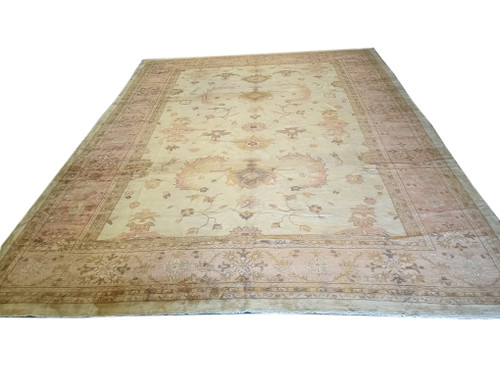
6'2" x 12'4" Turkish Oushak Rug | Light Sage All Over Field with Cloud Band Border | 1940s Antique
This is a genuine 1940s Oushak from western Anatolia, 6'2" x 12'4", hand-knotted in wool on a cotton foundation and now settled into the quiet, low pile state that collectors of antique Turkish weaving actively hunt for. The gallery proportion, longer than it is wide by a factor of two, suits a room where a standard 8x10 stops short: a long living space, a library wall, a wide entry run. Eighty years of use have taken the pile down to about a quarter inch, which is exactly why the drawing looks the way it does, softened and slightly ghosted rather than crisp, with the peach and brown outlines reading like watercolor on the sage ground. The wool is still tight to the knot with no bald areas, the sides and ends are secure, and the rug lies flat. Every rug we sell ships with a certificate of authenticity documenting origin, age, materials and construction. If you want to understand how pieces like this are placed in a decade, our guide on how to date an Oriental rug walks through the same evidence we used here.
Please Note About the Photographs:
The first studio photograph was shot under cooler light and reads greener and darker than the rug actually is. The daylight detail shots are the truer record: the field is a pale, dusty sage that shifts toward grey green in some light and warm beige in others. That shift is natural abrash in hand-dyed antique wool, not fading and not damage.
Design and Motifs
The field is an all over design with no central medallion, built from a loose lattice of small rounded rosettes, stepped leaf forms and angular vine stems that repeat the length of the rug. At each end the drawing changes character and becomes a band of larger architectural panels, columns of stacked geometric blocks with flowering tips, closed off by a straight horizontal line, so the piece reads with a top and a bottom rather than as a pure repeat. Three borders frame it. The inner guard is a fine chain of rosettes and hooked brackets, the main border carries upright tree and candelabra forms alternating with small latch hook blocks, and the wide outer band is given over to bold scrolling cloud bands and curling brackets drawn in dark brown on ivory, the single most graphic element on the rug and the detail that makes it recognizable from across a room. The corners are resolved honestly rather than perfectly, which is the signature of a village loom working from memory.
A Palette of Faded Sage, Beige and Peach
The dominant color is a soft sage green that sits somewhere between celadon and olive, gently uneven across the width as the dye lots change, which gives the long field movement instead of flatness. Against it the rosettes and lattice stems glow in muted peach and salmon, a color that has clearly gone soft with age and now reads closer to dried apricot than to pink. The main border is a warm blush beige, the guard stripes are ivory, and all the outlining, the cloud bands, the tree stems and the small hooked fillers, is done in a deep walnut brown that has held its strength while everything around it has lightened. There is no black, no strong red, no navy anywhere in the rug. That absence is the whole point: the palette is entirely neutral and warm, so the piece works against oak floors, linen upholstery, plaster walls and pale cabinetry without fighting anything, and it photographs beautifully in daylight. Close inspection of the pile shows individual peach knots surviving inside worn areas, which is what gives the surface its speckled, hand-painted quality.
Oushak Weaving in Western Anatolia
Oushak, the town of Usak in western Turkey, has been a weaving center since the 15th century and supplied the large formal furnishing pieces that turn up in Renaissance paintings, so the name carries real history. What distinguishes the Oushak tradition is scale of drawing rather than knot count: weavers there worked a symmetrical Turkish knot at a moderate density on a stout cotton foundation, and used the space to draw big, generous, open motifs that stay legible from standing height. The local wool is long staple and naturally lustrous, which is why an 80 year old piece like this can be worn down to a quarter inch and still feel silky underfoot rather than dry. Buyers new to this category often ask how Turkish work compares to other weaving traditions, and our article on Persian rugs versus Oriental rugs sets out where each one sits. A 6'2" x 12'4" antique Oushak in this condition, with the pile even end to end and the palette this quiet, is a piece you buy once and keep.
6'2" x 12'4" Turkish Oushak Rug | Light Sage All Over Field with Cloud Band Border | 1940s Antique
Ask about this rug
This piece is the only one of it, so the things worth knowing about it are particular to it. If you want to talk through the size, the colour in your own light, or the weave, speak to someone here first.