Watch the film
| Size in ft: | Width: 6'5" x Length: 9'8" |
| Size in Inch: | Width: 77" x Length: 116" |
| Size in meters: | Length: 2.95 x Width: 1.96 m |
| Colors: | Red, Brick Red, Indigo Navy, Ivory, Light Blue, Rose, Sage Green |
| Shape: | Rectangular |
| Woven: | 100% Hand-knotted | Handmade |
| Foundation: | Cotton |
| Pile: | |
| Design: | Heriz | Central medallion with ivory cornerpieces |
| Origin: | Persian Heriz | Made in Persia |
| Condition: | Excellent |
6'5" x 9'8" Persian Heriz Rug | Red Field, Indigo Medallion | Finely Drawn Village Weave
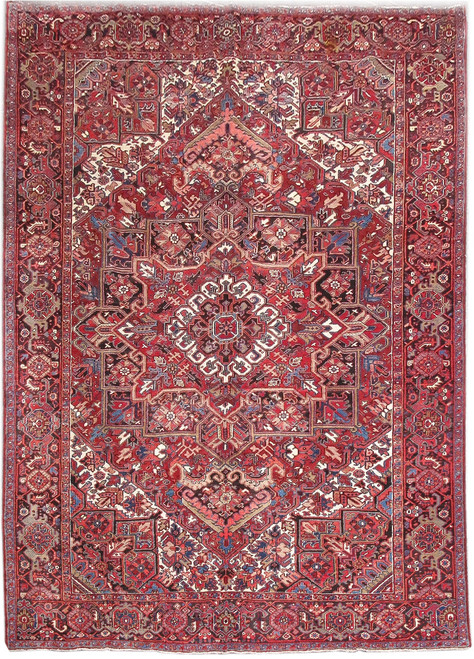
This 6'5" x 9'8" Persian Heriz is a more carefully drawn piece than the Heriz most buyers picture. The field is a deep brick red, the medallion is indigo, and the spandrels are ivory, but the drawing inside those shapes is tighter and more floral than standard village work, with small rosettes and slender stems filling ground that a coarser weaver would have left open. The wool has that dry, slightly glassy Heriz handle that takes light differently depending on which end of the room you stand in, and the pile is even from selvedge to selvedge with no thin areas in the photographs. Hand-knotted on a cotton foundation with a 100% wool pile, it ships with a certificate of authenticity confirming origin, materials and hand-knotted construction.
Please Note About the Photographs:
The first studio image renders the field a brighter, pinker red than it actually is. The floor photographs taken in natural light are the accurate reference: the ground is a deep brick red leaning toward terracotta, with indigo and ivory reading true in every shot.
Design and Motifs
A lobed indigo medallion sits dead center, outlined in ivory and filled with a light blue cartouche of paired rosettes and small leaves. Two ivory pendants run off the top and bottom of the medallion, each one capped with a palmette, and four ivory spandrels close the corners with rose and sage flowerheads. The open red field between those elements is worked with serrated leaves, hooked vine scrolls and large palmettes drawn at an angle, which is the Heriz habit of turning a curved court motif into straight-sided shapes that a village loom can hold. The main border is indigo, carrying alternating rosettes and split palmettes joined by ivory arabesque, and it is framed by narrow ivory guard stripes with a running vine. It is a medallion layout with the bones of a village weaving, so it sits comfortably beside other geometric Persian rugs while reading far more floral at close range.
Color: Brick Red Ground, Indigo and Ivory Architecture
The ground is a brick red with a terracotta cast, not a cherry red and not a wine red, and it carries subtle horizontal variation across the width where the dye lots shifted, the kind of gentle abrash that tells you the yarn was dyed in batches. Against it, the indigo of the medallion and main border is almost black in shadow and opens to true navy in direct light. Ivory does the structural work, outlining the medallion, filling the 4 corner spandrels and drawing the guard stripes, which keeps the composition legible from across a room. Inside the motifs the palette turns softer: pale sky blue in the leaves and medallion core, dusty rose and salmon in the rosettes, sage green in the flowerheads, and small touches of straw gold in the cornerpieces. It is a warm, saturated scheme that anchors oak and walnut floors, and it belongs squarely in the red and burgundy Persian rugs family.
Heriz: The Weaving Villages of Northwest Persia
Heriz is a cluster of villages east of Tabriz, on the slopes below Mount Sabalan, where mineral-rich water gives the local fleece a hardness that weavers elsewhere in Persia cannot buy. That wool is the reason Heriz rugs survive generations of traffic while holding their color, and it is why the pile on this piece still stands upright with a clean, even surface. Most Heriz village work is knotted below 200 knots per square inch, so a piece like this one, with rosettes small enough to need real resolution and outlines only 1 or 2 knots wide, sits at the finer end of what these looms produce and points toward a weaver working close to Tabriz standards. The back photograph shows straight, regular knot rows on a cotton foundation with no slack or bulge, the mark of a well-tensioned loom. Collectors who want to read the wear, the dyes and the weave themselves will find our guide on how to date an Oriental rug a useful companion to these photographs.
6'5" x 9'8" Persian Heriz Rug | Red Field, Indigo Medallion | Finely Drawn Village Weave
Ask about this rug
This piece is the only one of it, so the things worth knowing about it are particular to it. If you want to talk through the size, the colour in your own light, or the weave, speak to someone here first.