Watch the film
| Size in ft: | Width: 6'8" x Length: 10'4" |
| Size in Inch: | Width: 80" x Length: 124" |
| Size in meters: | Length: 3.15 x Width: 2.03 m |
| Colors: | Ivory, Red, Blue, Green |
| Shape: | Rectangular |
| Woven: | Hand-Knotted |
| Pile: | Wool And Silk |
| Origin: | Persia |
| Design: | Esfahan |
| Age: | 1980's |
| Condition: | Excellent-Perfect |
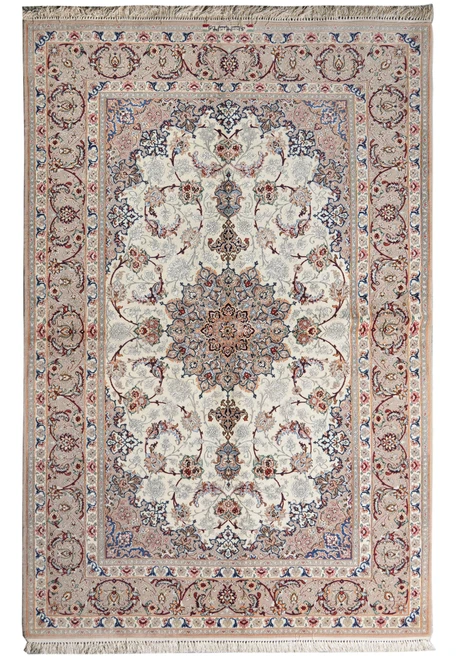
6'8" x 10'4" Persian Isfahan Rug | Signed Seirafian Wool & Silk | Ivory Field, 1980s
This is a signed workshop piece, and the cartouche at the end of the field says so plainly: the script reads "Bafte Iran, Esfahan, Seirafian". Woven in the 1980s in wool and silk at roughly 500 knots per square inch, this Persian Isfahan rug measures 6'8" x 10'4", a proportion that sits comfortably among 7x10 Persian rugs without the bulk of a room-filling carpet. The pile is still full, the silk highlights still catch light along the vine work, and the flat woven ends and fringe are intact. Every rug we sell ships with a certificate of authenticity documenting origin, materials and knot count.
Design and Motifs
The drawing is the classic Isfahan formula, executed with the kind of curved line that only a high knot count allows. A round central medallion sits on the ivory field, built outward from a small rosette core through 16 radiating lobes of light blue, gold and burgundy on a deep red ground. Around it the field carries a continuous arabesque: thin navy vine stems that loop into full circles, hooked saz leaves, and Shah Abbas palmettes drawn in rose, wine red and soft blue. Four navy spandrels anchor the corners, each filled with its own scrolling vine so the field reads as one composition rather than four repeats. The main border runs red with alternating palmettes and rosettes, flanked by ivory guard stripes of small connected flowerheads and two narrow navy bands. Look at the detail photos and you will see how tightly the outlines hold: the stems stay round, the petals keep their shape, and the mirror symmetry along both axes never drifts.
A Palette Built on Ivory and Red
The field is a warm ivory, closer to cream than white, and it is what makes this rug easy to live with in a light room. Against it the design works in a controlled range: a true madder red in the medallion and main border, a deep indigo navy in the spandrels, guard bands and vine outlines, and then the accent colors that give the piece its life. Those accents are light sky blue in the smaller flowerheads, rose and salmon pink in the palmette petals, old gold and camel in the border rosettes, and small strokes of green in the leaves and calyxes. The silk is used selectively, in highlight areas of the scrollwork and medallion, so the rug shifts tone as you walk past it and reads lighter or deeper depending on the nap direction. Nothing here is harsh or synthetic looking; the reds have mellowed slightly with age, which is exactly what you want from a 1980s Isfahan.
Isfahan Weaving and the Seirafian Name
Isfahan sits in central Persia and has been a weaving center since the Safavid court workshops of the 16th century. Its reputation rests entirely on drawing, on the ability to render a flowing curved vine without the stair-stepping you see in village work, and that only happens when the knot count is high enough to give the designer room. At roughly 500 knots per square inch on a silk foundation, this piece has that room, which is visible on the reverse in image 9 where the back is as legible as the front. The Seirafian atelier is among the names Isfahan is known by, and a woven cartouche of this kind means the rug left a named workshop rather than an anonymous loom. For a collector, a signed and dated-by-era Isfahan in excellent condition at this size is a straightforward piece to own and an easy one to place.
6'8" x 10'4" Persian Isfahan Rug | Signed Seirafian Wool & Silk | Ivory Field, 1980s
Ask about this rug
This piece is the only one of it, so the things worth knowing about it are particular to it. If you want to talk through the size, the colour in your own light, or the weave, speak to someone here first.