Watch the film
| Size in ft: | Width: 6'9" x Length: 9'8" |
| Size in Inch: | Width: 81" x Length: 116" |
| Size in meters: | Length: 2.95 x Width: 2.06 m |
| Colors: | Ivory, Red, Green, Blue, Black |
| Shape: | Rectangular |
| Woven: | 100% Hand-knotted | Handmade |
| Foundation: | Cotton |
| Pile: | |
| Age: | 1950s | Vintage |
| Design: | Herekeh | All-over floral repeat |
| Origin: | Turkish Kayseri | Made in Turkey |
| Condition: | Excellent |
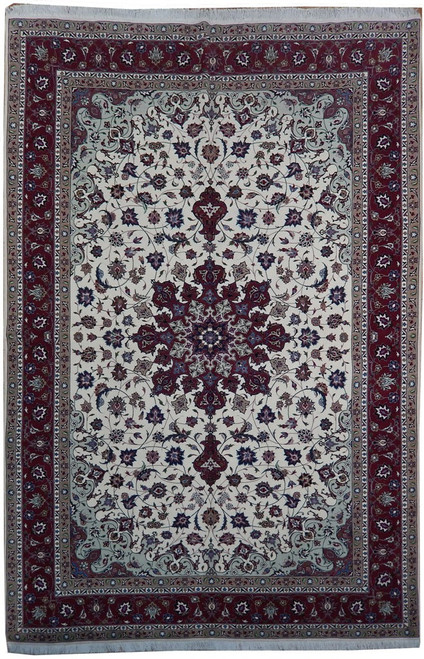
6'9" x 9'8" Turkish Kayseri Rug | Herekeh All-Over Floral Design | 1950s Ivory Gold Field
This 6'9" x 9'8" Kayseri was knotted in central Anatolia in the 1950s, and it is the kind of piece that explains why Kayseri weavers built their reputation on drawing rather than on knot count alone. The field carries a full Herekeh repeat, ivory to soft gold, filled edge to edge with flowering vines and paired leaf cartouches, and it is framed by a wide olive green border that keeps the whole composition calm instead of busy. At 81" by 116" it sits squarely in the most useful of the 7x10 Oriental rugs we stock, large enough to anchor a seating group yet still easy to place. The wool pile is even and full with no thin areas, the ivory fringe and selvedges are intact, and the reverse shows crisp knot definition over a cotton foundation. It ships with a certificate of authenticity confirming it as one of the genuinely hand-knotted Oriental rugs in our inventory, imported directly and never used on a floor.
Please Note About the Photographs:
The field reads ivory in the overhead photograph and warmer, closer to camel or gold, in the close-up and low-angle shots. That is studio lighting and the natural sheen of the wool catching from different directions, not two different colors and not fading. In daylight the ground sits between ivory and warm gold, and the pile shifts tone slightly as you walk around it, which is normal for a hand-knotted wool rug of this age.
Design and Motifs
The drawing here is pure Herekeh: an all-over repeat with no central medallion, built from tall paired palmettes that mirror left to right and stack up the length of the field in staggered rows. Between them run thin black outlined vines that split into curling tendrils, small 5 petal blossoms, tulip heads and feathery serrated leaves, so that the ground is never left empty but the eye still follows a clear vertical rhythm. Because the repeat mirrors on both axes, the rug reads the same from either end of the room, a deliberate workshop choice rather than an accident of the loom. The main border sets scrolling palmettes and rose colored cloud bands against olive green, and it is flanked by 4 narrow guard stripes: a pistachio ground meander of small red and blue rosettes on the outer side, a fine reciprocal dash stripe, and a plain crimson line at each edge. The corners resolve cleanly, with the border scroll turning the angle without breaking its repeat, which is the first thing to check on any Anatolian workshop weaving.
A Palette Built on Ivory, Olive and Crimson
The ground is an ivory that has mellowed toward warm gold and light camel, and it does most of the work in the room, throwing light back rather than absorbing it. Against it the weavers set deep crimson and oxblood red in the blossom centers, a softer rose and salmon in the palmette petals, and dusty sky blue and dark navy in the leaves and small florets. Muted olive and pistachio green appear in the vine work and then take over completely in the main border, which is the quietest green in the rug and the reason the whole piece feels aged rather than loud. Black is used sparingly and intelligently, as a fine outline around the palmettes and along the vine stems, giving the pattern its definition at a distance. There is no harsh contrast anywhere: the reds are softened by the ivory around them, and the greens sit close in value to the field, so the rug works with beige, cream and warm wood interiors without competing with them.
Kayseri Weaving and the Herekeh Tradition
Kayseri sits in central Anatolia at the foot of Mount Erciyes and has been a weaving and trading center since the piece was known to the ancient world as Caesarea. Its workshops built their name in the 19th and 20th centuries by taking the refined court patterns developed at the imperial Hereke manufactory and reworking them in local wool for the domestic and export market, which is exactly what this rug is: a Herekeh cartoon woven in Kayseri, on a cotton foundation, with a clipped wool pile short enough to hold the fine vine work. The back shows regular, tightly packed rows with no lazy lines and even tension from selvedge to selvedge, evidence of a workshop loom and an experienced pair of hands rather than village work. The 1950s date puts it in the last strong period of commercial Anatolian production before synthetic dyes and quicker weaves became the norm, and the wool quality alone makes the case, still soft and lustrous after 70 years of storage. If you want to understand how weavers, dealers and collectors put a date on a piece like this, our guide on how to date an Oriental rug walks through the same evidence we used here.
6'9" x 9'8" Turkish Kayseri Rug | Herekeh All-Over Floral Design | 1950s Ivory Gold Field
Ask about this rug
This piece is the only one of it, so the things worth knowing about it are particular to it. If you want to talk through the size, the colour in your own light, or the weave, speak to someone here first.