Watch the film
| Size in ft: | Width: 6'7" x Length: 9'8" |
| Size in Inch: | Width: 79" x Length: 116" |
| Size in meters: | Length: 2.95 x Width: 2.01 m |
| Colors: | Ivory, Warm Burgundy Coral, Green, Blue |
| Shape: | Rectangular |
| Woven: | 100% Hand-knotted | Handmade |
| Foundation: | Cotton |
| Pile: | Wool and Silk |
| KPSI: | 60 Raj | Approx. 400 |
| Age: | 2000's | Unused |
| Design: | Tabriz Floral | Central Medallion | All Over Vine Scroll |
| Origin: | Persian Tabriz | Made in Persia |
| Condition: | Excellent | Never used |
6'7" x 9'8" Persian Tabriz Rug | Ivory All Over Floral Field | 60 Raj Wool and Silk, Never Used
Woven in the 2000s and never put down on a floor, this 6'7" x 9'8" Tabriz still has full pile from selvage to selvage and the crisp, unwalked surface you only see on a rug that went straight from the loom into storage. It is hand-knotted at 60 Raj, roughly 400 knots per square inch, on a cotton foundation, with a wool pile carrying silk through the flowers and scrollwork so the drawing lifts and shifts as you move around it. At 79 inches by 116 inches it sits in the useful middle of the 7 x 10 Persian rug range, big enough to anchor a seating group and still balanced enough to read as one composition. Every rug we ship leaves with a certificate of authenticity recording origin, materials and knot count.
Design and Motifs
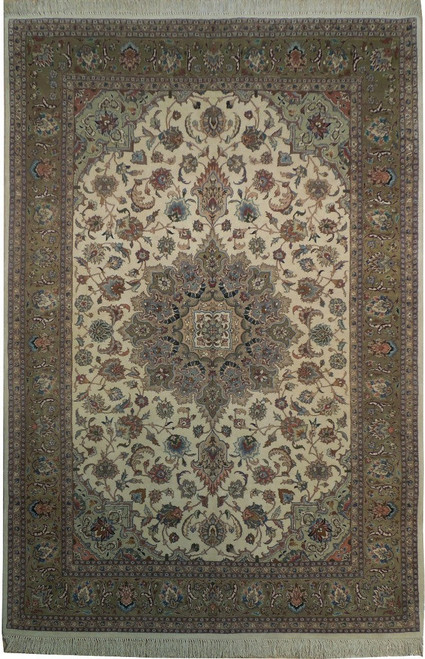
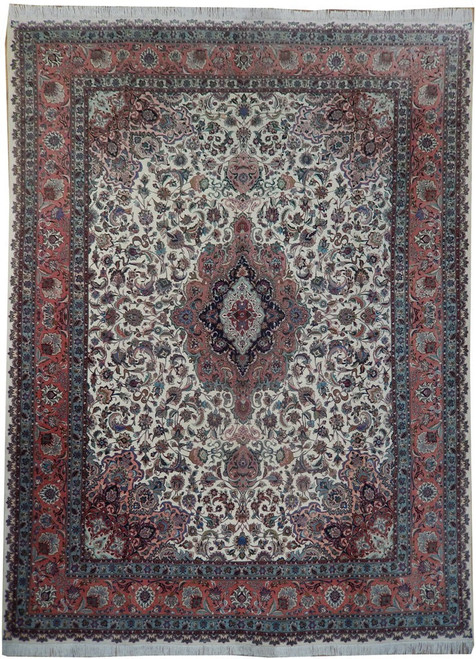
The field is a true all over floral design laid over a medallion, which is the classic Tabriz balancing act. A deep burgundy lobed medallion sits dead center, built from 8 curling cartouche lobes around a small navy core with an ivory rosette at its heart. Pointed burgundy pendants extend from the medallion toward both ends of the field, and the rest of the ground is filled edge to edge with thin vine scroll, split palmettes, serrated saz leaves and small rosettes, each one outlined so the shapes hold their edges at this knot count. Shaped spandrels at the 4 corners carry broad arabesque scrolls that frame the field without closing it in. The main border runs alternating palmettes and blossoming stems, flanked by a beige vine guard stripe and a narrow ivory meander of small blue and coral buds, the kind of layered border sequence that takes a full-size cartoon to draw properly.
A Closer Look at the Colors
The ground is a warm ivory, closer to unbleached cream than white, and it is what makes everything else readable. Against it the medallion and main border are a warm burgundy that leans coral where the silk catches light, and cooler and deeper in the shaded recesses of the palmettes. The spandrels and parts of the guard stripes are a soft sage green, muted rather than bright, which keeps the corners from competing with the center. Through the field you get small hits of navy and mid blue in the flower heads, camel and tan in the leaves and cartouche fills, and short flicks of leaf green on the stems. Outlines are drawn in dark brown to near black, which is what gives the flowers their definition. The palette is formal without being dark, so the rug sits comfortably on pale oak, walnut or stone flooring.
Tabriz: Weaving City of Northwest Persia
Tabriz sits in the northwest corner of Persia and has been the country's most organized weaving city for centuries, working from drawn cartoons in proper workshops rather than from memory. Tabriz counts fineness in Raj, the number of knots across a gereh of about 2.75 inches: 40 Raj is commercial work, 50 Raj is fine, and 60 Raj like this piece is where the workshops move into collector territory at roughly 400 knots per square inch. That density is why the vine scroll here stays a continuous curve instead of breaking into steps, and why the silk highlights read as individual petals rather than blurred patches. The back photo shows the result, a tight even grid on a cotton foundation with straight rows and no pulled areas, alongside hand-tied ivory fringe finished flat. A well-woven Tabriz of this grade is built to be used for generations, and this one has not started its first.
6'7" x 9'8" Persian Tabriz Rug | Ivory All Over Floral Field | 60 Raj Wool and Silk, Never Used
Ask about this rug
This piece is the only one of it, so the things worth knowing about it are particular to it. If you want to talk through the size, the colour in your own light, or the weave, speak to someone here first.